
Disclosure: This site may use affiliate links. Product specifications should be checked against manufacturer or retailer pages before purchase.
Direct Answer
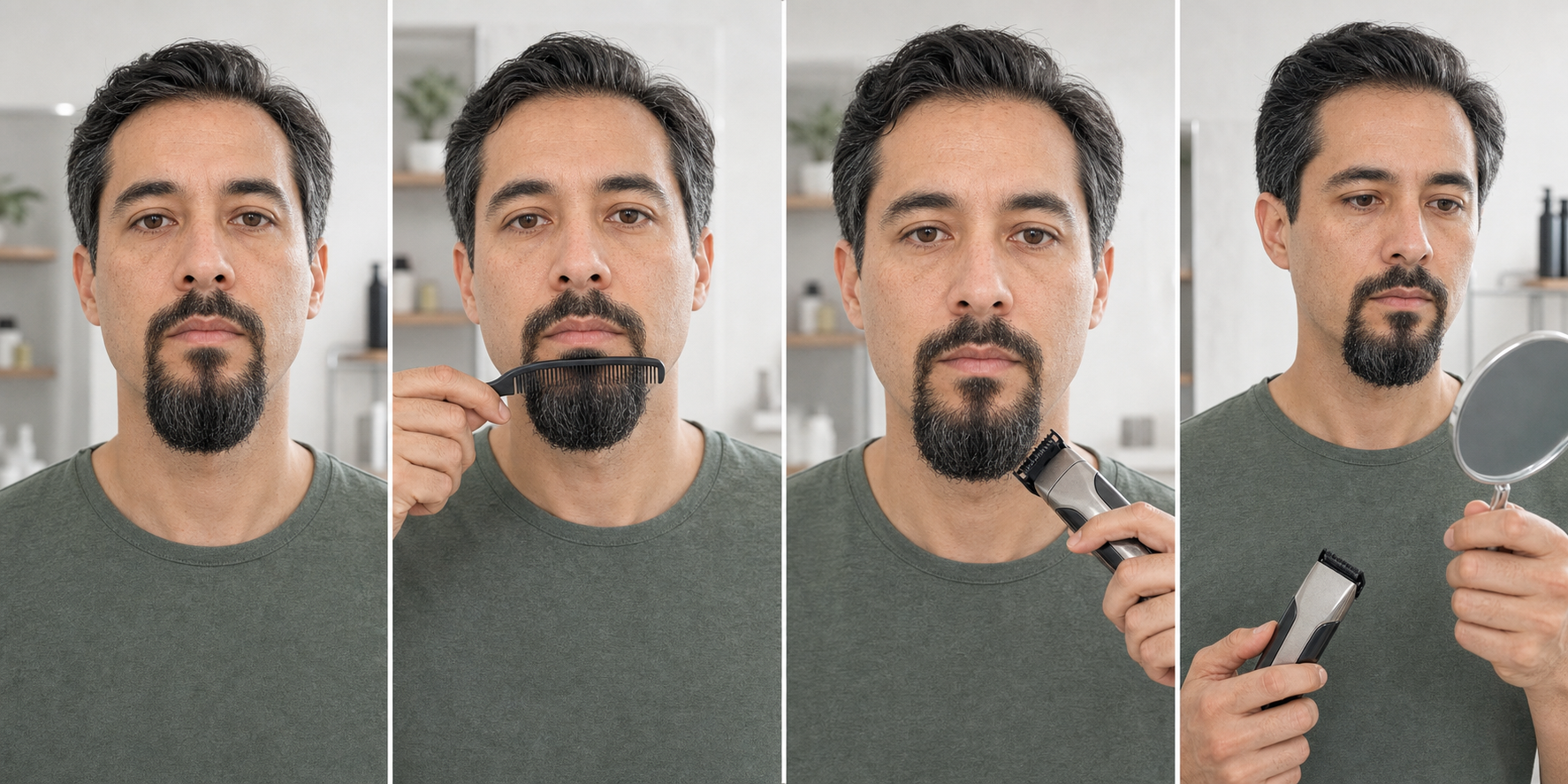
Direct answer: Avoid common goatee trimming mistakes by mapping the under-lip patch, left and right chin panels, mustache connectors, lower edge, and neckline transition before cutting. Verify the exact tool and longest useful guard, protect the shortest section, make one bounded outer-chin correction, then switch off, clear, recomb, release, compare, and stop before changing another variable.
This guide is an error-prevention and recovery workflow. It does not prescribe one goatee shape or replace separate preparation, guard-selection, grain-direction, bilateral-balance, outline, or neckline decisions. The exact trimmer manual controls attachment fit, supported direction, water exposure, cleaning, and maintenance.
Define One Goatee Task Before Cutting
Name the single observable job: reduce bulk in one chin panel, shorten one confirmed longer group, restore an established lower edge, remove one isolated projecting end, or maintain an existing outer endpoint. “Tidy the whole goatee” is too broad because it combines several zones and cutting planes.
Record what must remain unchanged: under-lip patch width, central column, mustache connectors, outer width, lowest released point, lower-edge arcs, and neckline transition. A protected landmark is part of the content contract for the trim, not a reminder added after an error.
Mistake: Treating the Goatee as One Cutting Zone
A goatee can contain hair with different origins, lengths, directions, densities, and design roles. The under-lip patch can be separated or connected; left and right chin panels can turn around the jaw; mustache connectors can overlap the cheeks; and under-jaw hair can support the lower edge.
Use the goatee preparation guide to create a dry released baseline and map each zone. Do not carry one guard path from the mustache through the chin and into the neckline merely because all of the hair belongs to the same named style.
Mistake: Starting Before the Goatee Is Released
Water, styling product, compression, tangles, repeated comb tension, and recent mask or towel pressure can change visible length and direction. Clean as needed, dry completely, comb gently, remove the comb, allow the hair to settle, and record a no-cut front and three-quarter reference.
Do not compare a stretched chin panel with a released panel. If the shape keeps changing after gentle release, the target is not stable enough for a correction. Wait rather than trim a temporary position.
Mistake: Using One Direction Across Every Zone
Under-lip hair can descend or fan outward, chin panels can angle toward the corners, lower-edge hair can curve under the jaw, and connectors can travel diagonally. “With the grain” means the observed local direction for a particular group, not one arrow for the whole goatee.
The goatee grain-direction guide explains root ownership and local mapping. Follow the exact product instructions when they prescribe a supported movement that differs from a generic preference.
Mistake: Copying Another Trimmer’s Setup
Two guards with the same printed number can have different cutting planes, fit, direction limits, and finished outcomes. Head type, attachment seating, dial position, blade condition, wet/dry rules, and cleaning instructions also vary by model.
Philips’ current MG3900 manual, for example, describes model-specific attachment handling, guarded movement, and cleaning. It illustrates why the complete model and manual matter; it is not a universal goatee method.
Mistake: Choosing a Guard From the Longest Hair
The longest projecting strand is not the protected floor. Identify the shortest released group that still provides useful central continuity, chin-panel coverage, connector weight, lower-edge support, or under-jaw transition. A setting that appears conservative for the longest hair can remove too much from that shorter layer.
Use the goatee guard-selection guide to verify exact-model fit and begin with the longest useful supported setting. A guard number alone does not predict the finished goatee.
Mistake: Cutting Into the Under-Lip Patch First
The under-lip patch and central column are prominent references for width, continuity, and the lowest released point. Starting there can create an unintended gap or narrow the center before the outer panels have been assessed.
Record whether the patch is separated, connected, offset, narrow, or wide. Keep it outside the first bulk-reduction pass. If the center design itself needs changing, define a separate style task rather than hiding it inside length maintenance.
Mistake: Narrowing Both Chin Panels Together
Moving both outer endpoints inward at once removes the comparison needed to judge width. Facial structure, density, curl, and hair direction can make one panel appear wider even when the endpoints are similar.
Use the goatee bilateral-balance guide to establish matched landmarks and one untouched reference panel. Correct one confirmed longer or wider group only after two released comparisons.
Mistake: Carrying a Pass Through the Chin Corner
The outer chin turn changes surface angle, hair ownership, guard contact, and visibility. A path that begins on a flat front panel can enter lighter side growth, a mustache connector, cheek stubble, or an under-jaw transition without a clear visual warning.
Stop before the corner, lift away, switch off if the attachment needs clearing, and release the hair. Re-map the next zone independently. Do not round the corner in one continuous movement simply to keep the pass smooth.
Mistake: Capturing Mustache Connector Hair
Connector hair can overlap a chin panel while originating beside the mouth. Trace it from root to released end and move it only long enough to identify ownership. Cutting it with a broad chin pass can weaken an established connection or create an unintended gap.
Record both connector endpoints in neutral expression because smiling or speaking can shift their apparent position. Keep connector design outside a chin-length task unless the intended change is separately mapped and supported.
Mistake: Moving the Lowest Chin Point
The lowest released point can be formed by overlapping central hair rather than one obvious strand. Cutting straight across it can flatten a deliberate taper, expose a gap, or move the apparent center after the goatee is released.
Use the low point as an observation anchor, not a ruler. Compare the left and right lower-edge arcs as they rise from it. Preserve the central low point during the first correction and reassess only after both panels settle naturally.
Mistake: Changing the Neckline During a Length Trim
Lower-edge bulk and neckline placement are separate decisions. A guard used to reduce chin-panel length should not drift into exposed-blade cleanup or move the skin boundary below the jaw. Under-jaw support can also contribute to the released front shape.
The beard neckline guide owns placement and cleanup. Stop the goatee-length path before the neckline transition and keep the existing boundary visible for comparison.
Mistake: Using an Outline to Solve a Bulk Problem
An outline defines a visible edge; a guard reduces hair admitted above its cutting plane. Removing the guard because bulk remains changes the task, risk, and evidence. It can create a sharper but narrower outline without correcting the original length group.
The tool-role comparison separates guarded length work from close cleanup. Define an outline task only after the released bulk result is stable.
Mistake: Trimming Hair While the Comb Pulls It
Wahl’s current trimmer instructions include combing facial hair in its growth direction before trimming. Observation does not require cutting while a comb stretches, lifts, or compresses the section.
Comb gently, remove the comb, and allow the goatee to settle. Hair cut under tension can retract, curl, or shift after release and produce a shorter panel, higher lower edge, or narrower endpoint than intended.
Mistake: Chasing Every Projecting End
A projecting end can cross from another panel, support the central low point, belong to a connector, or disappear after release. Trace it to its origin and compare it after two gentle recombs before calling it stray.
If one released end remains isolated and its removal fits the defined task, use an isolated-end method with clear visibility. Do not turn one visible strand into repeated guard passes across an entire panel.
Mistake: Equalizing Density With Length Removal
A denser side can look darker, wider, or lower without being longer. Shortening it until the same amount of skin is visible can remove useful coverage while leaving the density difference unchanged.
Record endpoint, width, bulk, curl, direction, and density as separate observations. Retain natural density variation or make a later style choice. Do not infer a medical cause, diagnose growth, or promise that trimming will change density.
Mistake: Trimming Curled Hair While Stretched
A curl can extend well beyond its ordinary endpoint under tension and spring back after release. Trace the group, observe its natural position twice, and protect supporting layers before deciding whether an end is truly excessive.
Do not pull one panel straight to match another. If curl behavior controls the target, pause the basic mistakes workflow and use a curl-specific process that accounts for grouping and spring-back.
Mistake: Alternating Sides After Every Stroke
Automatic alternation moves the reference. Each side becomes shorter in response to the latest change, and the target can keep shifting toward a narrower or shorter goatee.
Leave the better-shaped panel untouched. Make one bounded correction on the confirmed target, switch off, clear, recomb, release both sides, and compare the complete goatee before deciding whether anything else remains.
Mistake: Pressing Harder When Little Hair Is Removed
Reduced removal can mean the hair is shorter than the guard plane, lies outside the openings, curls across another zone, or is blocked by clippings. Added pressure can change skin contact and hair admission without resolving the cause.
Lift away, switch off, clear the attachment as the manual directs, release the hair, and verify setup. Do not force the teeth into the chin, flatten the lower edge, or repeat rapidly to make the pass feel productive.
Mistake: Repeating Passes Without Clearing
Loaded guards and cutters can change how the next group enters, hide a damaged tooth, or make an attachment appear unstable. After one bounded pass, switch off before touching or removing any component.
Follow the exact manual for brushing, rinsing, drying, oiling, and reassembly. The cleaning and oiling guide provides general boundaries, while the model instructions control the specific tool.
Mistake: Changing Several Variables Together
Shortening the setting, reversing direction, adding pressure, crossing a chin corner, switching tools, and trimming the reference side in one sequence destroys the comparison. The result no longer identifies which variable caused the change.
After clearing and release, change at most one verified variable. Keep preparation, posture, light, protected landmarks, reference panel, and tool condition stable.
Mistake: Ignoring Guard or Cutter Condition
Inspect guard teeth, rails, tabs, locks, dial stops, head seating, and cutter edges with power off. Stop for cracks, bends, movement, corrosion, residue that cannot be removed, or a mount that does not seat as the manual describes.
The guard-size guide explains why a fitting shape or familiar number does not prove compatibility. Do not hold a loose guard in place by hand or substitute an unverified attachment.
Mistake: Continuing Through Pulling, Heat, or Movement
Stop immediately for pulling, pinching, painful contact, broken or bleeding skin, unusual heat, odor, smoke, sound, vibration, slowing, guard movement, or more removal than planned. Switch off before inspecting the tool or hair.
The coarse-hair control guide provides conservative section-admission and pulling stop conditions. Do not press harder or shorten another panel to disguise an unexpected change.
Mistake: Trusting a Previous Setting Without Rechecking
Hair length, style, density, curl, guard condition, and tool setup can change between sessions. A prior record is useful evidence, not automatic permission to repeat the same setting or path.
Reconfirm the shortest useful group, complete attachment identity, zone map, and released reference every time. Record the model, head, guard, setting, direction, target zone, and final stop decision for the next session.
Mistake: Repairing an Error Immediately
After unexpected removal, stop, switch off, clear the tool, and let the entire goatee return to a stable released state. Record the under-lip patch, both chin panels, connectors, lower edge, neckline, and untouched areas.
Do not shorten the opposite side, move the neckline, or erase a connector automatically. A later recovery choice may be to retain the difference, adjust one endpoint after growth, or make a deliberate style change once the result is stable.
Use a Goatee Mistake-Prevention Checklist
- The task names one observable goatee problem and one stop boundary.
- The goatee is clean as needed, fully dry, gently combed, and released.
- The under-lip patch, chin panels, connectors, lower edge, and neckline are mapped.
- The shortest useful hair group and the better reference panel are protected.
- The exact model, head, guard, setting, direction, and care instructions are verified.
- The attachment is clean, undamaged, and securely seated.
- The first correction is confined to one low-consequence outer-chin group.
- The tool is switched off before clearing or adjustment.
- Both panels are recombed and released before another decision.
- The process stops when the target is unstable, anatomical, density-based, or crosses a protected landmark.
Record One Bounded Correction
Record the date, dry baseline, zone map, reference panel, target group, exact tool setup, direction, one correction, clipping load, clearing step, released comparison, protected landmarks, and stop decision. Use matched front and three-quarter views when photographs are appropriate.
Do not describe the result as professionally tested, perfectly symmetrical, irritation-free, safer, longer-lasting, or suitable for every face. Record only observable facts and the boundaries that remained unchanged.
Frequently Asked Questions
What is the most common goatee trimming mistake?
The most common mistake is treating the whole goatee as one cutting zone. Map the under-lip patch, left and right chin panels, mustache connectors, lower edge, and neckline transition separately, then protect the shortest useful section before making one bounded correction.
How do I avoid trimming my goatee too narrow?
Record the released outer width and both chin-panel endpoints before cutting. Keep the center and better-shaped panel untouched, begin with one small outer section, then switch off, clear, recomb, release, and compare before moving either side inward.
Should I fix an uneven goatee by shortening both sides?
No. First repeat the released comparison under the same posture and light. If one stable longer group is confirmed, leave the better side untouched and correct only that group. Stop when the difference comes from density, curl, direction, light, or facial structure.
What should I do after cutting too much from a goatee?
Stop, switch off, clear the tool, and let the whole goatee return to its ordinary released state. Record which landmark changed and protect the remaining center, connectors, lower edge, and neckline. Do not shorten another zone immediately to hide the first error.
Sources and Claim Boundary
- Wahl trimmer instructions for a current manufacturer example of combing facial hair in its growth direction and checking exact-tool setup.
- Philips MG3900 manual for a model-specific example of direction-aware guarded trimming, attachment handling, and cleaning.
- Goatee preparation guide for the dry released baseline and protected zone map.
- Goatee balance guide for matched landmarks and untouched reference-panel control.
Claim boundary: This page provides a generic exact-manual-bound goatee error-prevention, one-zone correction, release, comparison, recovery, and stop workflow. It does not prescribe a universal shape, guard, direction, pressure, speed, pass count, outline, neckline, wet-use method, or maintenance schedule; diagnose density or growth; rank a product; report hands-on testing; promise comfort, safety, symmetry, or a result; or replace exact-model instructions and qualified care.