
Disclosure: This site may use affiliate links. Product specifications should be checked against manufacturer or retailer pages before purchase.
Direct Answer
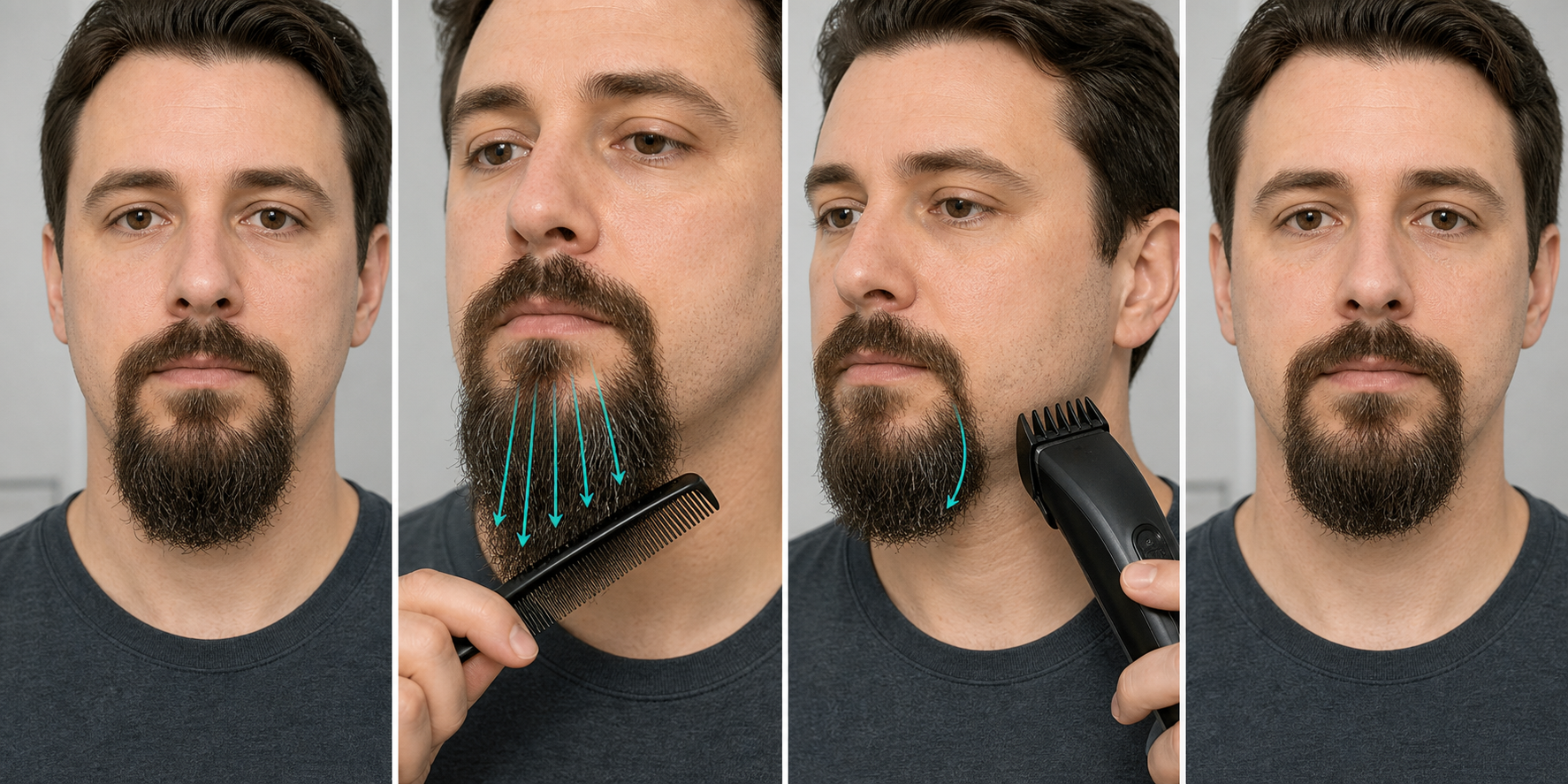
Direct answer: Trim a goatee with the grain by mapping the released direction of the under-lip patch, left and right chin panels, mustache connectors, lower edge, and neckline transition. Protect those boundaries, make one conservative guarded pass through a small outer-chin zone in its local growth direction, then switch off, clear the guard, recomb, compare, and stop before changing pressure or direction.
This is a direction-control guide, not a complete goatee trim. It begins after preparation and guard choice, and it ends after one mapped with-grain test and reassessment. It does not create the goatee outline, clear the mustache opening, define the lower edge or neckline, correct symmetry, select a style, or prescribe with-grain movement when the exact tool manual requires another method.
Goatee Grain-Direction Map
| Zone | Direction evidence | Protected boundary |
|---|---|---|
| Under-lip patch | Released vertical, diagonal, split, or curling flow below the lower lip | Do not create a gap or widen the existing separation |
| Left and right chin panels | Natural downward, outward, diagonal, or curling travel over the chin | Keep the first test inside one panel |
| Mustache connectors | Hair traced from each mouth corner toward the chin | Do not admit mustache or outside-beard hair accidentally |
| Lower edge | Released ends at the visual bottom of the goatee | Do not turn bulk reduction into outline work |
| Neckline transition | Where chin hair ends and neck hair begins | Stop before crossing the existing neckline |
Keep This Intent Separate From Preparation and Guard Choice
The goatee preparation guide owns cleaning, drying, natural combing, baseline photographs, boundary mapping, tool inspection, and no-cut readiness. The goatee guard guide owns exact-model compatibility, guard geometry, protected length, installation, and longest-useful-setting selection.
This page assumes both records exist. Its unique task is to translate a local growth map into one conservative guarded path, then clear, release, and reassess. It does not repeat the entire preparation or attachment decision, and it does not treat one successful path as permission to trim every goatee zone.
Follow the Exact Product Manual First
Direction advice is product-specific. Philips’ current beard-trimming support guidance directs against-growth strokes for the covered close-trimming tasks. Its OneBlade guidance also says hair can grow in different directions and requires model-specific comb contact and movement.
That is not a contradiction to solve with a universal rule. It means the manual, attachment, and task control. A with-grain path can be used only when it fits the exact instructions and the intended conservative test. If the manual directs against-growth use for that guard, follow the manual or choose a different supported method rather than claiming this page overrides it.
Define What With the Grain Means Locally
“With the grain” means moving in the same direction that a released hair group naturally emerges and rests. It does not always mean straight downward. The under-lip patch may split or curl, one chin panel may travel diagonally, a connector may angle inward, and lower-edge hair may sweep toward the neck.
Map direction after the goatee is dry, gently combed, and released. Do not stretch a curl, press the hair flat, or train it temporarily with product just to create a simple arrow. The direction record should describe the ordinary state that the guard will meet.
Use Natural Combing as Observation, Not a Cutting Command
Wahl’s official beard-trimming guide says to brush facial hair in the same direction, and it distinguishes the effect of cutting with the grain from cutting against it. Wahl’s guide-comb reference likewise notes that against-growth movement removes more hair than with-growth movement. These are useful direction boundaries, not permission to ignore the exact tool instructions.
Comb one small section gently, remove the comb, and let the hair settle. Record what stays aligned, what crosses into another zone, and what springs away. The cutting decision comes after release, not while the comb holds hair under tension.
Divide the Goatee Into Direction Zones
Use at least seven zones: under-lip patch, left chin panel, right chin panel, left mustache connector, right mustache connector, lower edge, and neckline transition. Add smaller zones when a curl, cowlick, density change, scar, or trained end creates a distinct flow. One zone can contain several visible layers with different origins.
Do not draw one arrow from the lower lip to the neck. A single broad path can cross the under-lip patch, collect a connector, shorten the visual lower edge, or enter outside beard and neck hair. Zone mapping makes it possible to stop when direction or hair ownership changes.
Map the Under-Lip Patch Without Cutting It
Observe whether the patch below the lower lip remains separate, joins the chin, splits, overlaps, or curls to one side. Keep it outside the first test. A small unintended opening or shortened center section can change the goatee’s visual structure and may be difficult to disguise without removing more hair.
Trace the patch from visible origin to released end and record where it meets the chin panel, if at all. A grain map should preserve the existing connection or separation rather than using direction as a reason to create a new gap.
Map Both Chin Panels From Origin to Released End
Select a small area on each side of the central chin with clear ownership and trace its visible flow from origin to released end. Note whether the panel points down, out, inward, diagonally, or into a curl. Observe any shorter supporting layer beneath longer crossing hair.
The first test should remain inside one panel, away from the under-lip patch, connector, lower edge, neckline, and outside beard. An outer-chin area provides room to observe hair admission without beginning at the most visible or least recoverable boundary.
Map the Mustache Opening in a Relaxed Position
With the lips relaxed, record where mustache hair ends relative to the mouth and where each connector begins. Speak or smile lightly, return to neutral, and observe whether a connector changes position. Do not stretch the lip or push the guard into mobile tissue to make a path appear stable.
Hair resting near a mouth corner can belong to the mustache, connector, cheek, or outside beard. Trace it before assigning it to a chin direction zone. Mustache-opening cleanup remains a separate visible-end or outline task, not part of this guarded grain test.
Map Both Mustache Connectors Independently
One connector may angle downward, curl outward, join the chin at a different height, or become lighter in density. Record each side separately under matched light and a level head. Apparent direction can change with facial expression or head tilt.
Do not carry the first pass into a connector. A guard that follows a chin panel can meet different hair ownership or skin geometry at the transition. Stop before that point and make a separate later decision.
Separate Goatee Hair From the Outside Beard
Trace side hair to determine whether it belongs to the goatee, mustache connector, cheek, jaw beard, or neck. Move neighboring hair only long enough to identify it, then let it return naturally. Mark the point where retained goatee flow becomes outside-beard flow.
The facial-hair tool-role guide separates broad guarded reduction, detail trimming, clipping, and close shaving. A broad guard should not absorb adjacent beard hair merely because the two zones touch.
Confirm the Guard Record Before Direction Testing
Verify the complete trimmer model, supported head, attachment, setting, mounting direction, condition, and protected shortest section. Inspect teeth, rails, locks, cutter, housing, and power components with the tool off. The direction test cannot repair an incompatible or damaged assembly.
Use the guard-size guide for system-specific numbering boundaries and the beard trimmer buying guide for model, attachment, support, and maintenance checks. Do not change to a shorter setting merely because a with-grain pass may remove less than another direction.
Select One Low-Consequence Outer-Chin Test Zone
Choose a small outer-chin area where the natural flow is visible, the guard can enter without crossing protected boundaries, and the shortest section is known. Record an untouched close reference under stable light. Keep the head level, jaw neutral, and lips relaxed.
Do not choose the under-lip patch, mustache opening, connector, lower edge, neckline, shortest patch, or densest curl for the first test. A bounded outer-chin zone limits the effect of an unexpected change and produces a clearer comparison.
Align the Approach With the Released Local Flow
With the tool off, rehearse the path beside the hair. The guard approach should follow the mapped chin-panel flow and stop before the direction changes. Confirm that the guard opening can admit the target hair without entering the connector, lower edge, neckline, or outside beard.
Do not rotate the head mid-pass to chase a projecting end. A direction change creates a second technique variable. If the target cannot be reached along the planned path, stop and reassess the method.
Make One Conservative Guarded Pass
Use only the operation and contact described for the exact product. Make one smooth bounded pass through the selected outer-chin zone in its local natural direction, then lift away before the connector, lower edge, or neckline transition. Do not add pressure, repeat immediately, or extend the path to make more hair enter.
A with-grain pass may admit less hair than an against-growth pass, depending on guard and hair geometry. That is an observation, not a defect or performance rating. The aim is to test controlled reduction while preserving the mapped boundary.
Do Not Turn Reduced Cutting Into Added Pressure
If little hair is removed, do not press the guard into the chin, stretch the jaw or lower lip, slow to the point of snagging, or repeat many strokes. Pressure can change guard contact and hair admission without solving a direction mismatch.
Switch off and inspect first. Hair may be shorter than the cutting plane, lying outside the opening, curling across another zone, or blocked by clippings. The next decision requires a cleared tool and released comparison.
Switch Off and Clear the Guard
After the single pass, switch off before touching, removing, or clearing the attachment. Follow the exact manual for brushing, rinsing, drying, and reassembly. Do not tap the cutter or guard on a hard surface.
The cleaning and oiling guide explains model-specific care boundaries. Clearing is part of measurement: trapped hair can change admission on the next pass and hide a damaged tooth or loose mount.
Recomb, Release, and Compare
Gently recomb the tested section in its natural direction, remove the comb, and let the hair settle. Compare the released section with the untouched reference under the same light, posture, and expression. Check the under-lip patch, opposite chin panel, connectors, lower edge, and neckline even though they were outside the path.
Record only observable changes: which hairs were shortened, which remained, whether the guard stayed seated, and whether neighboring hair moved. Do not infer comfort, safety, evenness, performance, or durability from one small test.
Assess Hair Admission Before Technique Changes
Determine whether target hair entered the guard. A section can look untouched because the hair lies parallel to the guard surface, curls away from the teeth, crosses over another layer, or remains below the cutting plane. Clear clippings and verify the attachment before changing anything.
If the guard cannot admit the target hair along the protected with-grain path, that method may not fit the zone. Do not force it. The exact manual may support another direction or attachment, but that becomes a separate verified decision.
Change Only One Variable at a Time
After clearing and reassessment, change at most one verified variable: the supported setting, the bounded adjacent portion of the same zone, or the manual-approved direction. Keep the guard, pressure, posture, and boundaries otherwise stable.
Do not shorten the setting, press harder, reverse direction, enter the under-lip patch or connector, and add repeated passes together. Multiple changes erase the evidence needed to explain the result and increase the chance of crossing the protected floor.
Respect Manual-Approved Against-Grain Instructions
Some exact product manuals direct guarded beard or goatee trimming against hair growth for effective cutting. If that instruction applies, do not present with-grain movement as a replacement. Use the manufacturer method or stop if it conflicts with the intended conservative task.
Philips’ OneBlade support guidance, for example, directs covered adjustable-comb use against growth and notes that hair directions vary. The model list and instructions on that page apply to the listed products, not every trimmer.
Do Not Convert the Test Into an Outline
A guarded flow test controls bulk inside an existing zone. It does not define the mustache opening, under-lip patch, side boundaries, lower edge, neckline, or endpoints. Do not remove the guard and continue freehand because one hair projects beyond the tested section.
Outline and isolated-end work require a separate visible boundary, supported tool, and stop plan. The beard neckline guide keeps lower-boundary placement separate from bulk reduction and does not turn one grain test into a new outline.
Handle Curl and Crossing Hair Separately
A curled or crossing hair may appear to follow one direction at the surface while originating in another zone. Trace it before admitting it into the guard. Do not pull it straight to force a simple with-grain path.
If curl release materially changes the direction map, stop and rebuild it. The curly long-beard workflow owns broader spring-back and layer-control questions; this page does not solve those variables during a basic goatee direction test.
Stop at Pulling or Unexpected Removal
Stop immediately for pulling, pinching, painful contact, broken or bleeding skin, unusual heat, odor, smoke, sound, vibration, slowing, guard movement, or more removal than the protected plan allowed. Switch off before inspection.
Use the coarse short-beard pulling-prevention guide to separate preparation, tangles, guard loading, cutter condition, maintenance, and pass control. Do not continue to “even out” an unexpected change.
Know When the Direction Is Too Uncertain
Stop when hair ownership cannot be traced, several layers point differently, product or moisture holds a false shape, a connector moves unpredictably, or the guard cannot remain inside one chin panel. Poor lighting, unstable posture, damaged equipment, and unclear manual instructions also end the test.
An unresolved direction is a useful result. Return to preparation, clean and release the hair, verify the tool, or choose another supported method. Direction uncertainty should not be solved by random multidirectional passes.
Build a Repeatable Zone Record
Record the exact model, head, guard, setting, goatee state, zone, local direction, protected boundaries, one-pass path, clippings cleared, released comparison, and stop decision. Note the date because hair length, training, condition, and attachments can change.
Do not convert one person’s zone record into universal advice. The under-lip patch, chin panels, connectors, lower edge, and neckline transition can differ on the same goatee, and another tool may prescribe a different direction.
With-the-Grain Goatee Checklist
- Preparation and exact guard choice are already complete.
- The exact manual permits the planned method or does not conflict with it.
- The goatee is dry, gently combed, released, and product-free as needed.
- The under-lip patch, chin panels, connectors, lower edge, and neckline are mapped.
- The shortest natural section and untouched reference are recorded.
- One low-consequence outer-chin test zone has clear ownership and direction.
- The guard is compatible, undamaged, securely seated, and clear.
- One bounded pass follows only the local released direction.
- No pressure, repeat, setting, direction, or zone is added during the test.
- The tool is switched off before clearing or adjustment.
- The section is recombed, released, and compared under matched conditions.
- Stop conditions and the option of another method are accepted.
Frequently Asked Questions
What does trimming a goatee with the grain mean?
It means moving through one mapped goatee section in the same local direction that its released hair naturally grows and rests. The under-lip patch, chin panels, mustache connectors, lower edge, and neckline transition may point differently, so there is no universal downward direction.
Is with-the-grain trimming required for every trimmer?
No. The exact product manual controls direction, guard contact, and technique. Some manufacturers direct guarded trimming against growth for the covered model. Use a with-grain test only when compatible with the tool instructions and the bounded task.
Why did a with-the-grain pass remove little hair?
Hair may be shorter than the guarded cutting plane, lying outside the guard opening, curling across another section, or blocked by clippings. Switch off, clear the attachment, release and recomb the section, then reassess instead of adding pressure or repeated passes.
When should I stop a goatee grain-direction test?
Stop for pulling, painful contact, heat, guard movement, unexpected removal, uncertain hair direction or ownership, damaged equipment, poor visibility, or a path that would cross the under-lip patch, mustache connector, lower edge, neckline, or outside beard.
Sources and Claim Boundary
- Wahl beard-trimming guidance for natural-direction brushing and the documented difference between with-grain and against-grain cutting.
- Wahl guide-comb reference for how combs direct hair and why against-growth movement can remove more hair than with-growth movement.
- Philips beard-trimming support guidance for a current model-bound example of against-growth instructions.
- Philips OneBlade support guidance for a model-bound example of against-growth guarded instructions and variable hair direction.
Claim boundary: This page provides a generic, exact-manual-bound local goatee grain map, one conservative guarded outer-chin pass, clearing, release, comparison, and stop-decision workflow. It does not prescribe with-grain movement for every tool, override against-growth instructions, select a guard, perform a complete trim, create an outline, correct symmetry, diagnose or treat a condition, rank products, report hands-on testing, or promise comfort, safety, performance, or results.