Disclosure: This site may use affiliate links. Product specifications should be checked against manufacturer or retailer pages before purchase.
Editorial update, June 19, 2026: This recovered page was rebuilt as a practical haircut, taper, and barber-tool guide using restored or current site media. It avoids hands-on test claims, live shopping data, score claims, medical claims, identity stereotypes, and unapproved affiliate language.
Image note: The old page drifted into an unrelated fish topic. This rewrite keeps the slug but returns the content to haircut shape, taper planning, and clipper control.
Direct answer: A triangle mullet is easiest to plan by shaping the back length first, then tapering the sides so the back forms a clear point or wedge without looking disconnected from the top.
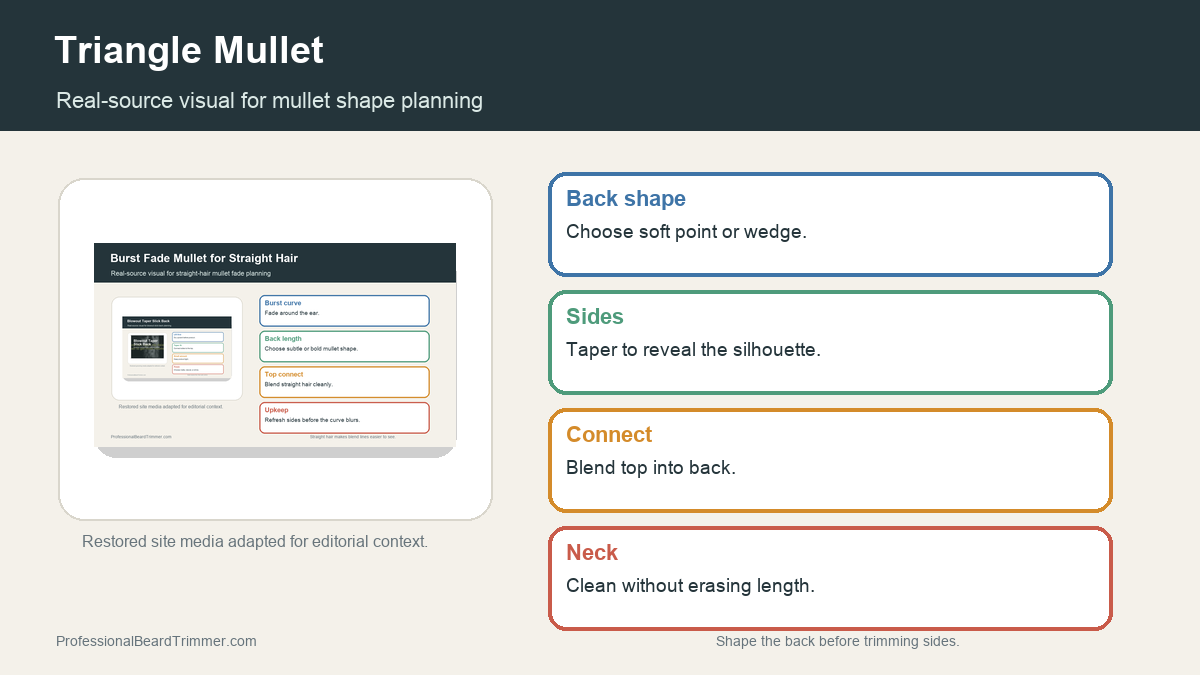
Triangle mullet planning checks
| Check | What to do | Why it matters |
|---|---|---|
| Back shape | Decide whether the back should form a soft point or stronger wedge | The back silhouette is the main visual signal |
| Side taper | Keep the sides controlled so the back shape stands out | Too much side bulk hides the triangle effect |
| Top connection | Blend the top into the back gradually | Disconnected top length can make the style look accidental |
| Neckline | Clean the lower neck while preserving the intended back length | Over-cleaning can remove the shape too early |
| Refresh plan | Trim sides before the back loses its line | Maintenance keeps the silhouette readable |
How to plan a triangle mullet
- Choose the back silhouette. Pick a soft point or stronger wedge before trimming the sides.
- Control the side length. Use taper or fade planning so the sides do not compete with the back.
- Blend the top connection. Keep the top and back connected enough to avoid a hard shelf.
- Clean the neckline carefully. Remove loose neck hair without cutting into the planned back shape.
- Refresh the sides first. Maintain the taper before shortening the back length too much.
Triangle mullet checklist
- Readable back shape: Creates the triangle or wedge effect.
- Controlled side taper: Keeps the back silhouette visible.
- Top-to-back connection: Prevents a disconnected shelf.
- Careful neckline: Cleans the edges without erasing the shape.
For related reference pages, compare the burst fade mullet guide, the mullet fade guide, and the low taper mullet guide.
Frequently asked questions
What is a triangle mullet haircut?
A triangle mullet is a mullet shape where the back length forms a clear point or wedge, while the sides are tapered enough to keep that back shape visible.
Does a triangle mullet need a fade?
It does not always need a fade, but a taper or fade can help the back shape stand out and keep the sides controlled.
How should the neckline be handled?
The neckline should be cleaned carefully so stray hair is removed without cutting away the planned back length.
How do you maintain the shape?
Refresh the side taper and edges first, then trim the back only enough to preserve the intended point or wedge.