
Disclosure: This site may use affiliate links. Product specifications should be checked against manufacturer or retailer pages before purchase.
Editorial update, June 19, 2026: This recovered page was rebuilt as a practical fade, mullet, mohawk, and clipper-planning guide using restored or current site media. It avoids hands-on test claims, live shopping data, score claims, and unsupported barber-service claims.
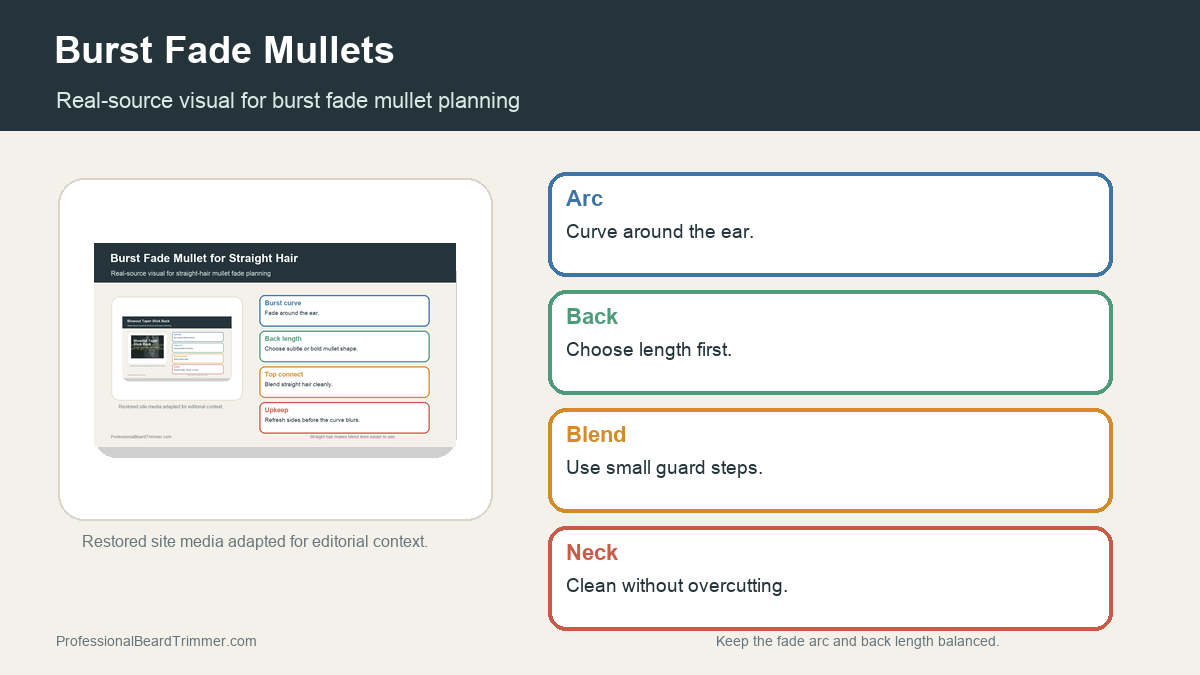
Image note: The image gives burst-fade mullet context from existing site media. Use it as a planning guide for shape, not as proof of a single required cut.
Direct answer: A burst fade mullet works best when the fade curves cleanly around the ear, the back length is planned before cutting, and the neckline is cleaned without removing the mullet shape.
Burst fade mullet checks
| Check | What to do | Why it matters |
|---|---|---|
| Fade arc | Curve the fade around the ear | The arc separates a burst fade from a plain low fade |
| Back length | Choose the mullet length before trimming | The back controls the whole silhouette |
| Guard blend | Blend the side in small guard steps | Large jumps can leave a hard shelf |
| Neckline | Clean loose edges without cutting the back too high | Over-cleaning can erase the mullet shape |
| Maintenance | Refresh sides before the back looks heavy | Sides blur faster than the longer back |
How to plan a burst fade mullet
- Set the back length. Decide how much length should remain before any side fading starts.
- Map the burst arc. Place the fade around the ear so it follows the head shape.
- Blend with guard steps. Use controlled guard changes instead of jumping from skin to bulk.
- Clean the neckline. Remove loose neck hair while keeping the back length intentional.
- Check the side view. Confirm the fade arc and back length work together from the side.
Burst fade mullet checklist
- Curved fade arc: Defines the burst shape.
- Planned back length: Keeps the mullet balanced.
- Guard control: Prevents a harsh side step.
- Light neckline cleanup: Finishes the cut without shortening the back too much.
For related reference pages, compare the mullet fade guide, the burst fade blowout guide, and the fade consultation guide.
Frequently asked questions
What makes a burst fade mullet different?
The fade curves around the ear while the back keeps visible length. That contrast creates the burst shape and the mullet outline.
Should the back be cut first?
Plan the back length first, then blend the sides around it. Cutting the sides first can make the back look disconnected.
What guards help with this haircut?
The exact guards depend on hair density and target contrast, but small guard steps are usually easier to blend than big jumps.
How do you maintain a burst fade mullet?
Refresh the side fade and neckline lightly while leaving the back length unless the shape has become too heavy.