
Disclosure: This site may use affiliate links. Product specifications should be checked against manufacturer or retailer pages before purchase.
Editorial update, June 19, 2026: This recovered page was rebuilt as a practical haircut, fade, and clipper-planning guide using restored or current site media. It avoids hands-on test claims, live shopping data, score claims, and unsupported barber-service claims.
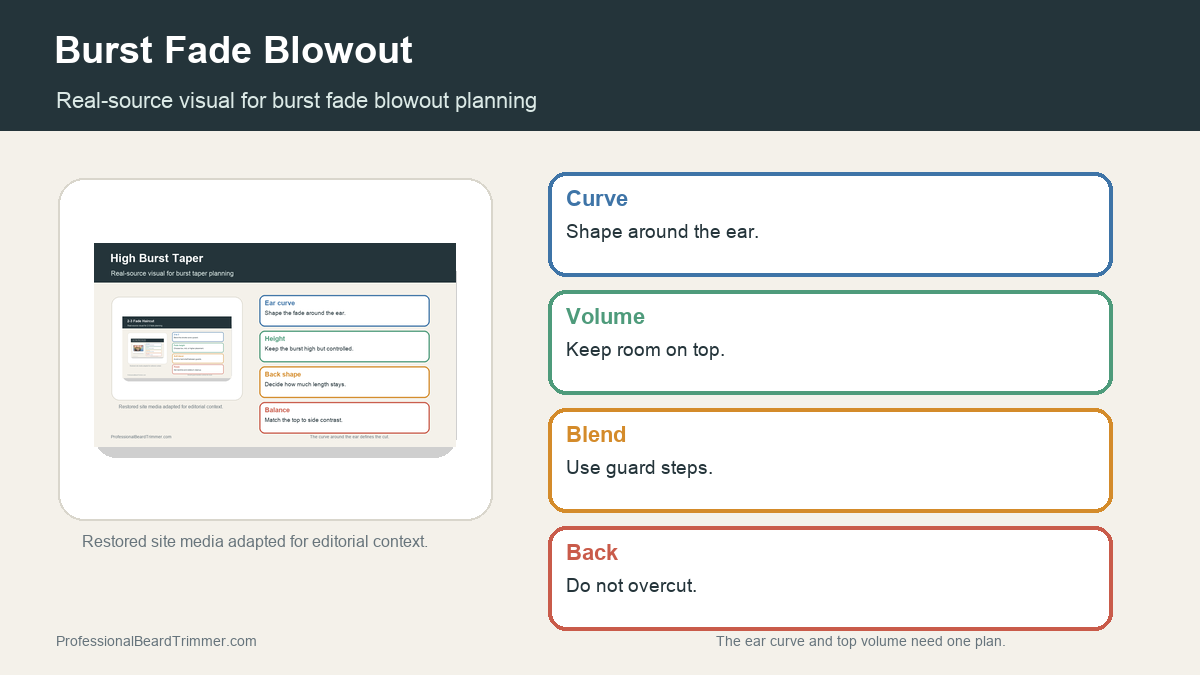
Image note: The image gives burst fade context from existing site media. Final shape depends on hair density, top length, clipper range, and styling product choice.
Direct answer: A burst fade blowout should define the curve around the ear, keep enough top volume for the blowout shape, and use gradual guard changes around the sides. The fade should support the volume instead of cutting too high into it.
Burst fade blowout checks
| Check | What to do | Why it matters |
|---|---|---|
| Ear curve | Ask where the burst should wrap around the ear | The curve defines the haircut |
| Top volume | Keep enough length for lift and shape | A blowout needs room to move |
| Guard blend | Step through guards around the side curve | Rushed transitions create patches |
| Back shape | Decide how much length stays behind the ear | The back controls balance |
| Finish | Use light cleanup around the neckline | Overcutting can flatten the style |
How to ask for a burst fade blowout
- Choose the burst height. Decide how high the fade should arc around the ear.
- Protect top volume. Tell the barber how much height or movement should stay on top.
- Blend the curve. Use gradual guard changes around the ear instead of one harsh jump.
- Check side balance. Compare both sides before the back is cleaned up.
- Style lightly. Use enough hold for shape without flattening the blowout.
Burst fade blowout checklist
- Defined ear curve: Keeps the burst fade intentional.
- Protected volume: Lets the blowout shape remain visible.
- Gradual blend: Prevents harsh patches around the curve.
- Clean neckline: Finishes the cut without removing too much back length.
For related reference pages, compare the high burst taper guide, the blowout taper slick back guide, and the fade consultation guide.
Frequently asked questions
What is a burst fade blowout?
It combines a curved fade around the ear with a top shape that keeps height, movement, or volume.
Should the burst fade be high or low?
A higher burst creates stronger contrast, while a lower burst keeps more side softness. Choose based on how bold you want the shape.
Does a blowout need long hair?
It needs enough top length to lift and shape, but it does not have to be very long.
How do I keep it from looking uneven?
Ask for the ear curve, back length, and top volume to be checked together before final edge cleanup.