Disclosure: This site may use affiliate links. Product specifications should be checked against manufacturer or retailer pages before purchase.
Editorial update, June 19, 2026: This recovered page was rebuilt as a practical men's haircut, guard, and clipper-control guide using restored or current site media. It avoids firsthand-service claims, live shopping data, score claims, and brand-owned imagery.
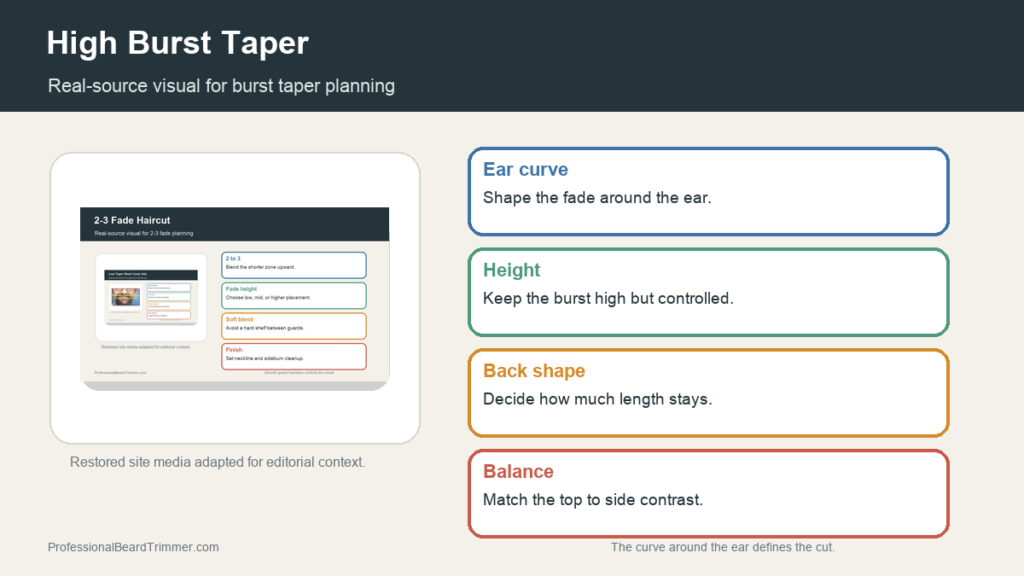
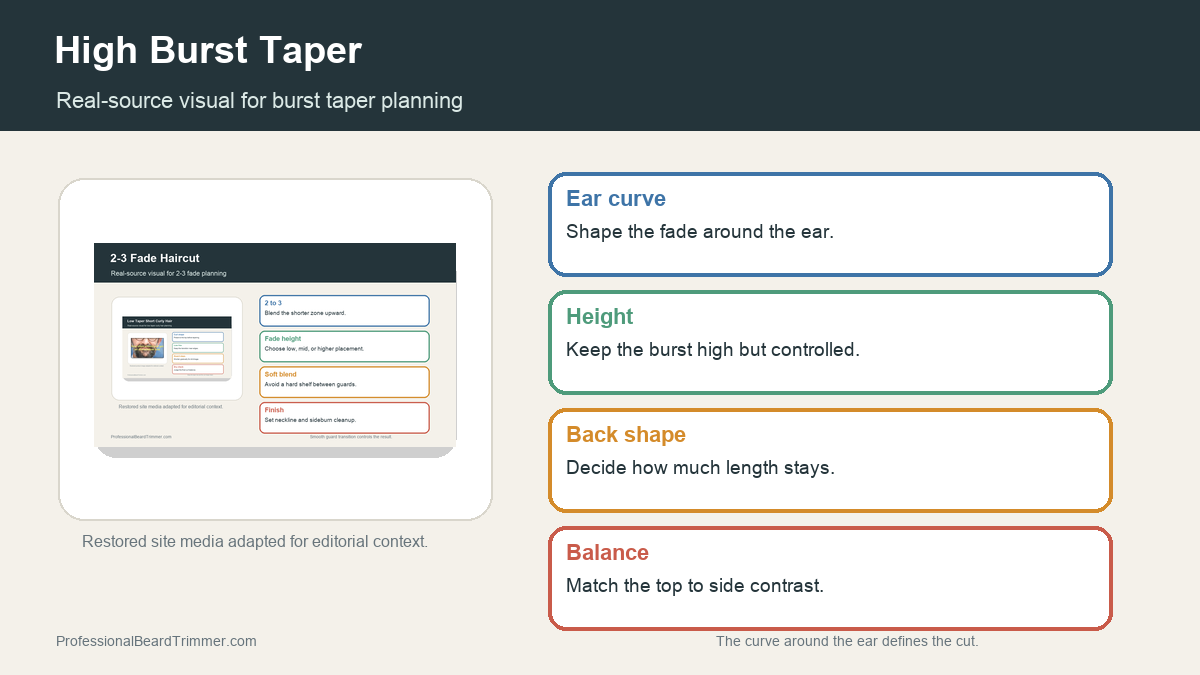
Image note: The image gives high-burst-taper planning context from existing site media. It is not a barber-service record or proof of a specific finished haircut.
Direct answer: A high burst taper is a curved fade that rises higher around the ear while keeping more shape at the back than a full skin fade. The style works best when the burst curve, top length, and neckline cleanup are planned together before cutting.
High burst taper planning checks
| Check | What to do | Why it matters |
|---|---|---|
| Burst curve | Place the fade in a curved shape around the ear | The curve is what separates it from a straight taper |
| Fade height | Ask for the burst to rise high but stay controlled | Too much height can remove the intended back shape |
| Top balance | Keep the top length compatible with the side contrast | Heavy tops need a cleaner transition |
| Back shape | Decide how much length stays behind the ear | This controls whether the cut feels modern or dramatic |
| Cleanup | Finish sideburns and neckline consistently | Clean edges make the burst shape look deliberate |
How to ask for a high burst taper
- Use the phrase high burst taper. Name the style and point to the area around the ear where the curve should rise.
- Set the height. Say how high the burst should climb before it blends into the top and back.
- Keep the back shape. Explain whether you want more length behind the ear or a tighter finish.
- Blend gradually. Use guard changes and lever control so the curve does not look like a hard patch.
- Check both sides. Compare the curve around each ear before final cleanup.
Burst taper checklist
- Curved placement: Defines the burst taper shape.
- Controlled height: Keeps the style from turning into a full high fade.
- Balanced top: Makes the fade connect naturally.
- Even sides: Prevents one burst curve from climbing higher than the other.
For related reference pages, compare the clipper taper guide, the fade consultation guide, and the taper guard guide.
Frequently asked questions
What is a high burst taper?
A high burst taper is a curved fade around the ear that rises higher than a low burst while keeping shape through the back and top.
Is a high burst taper the same as a burst fade?
They are related, but a taper usually keeps more controlled edges and length than a more aggressive burst fade.
Who should ask for a high burst taper?
It suits people who want strong side shape around the ear without removing all the back length.
What should I tell the barber?
Ask for a high burst taper around the ear, state how high it should rise, and explain how much length you want to keep at the back.