
Disclosure: This site may use affiliate links. Product specifications should be checked against manufacturer or retailer pages before purchase.
Editorial update, June 18, 2026: This recovered page was rebuilt as a basic taper workflow for hair and beard-edge blending.
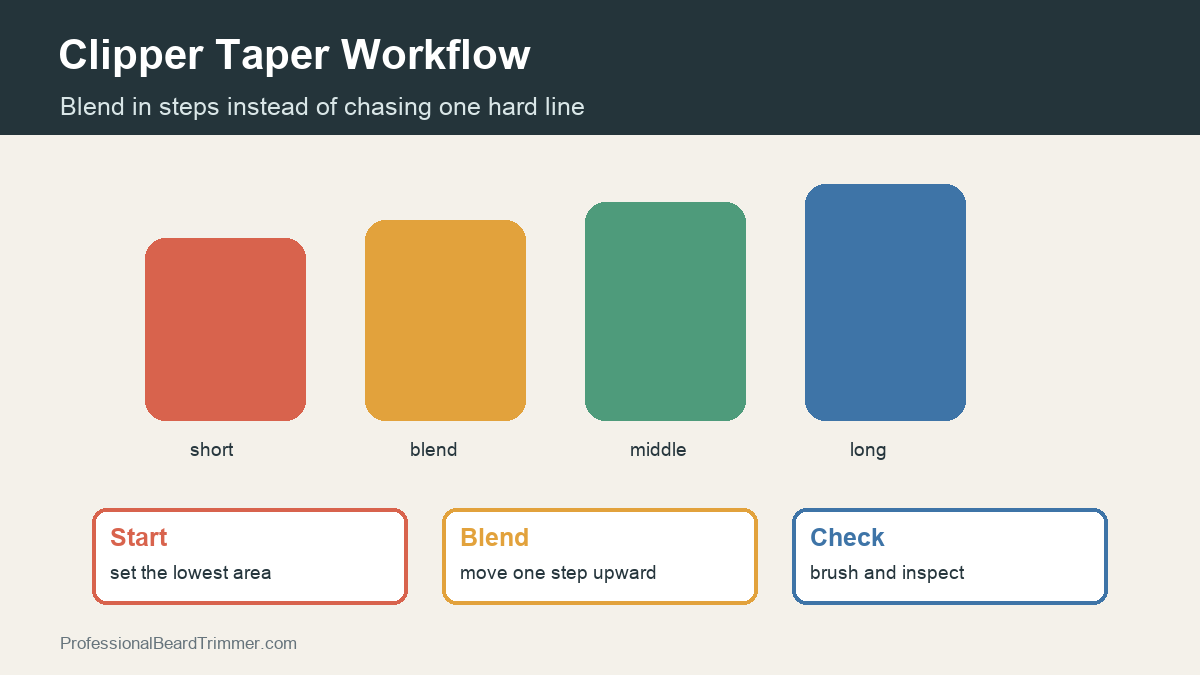
Direct answer: A clipper taper blends a shorter area into a longer area through small guard or lever changes. Set the shortest zone first, brush the area clean, then blend upward one step at a time. The safest approach is gradual adjustment, frequent checks, and light pressure.
Clipper taper blending table
| Decision point | Use this rule | Why it matters |
|---|---|---|
| Starting zone | Set the shortest area first | The base gives the blend a clear limit |
| Middle step | Use one nearby length | Small jumps reduce hard lines |
| Lever use | Adjust only a little at a time | Tiny changes soften the blend |
| Brush out | Clear cut hair between passes | Loose hair hides the true transition |
| Final check | Look from more than one angle | Different angles reveal uneven spots |
How to build a simple clipper taper
- Choose the end length. Decide where the taper should finish before cutting.
- Create the short base. Use the shortest planned setting only in the lower area.
- Blend one step higher. Move to a nearby length and blend just above the base.
- Soften the transition. Use small lever or guard changes instead of a large jump.
- Brush and inspect. Clear loose hair and check the blend from the side and front.
Taper setup checklist
- Length plan: Know the short and long areas before starting.
- Nearby guards: Small steps help avoid hard lines.
- Light pressure: Keeps the cut more consistent.
- Frequent checks: Prevents overworking one area.
For related reference pages, compare the beard fade guide, the taper guard guide, and the lever position guide.
Frequently asked questions
What is a clipper taper?
It is a controlled blend from a shorter area into a longer area, usually made with guard or lever changes.
Why does my taper leave a hard line?
Hard lines usually come from skipping length steps, pressing too hard, or not brushing away loose hair before checking the blend.
Should I start with the shortest setting?
Use the shortest planned setting only in the area meant to be shortest. Then blend upward in small steps.
Can a taper work on beard edges?
Yes. The same gradual approach can soften sideburns, cheek transitions, or lower beard edges when used carefully.