Disclosure: This site may use affiliate links. Product specifications should be checked against manufacturer or retailer pages before purchase.
Editorial update, June 19, 2026: This recovered page was rebuilt as a practical grooming-tool guide using restored old-site media. It does not claim hands-on lab testing, current manufacturer specifications, offers, or availability.
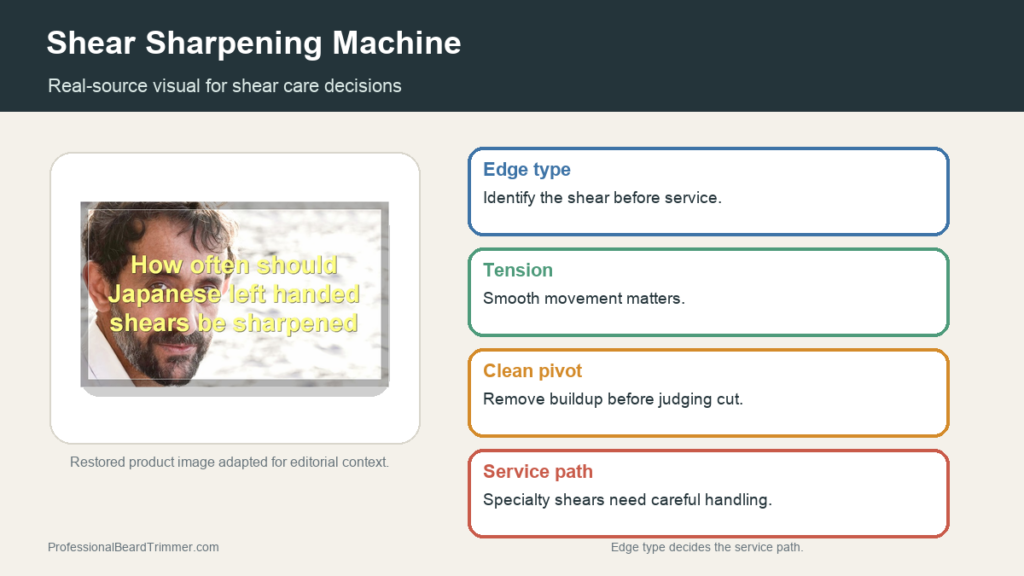
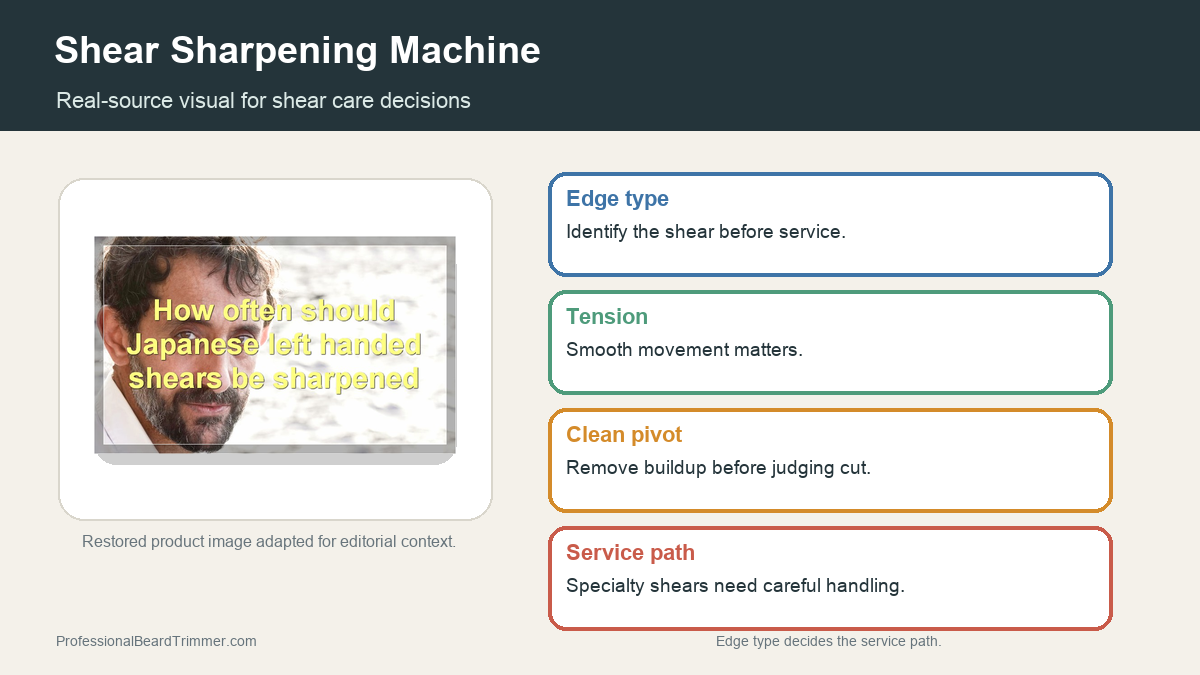
Image note: The image gives real shear-care context from restored site media. It does not prove a specific machine result or replace checking the shear maker's care guidance.
Direct answer: A shear sharpening machine is not a universal fix. Barber and grooming shears should be checked for edge type, tension, nicks, looseness, corrosion, and cutting feel before service. Valuable convex or specialty shears are usually safer with a qualified shear sharpener.
Shear sharpening decision checks
| Check | What to do | Why it matters |
|---|---|---|
| Edge type | Identify whether the shear has a bevel, convex, or specialty edge | Different edges need different sharpening handling |
| Tension | Check whether the blades meet smoothly without forcing | Poor tension can feel like a dull edge |
| Clean pivot | Remove hair and residue around the pivot and blades | Buildup can affect cutting feel |
| Visible damage | Look for nicks, corrosion, loose screws, or bent tips | Damage may need repair before sharpening |
| Service fit | Use a qualified shear service for valuable or specialty shears | Wrong grinding can shorten tool life |
How to evaluate shears before sharpening
- Clean the shears. Remove loose hair and residue from the blades and pivot area.
- Check tension. Open and close the shears slowly to see whether the blades meet smoothly.
- Inspect the edge. Look for nicks, rough spots, bent tips, corrosion, or uneven contact.
- Identify the edge style. Do not assume every shear can be sharpened the same way.
- Choose the service path. Use a qualified shear sharpener when the edge style, value, or damage is uncertain.
Barber shear care checklist
- Clean pivot: Improves movement before judging edge quality.
- Smooth tension: Helps shears cut without folding hair.
- Known edge type: Keeps the sharpening method appropriate.
- Safe storage: Protects tips and edges between uses.
For related reference pages, compare the men's scissor cut guide, the men's haircut scissor guide, and the barber tool kit guide.
Frequently asked questions
What should I check before using a shear sharpening machine?
Check edge type, pivot cleanliness, blade tension, visible nicks, bent tips, corrosion, and whether the shears are valuable or specialty tools.
Can poor tension make shears feel dull?
Yes. If the blades do not meet correctly, hair can fold or slide even when the edge is not the only problem.
When should shears go to a qualified service?
Use a qualified service for convex edges, specialty shears, valuable barber tools, visible damage, or any shear where the correct sharpening method is uncertain.
How can shears stay sharper longer?
Keep them clean and dry, protect the tips, avoid cutting unsuitable materials, store them safely, and correct tension problems early.