
Disclosure: This site may use affiliate links. Product specifications should be checked against manufacturer or retailer pages before purchase.
Editorial update, June 19, 2026: This recovered page was rebuilt as a practical barber clipper set planning guide using a restored real grooming kit image. It does not claim hands-on lab testing, current product availability, or retailer offers.
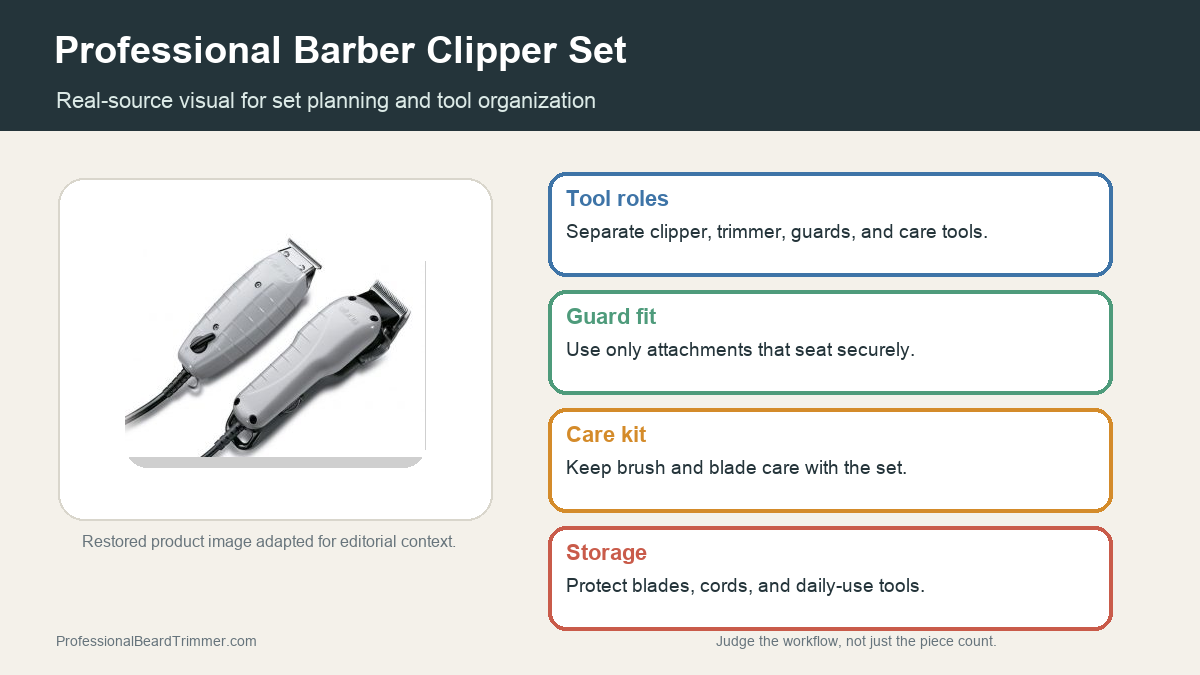
Image note: The image is adapted from restored site media and is used for set-planning context. Exact contents, fit, and support still depend on the specific kit and tool labels.
Direct answer: A professional barber clipper set should cover separate roles: bulk cutting, detail trimming, guards or combs, blade care, cleaning, cord or charger management, and safe storage. A smaller set with reliable fit and upkeep can be more useful than a large set with mismatched accessories.
Barber clipper set planning checks
| Check | What to do | Why it matters |
|---|---|---|
| Main clipper | Use it for bulk cutting, taper work, and guard-based length control | The main clipper carries the heaviest workload |
| Detail trimmer | Reserve it for lineups, necklines, and short finishing | Detail tools give control where a clipper is too wide |
| Guards and combs | Match guards to the exact clipper and length plan | Loose or mismatched guards can create uneven cuts |
| Care tools | Keep a brush and approved oil or care routine with the set | Maintenance keeps blades cutting predictably |
| Storage | Separate sharp parts, cords, guards, and daily tools | Good storage reduces damage and missing accessories |
How to evaluate a clipper set before use
- List the tool roles. Separate bulk cutting, detail trimming, guard work, blending, and cleanup before judging the set.
- Check guard fit. Attach each guard and make sure it locks or seats securely on the matching clipper.
- Inspect blades. Look for clean teeth, flat seating, and no visible damage before cutting.
- Match cords and chargers. Keep each charger or cord with the tool it belongs to.
- Store clean and dry. Brush hair out and let tools dry before closing a case or drawer.
Clipper set checklist
- Bulk clipper: Handles longer passes and guard-based cutting.
- Detail trimmer: Handles lines, neck cleanup, and short finishing.
- Secure guards: Make length control repeatable.
- Cleaning brush: Keeps hair from building up around the blade channel.
For related reference pages, compare the barber tool kit guide, the clipper case guide, and the barber cleaning supplies checklist.
Frequently asked questions
What should a professional barber clipper set include?
A practical set should include a main clipper, a detail trimmer, secure guards or combs, cleaning tools, a sensible care routine, and storage that protects blades and cords.
Is a bigger clipper set always better?
No. A large set is only useful when the guards, cords, blades, and care tools fit the actual workflow. Mismatched accessories add clutter without improving cuts.
How should a barber clipper set be stored?
Store tools clean and dry, separate sharp parts from cords, keep chargers matched to each tool, and avoid compressing guards or blades in a tight case.
What should be checked before using a clipper set?
Check blade cleanliness, guard fit, cord or charger match, tool power, and whether each tool is suited to the task you plan to do.