Disclosure: This site may use affiliate links. Product specifications should be checked against manufacturer or retailer pages before purchase.
Editorial update, June 19, 2026: This recovered page was rebuilt as a practical men's haircut, taper, and clipper-control guide using restored or current site media. It avoids firsthand-service claims, identity stereotypes, live shopping data, score claims, and brand-owned imagery.
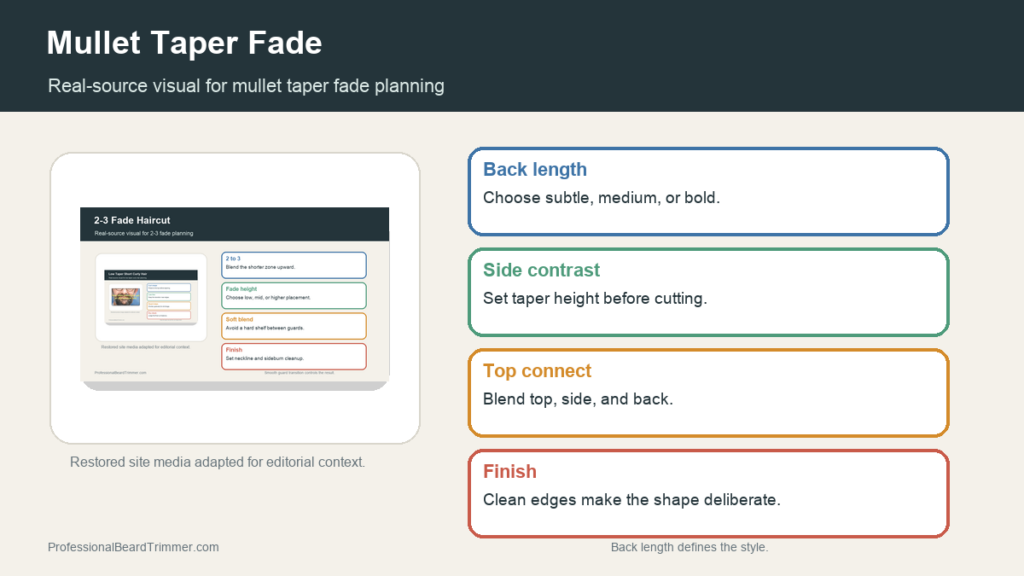
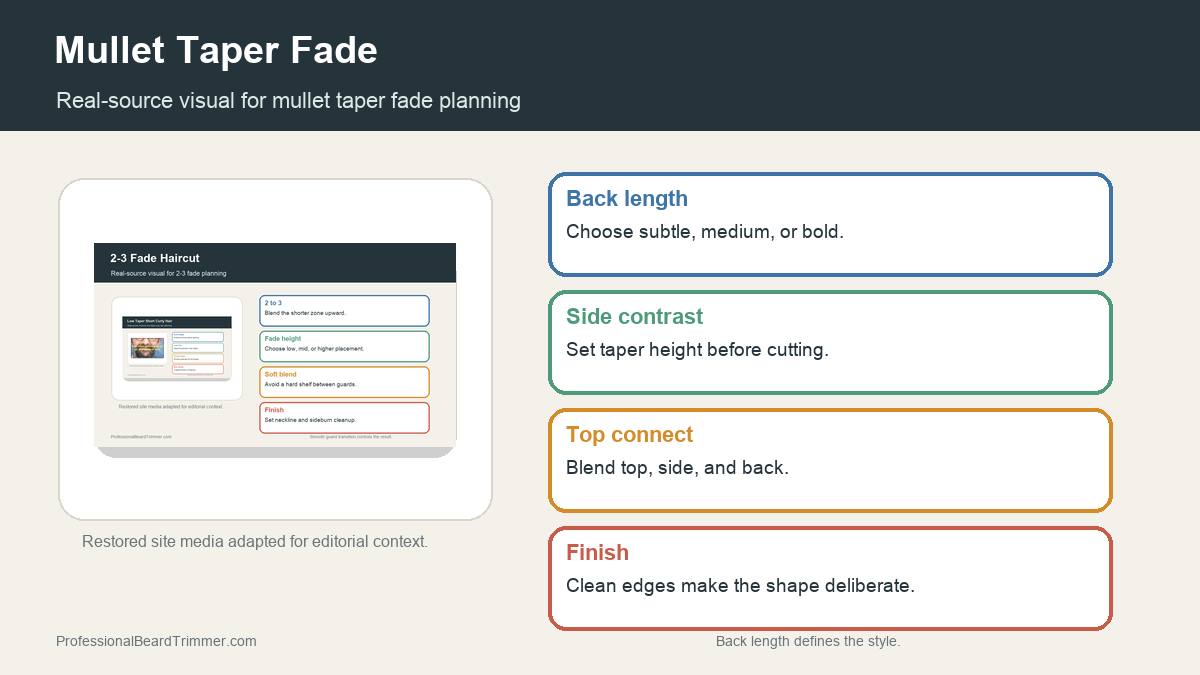
Image note: The image gives taper-fade planning context from existing site media. It is not a barber-service record or a claim about one cultural style being a single fixed haircut.
Direct answer: A mullet taper fade combines short, clean side contrast with extra length in the back. The style should be planned by back length, taper height, top connection, and neckline finish, not by assuming one fixed version of the cut.
Mullet taper fade planning checks
| Check | What to do | Why it matters |
|---|---|---|
| Back length | Choose subtle, medium, or long back shape | The back length defines the mullet more than the side fade does |
| Taper height | Decide whether the side stays low or rises toward a fade | Height controls how bold the side contrast feels |
| Top connection | Blend the top into the side and back shape | A disconnected top can make the cut look unfinished |
| Guard plan | Use gradual guard steps around the side edge | This keeps the taper fade from looking patchy |
| Finish | Set neckline and sideburn cleanup before final detailing | Edges make the shape look intentional |
How to ask for a mullet taper fade
- State the back length. Start by explaining how long and bold you want the mullet shape to be.
- Choose side contrast. Say whether you want a low taper, a stronger taper fade, or a more dramatic side cut.
- Connect the top. Ask for the top to blend into both the side and back so the shape feels deliberate.
- Set the neckline. Choose the back finish before cleanup starts.
- Check both sides. Check side height and back balance before the final detail pass.
Mullet taper fade checklist
- Back-length decision: Defines whether the mullet is subtle or bold.
- Taper height: Controls side contrast and overall sharpness.
- Top connection: Keeps the haircut from looking like separate pieces.
- Clean edges: Make the final shape intentional.
For related reference pages, compare the mullet haircut fade guide, the burst fade mullet guide, and the 2-3 fade guide.
Frequently asked questions
What is a mullet taper fade?
It is a haircut that keeps extra length in the back while using a taper or fade on the sides for cleaner contrast.
How do I ask for a mullet taper fade?
Say how long you want the back, how high the side taper or fade should rise, and how the top should connect into the side and back.
Is a taper fade mullet subtle or bold?
It can be either. A low taper and shorter back feel subtle, while a higher side fade and longer back create a bolder shape.
What grows out first?
The side taper or fade usually loses shape before the back length needs a major trim, so edge cleanup is the first maintenance step.