
Disclosure: This site may use affiliate links. Product specifications should be checked against manufacturer or retailer pages before purchase.
Editorial update, June 19, 2026: This recovered page was rebuilt as a practical men's haircut, guard, and clipper-control guide using restored or current site media. It avoids firsthand-service claims, live shopping data, score claims, and brand-owned imagery.
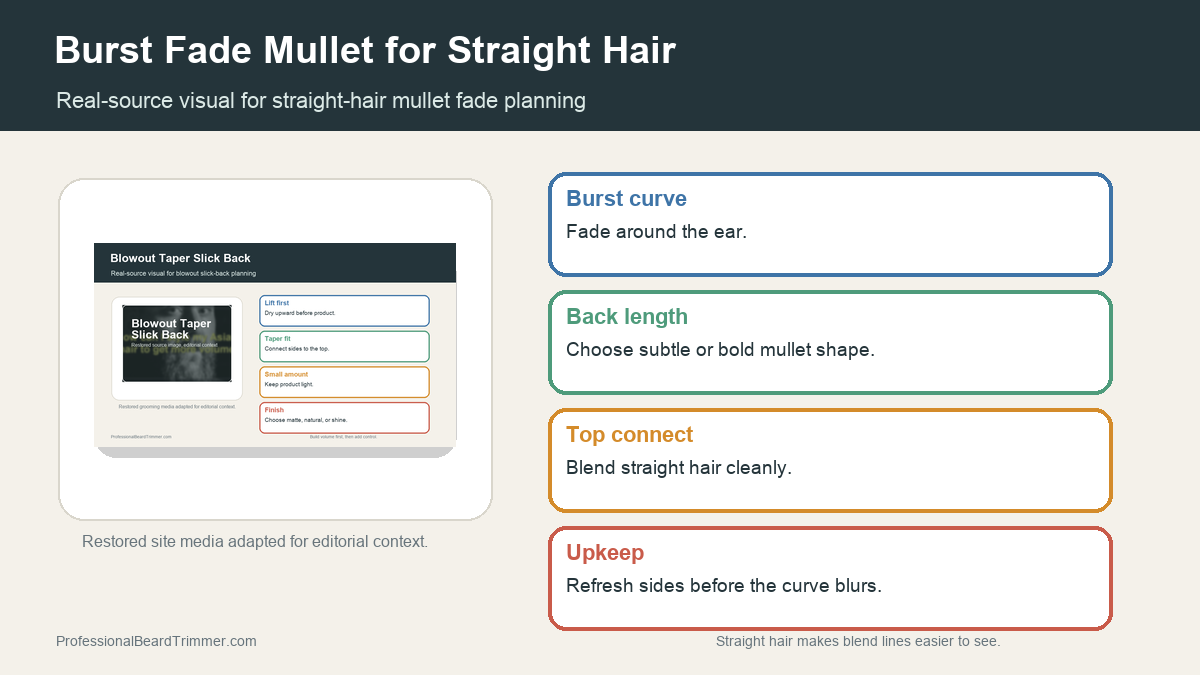
Image note: The image gives haircut-shape planning context from existing site media. It is not a barber-service record or exact result for every hair type.
Direct answer: A burst fade mullet for straight hair works when the fade curves around the ear, the back length is intentional, and the top connects cleanly into the sides. Straight hair shows uneven lines quickly, so the guard plan and cleanup timing matter more than adding extra detail.
Burst fade mullet checks
| Check | What to do | Why it matters |
|---|---|---|
| Burst placement | Curve the fade around the ear instead of cutting straight up | This gives the mullet shape its side contrast |
| Back length | Choose how long the back should stay | The back length controls whether the style is subtle or bold |
| Top connection | Blend the top into the side and back shape | Straight hair can show harsh transitions |
| Side contrast | Use guard changes gradually around the ear | A rushed fade can look patchy on straight hair |
| Upkeep | Clean the side curve before the back becomes unbalanced | The fade grows out faster than the mullet shape |
How to ask for a burst fade mullet on straight hair
- Describe the back length. Say whether you want a subtle mullet shape or a longer back section.
- Place the burst fade. Ask for the fade to curve around the ear rather than climb straight up.
- Blend the top. Connect the top into the sides so straight hair does not show a harsh shelf.
- Keep side contrast controlled. Use gradual guard changes so the side fade does not look patchy.
- Plan cleanup. Refresh the sides when the burst curve softens, even if the back length can grow longer.
Straight-hair mullet fade checklist
- Curved side fade: Creates the burst shape around the ear.
- Intentional back length: Keeps the mullet from looking accidental.
- Smooth top connection: Prevents straight hair from showing hard steps.
- Side cleanup: Keeps the shape readable as it grows.
For related reference pages, compare the mullet haircut fade guide, the curly mullet fade guide, and the low taper mullet guide.
Frequently asked questions
Can straight hair work with a burst fade mullet?
Yes. Straight hair can work well, but it shows uneven transitions quickly, so the fade curve and top connection need to be clean.
What makes it a burst fade mullet?
The burst fade curves around the ear while the back keeps extra length, creating side contrast without removing the mullet shape.
What should I ask for at the barbershop?
Ask for a burst fade around the ear, state how long the back should stay, and request a smooth connection from the top into the sides.
How often does it need cleanup?
The side fade usually needs cleanup before the back length does, because the burst curve softens as the short hair grows.