
Disclosure: This site may use affiliate links. Product specifications should be checked against manufacturer or retailer pages before purchase.
Editorial update, June 19, 2026: This recovered page was rebuilt as a practical men's haircut and clipper-planning guide using restored or current site media. It avoids hands-on test claims, live shopping data, score claims, and stereotypes.
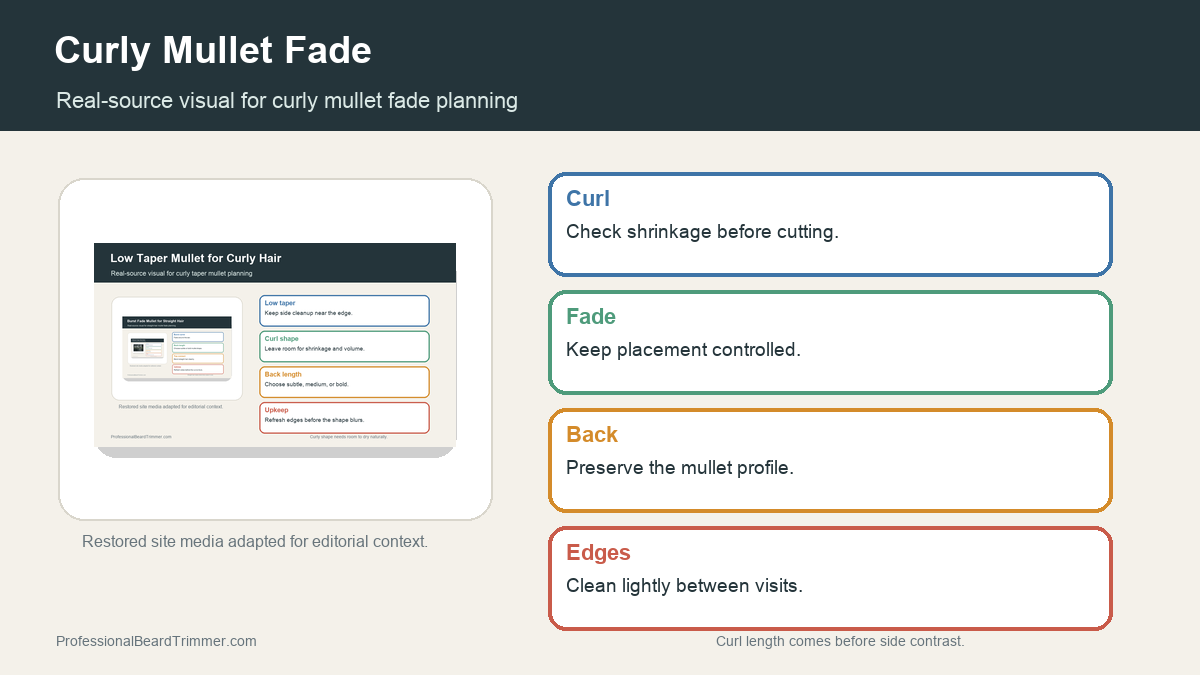
Image note: The image gives curly taper and fade-planning context from existing site media. It is not a universal rule for every curl pattern or density.
Direct answer: A curly mullet fade works best when the curls keep enough length on top and back while the sides are cleaned with a low, temple, burst, or drop fade. Avoid cutting the sides before deciding how much curl volume should remain.
Curly mullet fade checks
| Check | What to do | Why it matters |
|---|---|---|
| Curl length | Keep enough length for curl shape and shrinkage | Curly hair can look much shorter after drying |
| Fade placement | Use low, temple, burst, or drop placement for controlled contrast | Placement decides how much curl area remains |
| Back balance | Leave enough back length to keep the mullet shape | The back should not disappear into the fade |
| Edge cleanup | Clean temples, sideburns, and neckline gradually | Over-sharpening can remove useful shape |
| Upkeep | Plan refresh timing for sides and curl shape | The fade and curls grow out at different speeds |
How to plan a curly mullet fade
- Check shrinkage first. Judge the haircut with dry or mostly dry curls before choosing the final length.
- Pick fade placement. Choose low, temple, burst, or drop placement based on how much curl you want to keep.
- Protect the back length. Ask the barber to preserve enough length behind the ears and at the back.
- Shape edges lightly. Clean the neckline and sideburns without chasing the line too far back.
- Maintain both zones. Refresh the fade and curl shape on a schedule that matches your growth.
Curly mullet fade checklist
- Dry curl check: Prevents the cut from ending shorter than intended.
- Low or burst fade: Keeps more curl area while still cleaning the sides.
- Back length: Preserves the mullet profile.
- Light edge cleanup: Keeps shape without overcutting.
For related reference pages, compare the curly low taper mullet guide, the fade request guide, and the guard size guide.
Frequently asked questions
What fade is best for curly mullet hair?
Low, temple, burst, and drop fades can work well because they clean the sides while preserving more curl volume.
Should curly hair be cut wet or dry for this style?
A dry or mostly dry check helps because curls shrink. The final length should be judged after the curl pattern is visible.
How do I keep the curly mullet shape?
Preserve back length, avoid taking the sides too high too quickly, and refresh the fade and curl outline separately.
Can I maintain the edges at home?
Light neckline or sideburn cleanup is possible with a detail trimmer, but avoid moving the fade line unless you are confident with guard control.