
Disclosure: This site may use affiliate links. Product specifications should be checked against manufacturer or retailer pages before purchase.
Editorial update, June 19, 2026: This recovered page was rebuilt as a practical men's haircut and clipper-control guide using restored or current site media. It avoids firsthand-service claims, celebrity identity claims, live shopping data, score claims, and brand-owned imagery.
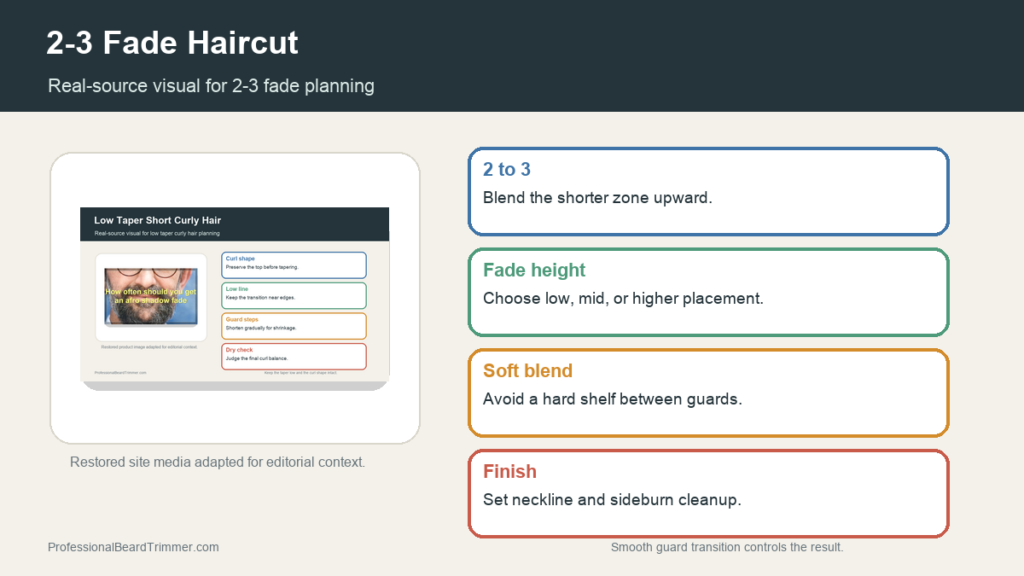
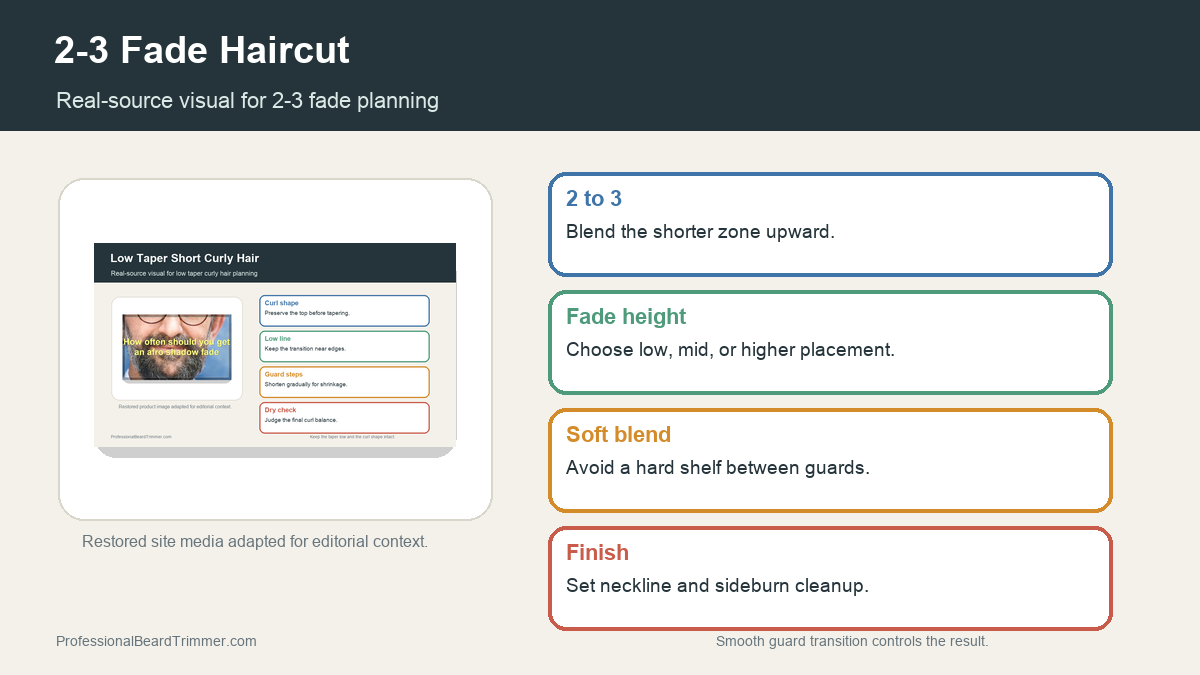
Image note: The image gives fade-planning context from existing site media. It is not proof of a specific barber service or exact result on every hair texture.
Direct answer: A 2-3 fade haircut blends a shorter number 2 area into a longer number 3 area, usually on the sides or lower taper. The result depends on where the blend line sits, how much top length remains, and whether the neckline is left natural, rounded, or squared.
2-3 fade haircut checks
| Check | What to do | Why it matters |
|---|---|---|
| Short zone | Use the number 2 area where the side should look tighter | This creates the lower contrast of the fade |
| Long zone | Use the number 3 area above the shorter section | This keeps coverage before the top transition |
| Blend line | Ask for a soft transition, not a hard shelf | The fade works only if the guards are blended |
| Top length | Match the top to the side coverage | The haircut can look disconnected if the top is too heavy |
| Cleanup | Choose neckline and sideburn detail | Finishing changes the overall neatness of the cut |
How to ask for a 2-3 fade
- Name both guards. Ask for a number 2 into a number 3 fade or taper on the sides.
- Set the fade height. Say whether the shorter area should stay low, mid, or higher on the sides.
- Describe the top. State whether the top should be scissor cut, textured, longer, or blended close.
- Ask for a soft blend. Make clear that the number 2 and number 3 areas should transition smoothly.
- Confirm finish details. Choose neckline shape, sideburn cleanup, and whether the edges should be natural or sharp.
2-3 fade checklist
- Number 2 lower area: Creates a tighter lower fade zone.
- Number 3 upper area: Keeps coverage before the top transition.
- Soft blend line: Prevents a visible shelf between guard lengths.
- Finish details: Make the cut look intentional from the sides and back.
For related reference pages, compare the taper clipper guard guide, the clipper lever guide, and the number 3 fade haircut guide.
Frequently asked questions
What is a 2-3 fade haircut?
A 2-3 fade blends a shorter number 2 guard area into a longer number 3 guard area, usually on the sides or lower taper.
Is a 2-3 fade very short?
It is moderately short. It keeps more coverage than a skin fade but looks cleaner than leaving the sides unblended.
What should I ask the barber for?
Ask for a number 2 into a number 3 fade, then specify fade height, top length, neckline shape, and how sharp or natural you want the edges.
Why can a 2-3 fade look uneven?
Unevenness usually comes from a hard blend line, rushed guard transition, uneven pressure, or a top length that does not match the side coverage.