
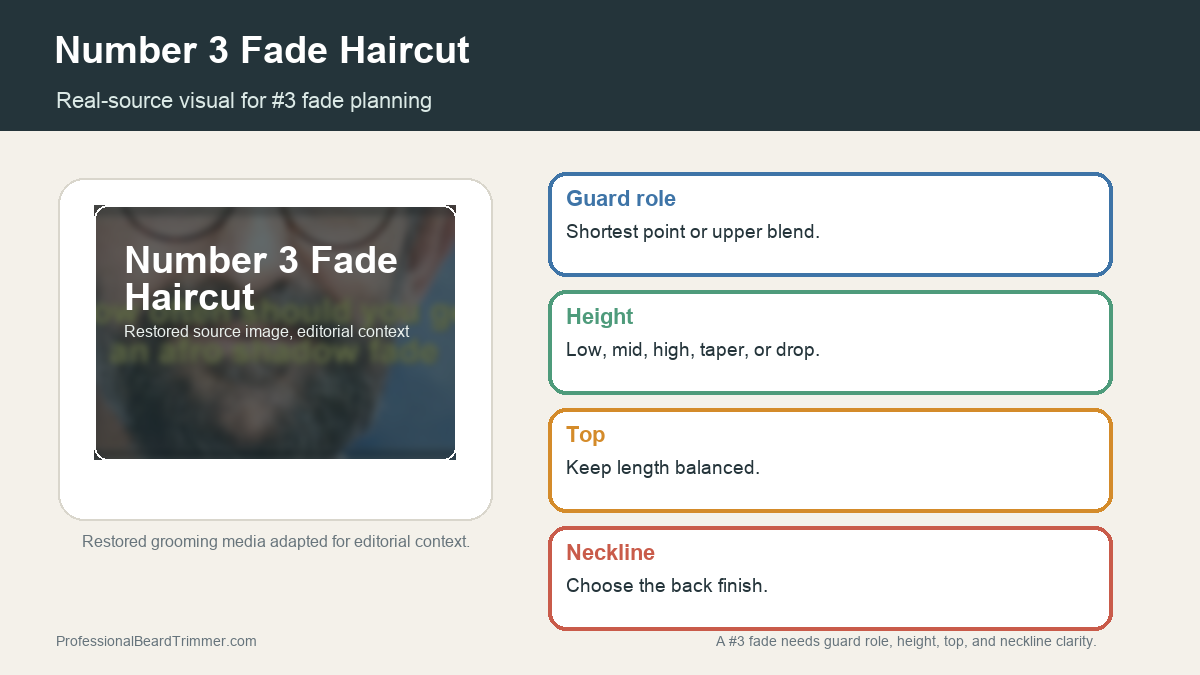
Disclosure: This site may use affiliate links. Product specifications should be checked against manufacturer or retailer pages before purchase.
Editorial update, June 19, 2026: This recovered page was rebuilt as a practical men's grooming guide using restored old-site media. It does not claim direct barber work, lab measurement, retailer offer data, or availability.
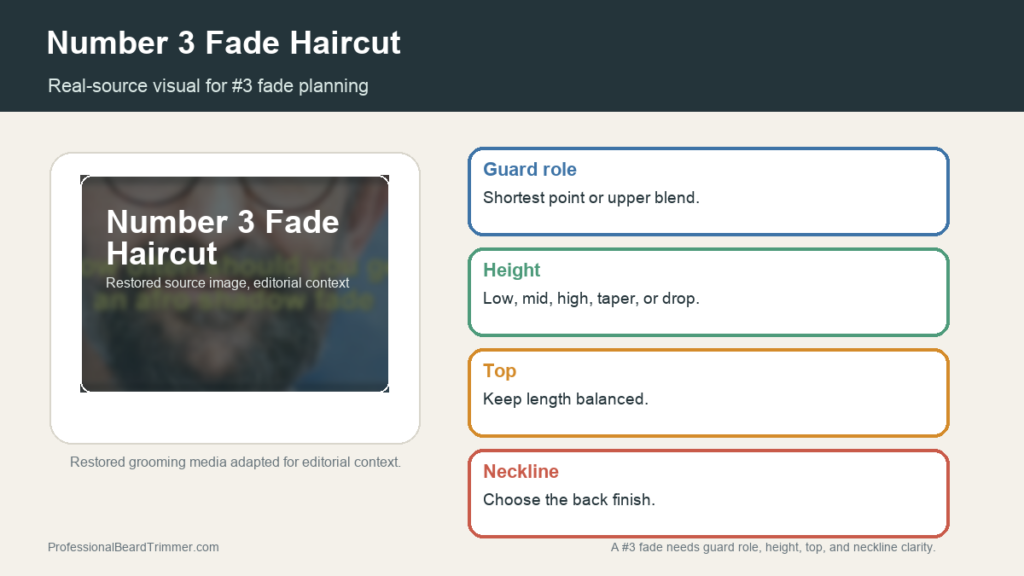
Image note: The image gives restored haircut-category context. It is a planning aid, not proof of a specific barber service or final cut.
Direct answer: A number 3 fade uses a #3 guard, about 3/8 inch or 10 mm, as the key length on part of the sides or blend. Tell the barber whether the #3 should be the shortest point, the upper blend length, or the transition into longer hair on top.
Number 3 fade planning checks
| Check | What to do | Why it matters |
|---|---|---|
| Guard role | Say whether #3 is the shortest length or the upper blend | The same guard can create different fades |
| Fade height | Choose low, mid, high, taper, or drop | Height changes the silhouette |
| Top length | Describe what stays on top and how it should blend | The top controls balance |
| Neckline | Choose natural, tapered, rounded, or squared | The back finish affects upkeep |
| Maintenance | Plan touchups as the blend starts to blur | Shorter fades lose shape sooner |
How to ask for a number 3 fade
- Define the #3 guard role. Tell the barber if the #3 is the shortest side length or only the upper transition length.
- Pick the fade height. Choose low, mid, high, taper, or drop before the sides are cut.
- Explain the top. Say how much hair to keep on top and whether the transition should look soft or sharp.
- Confirm neckline and sideburns. Choose the back finish and sideburn shape before final edge work.
- Use a reference photo. Show a similar hair type and point out the exact blend height you want.
Number 3 fade checklist
- #3 guard clarity: Prevents confusion about the shortest side length.
- Fade height choice: Controls whether the haircut looks subtle or high contrast.
- Top-length plan: Keeps the haircut from looking disconnected.
- Touchup timing: Keeps the blend readable as hair grows out.
For related reference pages, compare the guard size guide, the clipper taper guide, and the fade request guide.
Frequently asked questions
How long is a number 3 haircut?
A number 3 guard usually leaves about 3/8 inch or 10 mm of hair. The final look still depends on fade height, top length, hair texture, and how the shorter guards are blended below it.
Is a number 3 fade short?
A number 3 fade is short but not bare. It usually keeps enough coverage to look softer than a skin fade, especially when the #3 is used higher in the blend.
What should I tell my barber for a number 3 fade?
Say where the #3 guard should appear, what the shortest point should be, how high the fade should sit, and how much hair to keep on top.
How often should a number 3 fade be cleaned up?
Most number 3 fades need a shape check when the side blend starts to blur. The exact timing depends on hair speed, contrast level, and how sharp you want the outline.