
Disclosure: This site may use affiliate links. Product specifications should be checked against manufacturer or retailer pages before purchase.
Editorial update, June 20, 2026: This recovered page was rebuilt as a practical men's grooming, barber workflow, and cleanup guide using restored or current site media. It avoids fake testing, live commercial data, shop visit claims, medical promises, and affiliate language.
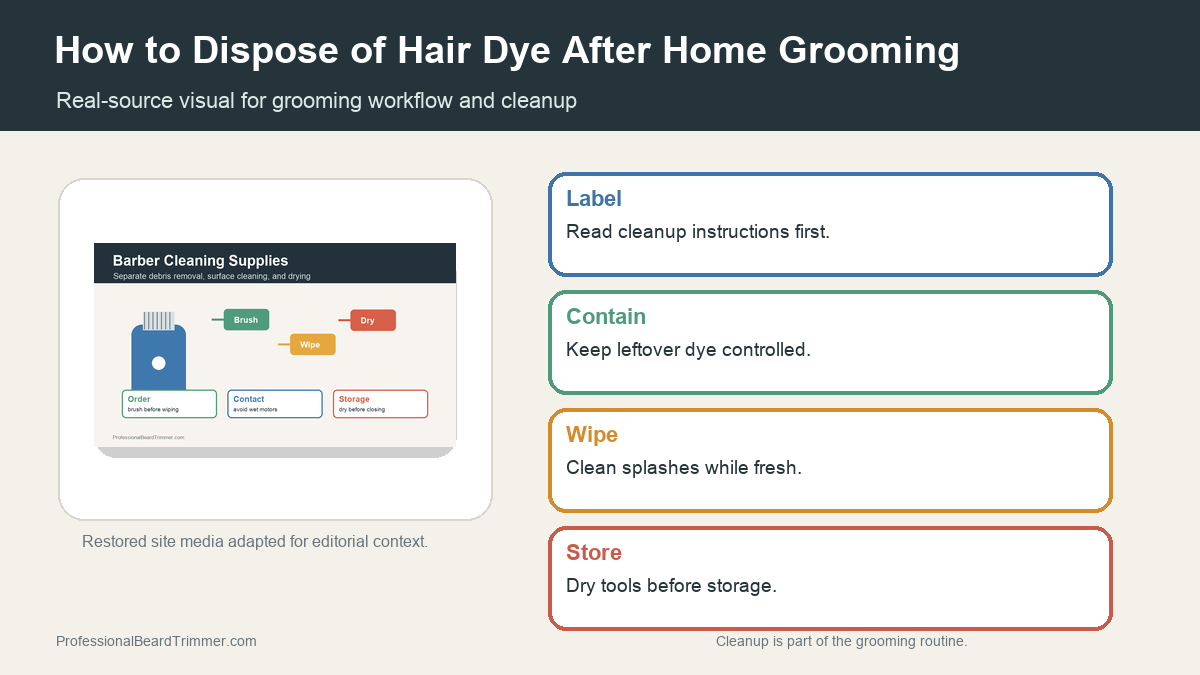
Image note: The image uses an existing cleanup workflow visual for editorial context. It does not replace the product label or local waste guidance.
Direct answer: After a home hair or beard dye session, treat cleanup as part of the grooming routine: contain leftover dye, keep stained towels separate, rinse tools only as directed on the product label, protect the sink area, ventilate the room, and check local waste rules before discarding unused product.
Hair dye cleanup checks
| Check | What to do | Why it matters |
|---|---|---|
| Product label | Read disposal and rinsing instructions before cleanup | Dye formulas and containers can have different handling notes |
| Leftover dye | Keep unused mixture contained until you know how it should be discarded | Loose dye can stain surfaces or create avoidable mess |
| Towels and gloves | Separate stained disposable items from reusable towels | This prevents dye transfer to clean grooming tools |
| Sink area | Wipe splashes quickly and keep drains clear of hair clumps | Surface cleanup is easier before dye dries |
| Local rules | Check municipal guidance when product instructions are unclear | Waste rules can vary by location |
How to clean up after a home dye session
- Pause before pouring anything out. Read the dye label and decide what should be rinsed, sealed, or discarded.
- Separate stained items. Keep gloves, applicators, towels, and packaging away from clean trimmers, guards, and combs.
- Wipe the sink and counter. Clean splashes while they are fresh, using the product label as the first instruction source.
- Brush hair away from drains. Remove loose hair before rinsing tools so clumps do not build up around the sink.
- Store grooming tools dry. Let combs, clips, and washable accessories dry before returning them to a kit or drawer.
Hair dye disposal checklist
- Label-first cleanup: Keeps disposal tied to the actual dye formula.
- Separated towels: Reduce dye transfer to clean tools and surfaces.
- Fresh splash cleanup: Limits staining around the grooming area.
- Dry storage: Keeps trimmers, combs, and guards ready for the next routine.
For related reference pages, compare the barber cleaning supplies checklist, the barber tool kit guide, and the clipper case storage guide.
Frequently asked questions
Can leftover hair dye go straight down the sink?
Do not assume that. Read the product label first and check local waste guidance if the label does not clearly explain how unused dye should be handled.
How should stained towels be handled?
Keep stained towels or disposable wipes separate from clean grooming tools until they can be washed or discarded according to the product instructions.
What should be cleaned first after dyeing hair or beard hair?
Clean fresh splashes, applicators, gloves, and loose hair before dye dries or transfers to trimmers, guards, combs, or the sink area.
Should trimmers be stored near dye products?
No. Keep electric tools dry and away from dye containers, wet towels, and residue unless the tool's instructions say a part can be rinsed.