
Disclosure: This site may use affiliate links. Product specifications should be checked against manufacturer or retailer pages before purchase.
Editorial update, June 19, 2026: This recovered page was rebuilt as a practical men's grooming tool guide using restored or current site media. It avoids firsthand-test claims, live shopping data, score claims, and brand-owned imagery.
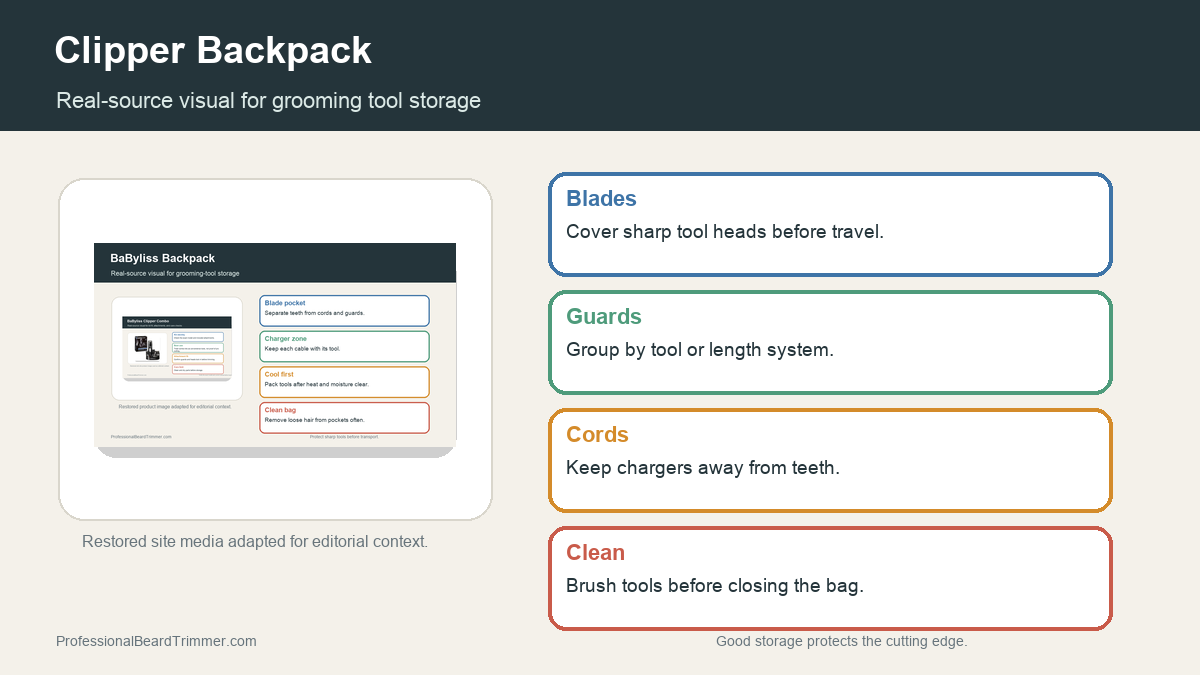
Image note: The image gives tool-storage context from existing site media. It is not a current product listing or proof of exact accessory capacity.
Direct answer: A clipper backpack should protect blades, keep guards organized, separate chargers and cords, and leave room for clean and used tools. The best setup is about safe storage and workflow, not simply carrying the most tools possible.
Clipper backpack storage checks
| Check | What to do | Why it matters |
|---|---|---|
| Blade protection | Use sleeves, caps, or compartments for sharp tool heads | Blades can chip or bend when loose in a bag |
| Guard storage | Group guards by tool or length system | Mixed guards make setup slower and can cause length mistakes |
| Cord separation | Keep chargers and cords away from blade teeth | Cord clutter can damage tools and hide small parts |
| Clean tools | Brush hair out before packing the bag | Loose hair builds up quickly in enclosed storage |
| Daily access | Place most-used tools where they can be reached first | Good layout saves time during repeated grooming work |
How to organize a clipper backpack
- Empty and sort the bag. Separate clippers, trimmers, guards, cords, cleaning items, and sharp parts.
- Protect blades first. Cover or isolate tool heads so teeth do not hit metal parts or chargers.
- Group guards. Keep guards together by tool family, size, or job type.
- Separate cords. Bundle chargers and cords so they do not press into blade teeth.
- Clean before closing. Brush tools and let damp items dry before zipping the bag.
Barber tool bag checklist
- Blade covers: Reduce damage during transport.
- Guard pouch: Keeps length attachments easy to find.
- Cord pocket: Stops chargers from tangling with blades.
- Cleaning brush: Keeps the bag from collecting loose hair.
For related reference pages, compare the barber bag for clippers guide, the clipper case guide, and the barber clipper set guide.
Frequently asked questions
What should go in a clipper backpack?
A practical clipper backpack can hold clippers, trimmers, guards, cleaning tools, chargers, cords, blade covers, and small grooming accessories if each part has a protected place.
How do you protect clipper blades in a bag?
Use blade covers, sleeves, or separate compartments so teeth do not hit guards, chargers, or other metal parts during travel.
Should guards and cords be stored together?
No. Guards are easier to find when grouped by size or tool, while cords should stay bundled in a separate pocket.
How often should a clipper backpack be cleaned?
Brush loose hair out often and wipe compartments when buildup appears, especially if tools are packed after repeated grooming work.