
Disclosure: This site may use affiliate links. Product specifications should be checked against manufacturer or retailer pages before purchase.
Direct Answer
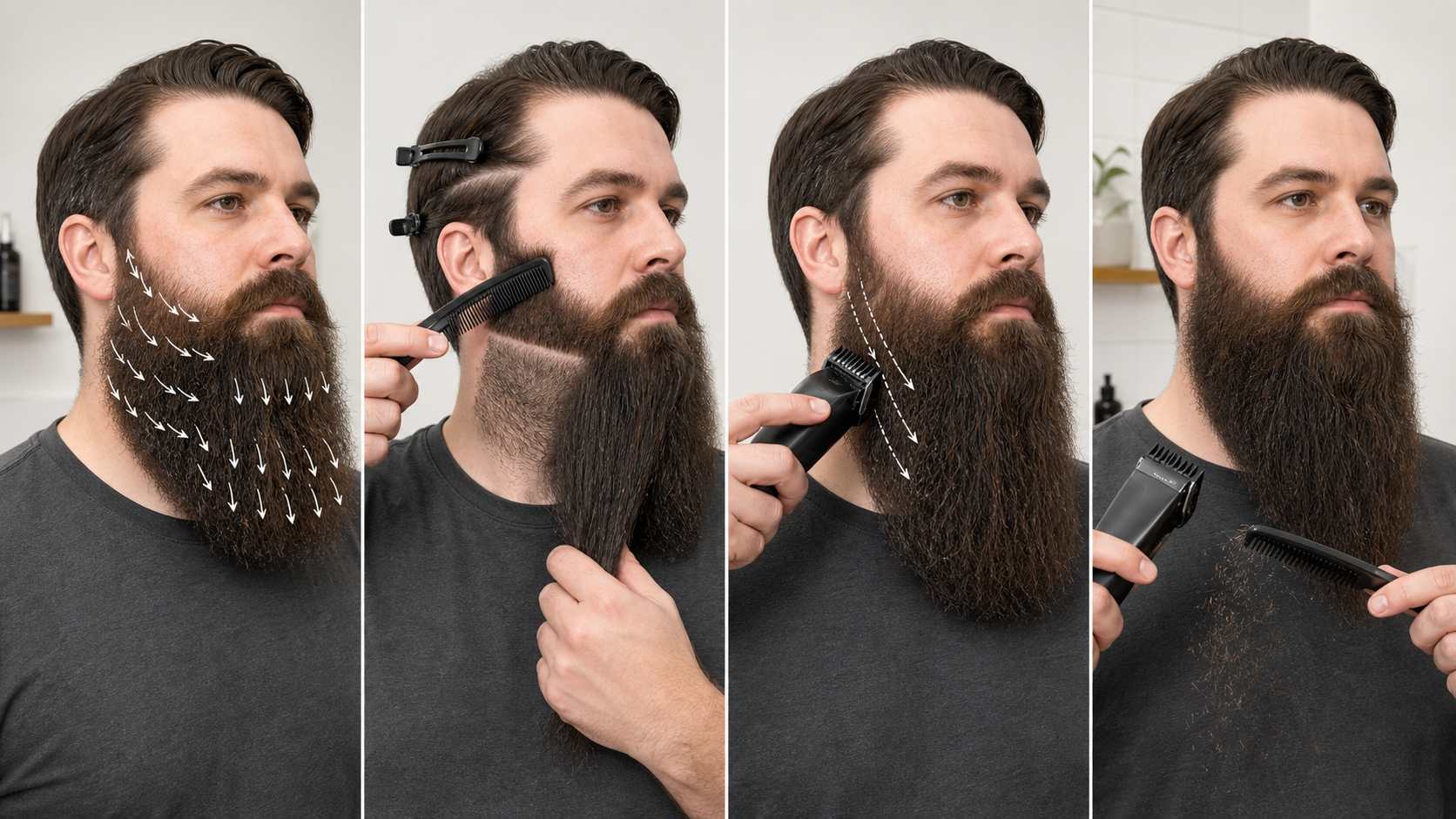
Direct answer: Trim a long beard with the grain by mapping the direction of each released outer section, protecting shorter underlayers and structural anchors, and using the longest verified compatible guard for one short visible pass in the direction that section naturally lies. Switch off, clear clippings, recomb, release, and reassess the complete shape before repeating or changing direction.
This is a conservative first-pass workflow, not a universal finishing prescription. A with-the-grain pass can preserve correction room but may leave low-lying or crossing hair longer. The exact trimmer manual controls guard identity, contact, movement, cleaning, and safety. Natural layers and the intended retained shape control which zones receive a pass.
Why Long-Beard Grain Needs Its Own Guide
Stubble grain can often be observed close to the skin. A medium beard adds visible zones and some spring-back. A long beard adds hanging outer hair that can cross the cheek, jaw, chin, and under-jaw boundaries while shorter supporting hair remains hidden beneath it. The root direction, middle curve, and released endpoint may not point the same way.
The medium-beard grain guide covers a compact zone map. This page adds outer-versus-underlayer separation, crossing-hair ownership, structural anchors, supported release, guard admission, path visibility, long-clipping loading, and full-silhouette resets. It is not a longer keyword copy of the medium-beard page.
Prepare the Natural Dry Long-Beard Shape
Complete the long-beard preparation workflow first. Remove heavy residue when needed, let roots and underlayers dry, detangle from the ends in supported sections, release hand tension, and record front, profile, three-quarter, and under-jaw views.
Do not map grain from a wet, tightly banded, heavily compressed, heat-straightened, or fully stretched beard unless a documented professional method deliberately uses that state. The useful reference is the normal dry shape you intend to wear and preserve.
Separate Root Direction From Hanging Direction
At the root, cheek hair may angle toward the jaw while its long end curves forward. Chin hair may begin forward and finish downward. Under-jaw hair can turn sideways before joining the front silhouette. Record the direction at the root, middle, and released end instead of drawing one arrow across the whole beard.
A guarded pass interacts with the hair admitted by the comb, not with an abstract face-wide arrow. When root and hanging directions differ, test only a section whose path can remain visible and whose protected layers can stay outside the guard.
Build a Zone Map Before Switching On the Tool
Divide the beard into right and left upper side panels, lower side panels, jaw corners, central chin, mustache connection, under-jaw left, under-jaw center, under-jaw right, neckline, and sideburn transitions. Add smaller zones where a swirl or direction change is visible.
Lightly stroke or comb a released section in several directions. The movement that follows the local lay with less lifting is generally with the grain. Do not use force, stretch the final length, or infer direction from one photograph. Record uncertain zones as “no pass” until they can be mapped.
Assign Crossing Hair to Its Source Zone
Long hair can hang over another zone. Lift and support one small section near its middle, trace it back to the root without pulling, and then release it. Assign that hair to the source zone even if its end contributes to another part of the silhouette.
Do not trim a crossing end as though it grows from the area beneath it. Otherwise a pass intended for a jaw section can shorten outer cheek hair or central chin hair that merely rests there.
Protect the Shorter Supporting Underlayer
Separate the visible outer layer from shorter hair underneath. The underlayer may support side width, jaw continuity, lighter-density coverage, or the connection between cheek and chin. A guard that admits both layers can remove structure even when the outer ends remain long.
The long-beard guard-choice workflow explains how to identify the shortest retained layer, inspect guard geometry, and test whether one outer section can enter without capturing protected hair. Complete that calibration before a with-the-grain pass.
Mark Structural Anchors as No-Pass Boundaries
Mark the central chin point, two jaw corners, maximum side width, mustache connection, cheek boundary, neckline, and any intentional asymmetry. These anchors define the shape. Keep them out of the first direction test unless the broader trim plan specifically assigns work there.
The long-beard length-preservation guide covers staged shape control. A direction map does not authorize shortening every anchor that projects beyond a comb.
Record the Direction and Protected Floor by Zone
| Zone evidence | Record before the pass | Reason to exclude the zone |
|---|---|---|
| Outer side panel | Root, middle curve, released endpoint, and intended path | Path crosses a shorter underlayer |
| Jaw corner | Turn between side and chin plus structural width | Direction or ownership is ambiguous |
| Central chin | Lowest point, supporting layer, and protected projection | Core anchor is not assigned for reduction |
| Under jaw | Left, center, and right grain plus neckline boundary | Cutter path cannot remain visible |
| Mustache connection | Lip clearance and link to beard body | Requires a separate tool or method |
| Lighter-density area | Coverage contribution after release | Additional cutting could expose skin contrast |
A zone is ready only when its source hair, direction, retained floor, guard, contact surface, and stop boundary are all clear.
Verify the Exact Guard and Model Instructions
Identify the complete trimmer model, cutting head, compatible guard, and documented setting. Confirm how the guard attaches, which surface contacts hair or skin, whether the manufacturer specifies a direction for guarded trimming, and how accumulated hair is cleared.
The current Philips Multigroom manual is an example of model-dependent guard types, settings, attachment instructions, and clearing steps. Its directions apply only to covered models. Do not transfer its guard range or movement instructions to another tool.
Understand the Role of a With-the-Grain Pass
Moving with the local lay can make a conservative first reduction because some low-lying hair may remain below the guard’s most effective feed path. That can preserve room for correction. It does not prove the final result is even, and it does not replace the exact model’s documented finishing direction.
The official Philips OneBlade trimming guidance tells users of covered systems to comb hair in its natural growth direction, start with a longer setting when learning, and follow product-specific movement guidance. This page uses those bounded preparation principles without claiming that every tool should cut in one direction.
Choose One Low-Visibility Outer Test Section
Select a small dense outer-side section whose extra length is not a central part of the silhouette. Keep the chin point, jaw corner, mustache connection, neckline, lighter-density patch, and hidden crossing hair outside the first test.
Record the source zone, grain path, protected floor, chosen guard, setting, starting point, end point, and planned hand position. If the route cannot be described before the tool is on, the section is not ready.
Keep the Cutter Path Visible
Arrange the mirror and head position so the guard, intended section, and stop boundary remain visible. Support adjacent long hair away from the path without stretching the test section. Do not bury a running cutter inside a dense hanging mass or work by sound alone.
Use a second mirror for the under jaw, but return to a neutral posture before judging the released shape. Extreme neck stretching can move the apparent boundary and change how hair falls.
Run the Assembled Tool Away From Hair
Install the verified guard while the tool is off and disconnected from charging power. Confirm that it sits level and holds its setting. Run the tool away from hair and stop for abnormal rattle, vibration, blade contact, speed change, heat, odor, unstable power, or guard movement.
Use the trimmer pulling guide when blade condition, cleanliness, power, lubrication, or guard fit is uncertain. A long beard should not be used to diagnose a questionable tool.
Make One Short Pass With the Mapped Grain
Place the documented guard surface as instructed for the exact model. Use light stable handling and move through only the mapped outer section in the direction its released hair lies. End before the marked structural boundary, move the tool away, and switch it off.
Do not press harder, tilt the guard, cross the jaw corner, reverse direction, or repeat the strip because little hair was removed. Those changes would introduce new variables before the first pass has been assessed.
Clear Long Clippings Before Reassessment
Long clippings can bridge across guard teeth, pack near the cutter, or remain tangled in the beard. With the tool off, clear the attachment only as the manual permits. Reconfirm the guard identity, attachment lock, and setting after any removal or cleaning.
The cleaning and oiling guide provides a generic maintenance boundary. Water exposure, brush use, blade removal, and lubrication remain model-specific.
Recomb, Release, and Reset the Whole Beard
Recomb the tested section into the normal worn direction, release all hand tension, and wait for compressed hair to settle. Clear loose hair from the beard and clothing. Compare the local section and the complete front, profile, three-quarter, and under-jaw shape with the starting record.
Ask whether the pass removed only the planned outer excess, exposed a shorter layer, narrowed an anchor, changed a density transition, or produced no observable change. Record the answer before repeating.
Distinguish Missed Hair From Protected Hair
A strand that remains longer may lie below the guard path, cross from another zone, belong to a protected underlayer, curve away from the comb, or simply be shorter than the guard setting. Do not label every remaining strand a miss.
Trace the strand to its source and release it. If it belongs to another zone or supports the retained shape, protect it. If it belongs to the tested outer section and remains above the target, decide whether the same model-compliant pass should be repeated only after the guard is clear and the complete shape is stable.
Do Not Convert a Conservative Pass Into Random Multidirectional Cutting
Random upward, downward, diagonal, and sideways passes can repeatedly load the same hair before the released result is visible. A direction change should be a separate planned step supported by the exact model instructions and the remaining zone evidence.
If the manual directs an against-growth finishing pass for the covered guard, reassess whether that step would admit protected long-beard layers. A product direction does not remove the need for layer control and visible boundaries.
Map the Under Jaw as Three or More Zones
Use left, center, and right under-jaw zones at minimum. Hair may point forward, backward, sideways, or form a swirl. Some strands rooted under the jaw contribute to the front chin shape, while others support side width or the neckline transition.
Keep the neckline separate from bulk trimming. The beard neckline guide covers placement and controlled cleanup. Do not carry an under-jaw grain pass across an established boundary.
Handle Coarse, Curly, or Easily Compressed Sections Conservatively
Coarse or curly long hair can bunch at the guard opening, spring back after release, or hide shorter layers. Use smaller supported sections, more frequent off-tool clearing, and longer reset time. Do not promise pull-free trimming or straighten the beard into a different length reference.
The curly medium-beard control guide explains spring-back and section release. Long-beard work adds hanging layer ownership and anchor protection.
Recognize When With-the-Grain Trimming Is Not Suitable
Do not proceed when the longest compatible guard is shorter than the retained floor, the intended outer section cannot enter without protected hair, the cutter path is hidden, the guard requires heavy compression, or the model instructions do not support the planned contact and movement.
Scissors-over-comb, freehand clipper work, and professional shaping are different methods with different skill and safety requirements. They are not improvised extensions of this guarded workflow.
Common Long-Beard Grain Errors
- Treating “downward” as with the grain across every face and neck zone.
- Mapping only the visible ends and ignoring root direction.
- Trimming crossing hair as though it grows from the zone beneath it.
- Admitting shorter supporting layers with the outer section.
- Testing first on the central chin, jaw corner, mustache, or lighter-density area.
- Using one setting and direction across the complete beard.
- Repeating passes before clearing, recombing, releasing, and comparing.
- Pressing harder when a with-the-grain pass removes little hair.
- Changing direction without a separate documented plan.
- Continuing when clippings obscure the guard or cutter path.
Repeatable Long-Beard With-the-Grain Sequence
- Prepare and record the natural dry long-beard shape.
- Map root, middle, and released-end direction by zone.
- Trace crossing hair back to its source zone.
- Separate outer hair from protected shorter underlayers.
- Mark structural anchors and no-pass boundaries.
- Verify the exact model, head, guard, setting, and movement instructions.
- Select one low-visibility outer test section.
- Arrange a visible cutter path and protect adjacent hair.
- Run the assembled tool away from hair.
- Make one short model-compliant pass with the mapped grain.
- Switch off and clear the guard and loose clippings.
- Recomb, release, and compare the complete shape.
- Classify remaining hair before repeating or changing direction.
Stop Conditions
Stop when the section, grain, retained floor, guard identity, setting, contact surface, or boundary is uncertain; the attachment is loose, cracked, bent, packed, or unable to hold its setting; or the tool rattles, stalls, pulls, smells abnormal, overheats, or loses power.
Also stop when the guard captures protected hair, the cutter path disappears, repeated passes change an anchor, or skin is painful, broken, bleeding, swollen, or actively irritated. This page does not diagnose skin or hair conditions.
Frequently Asked Questions
What does trimming a long beard with the grain mean?
It means moving through one mapped zone in the direction its released hair naturally lies. The direction can change across the cheek, jaw, chin, and under jaw, so one downward stroke is not automatically with the grain everywhere.
Will a with-the-grain pass make a long beard even?
Not necessarily. A with-the-grain pass can make a conservative first reduction while leaving low-lying or crossing hair longer. Clear the guard, recomb, release the beard, and follow the exact model instructions before deciding whether another direction is appropriate.
Should every long-beard layer receive the same pass?
No. Hanging outer hair, shorter supporting underlayers, the central chin, jaw corners, mustache, and under-jaw sections can have different directions and structural roles. Protect anchors and assign a path only to the mapped layer and zone.
When should I stop a with-the-grain long-beard trim?
Stop when the guard captures a protected layer, the cutter path is hidden, hair packs into the attachment, the guard shifts, the tool pulls or behaves abnormally, or the released shape changes beyond the planned test zone.
Sources and Claim Boundary
Primary references reviewed in July 2026 are the linked Philips OneBlade support page and current Philips Multigroom manual. They support combing in natural growth direction for covered workflows, exact-model guard identification, longer-setting familiarization, secure attachment, gentle movement, and clearing accumulated hair.
This page applies those bounded principles to a generic layered long-beard with-the-grain first-pass workflow. It reports no hands-on testing, defines no universal direction, guard, pressure, pass count, or finishing method, and does not guarantee comfort, symmetry, density, growth, cutting performance, or a particular result. The exact model manual and the natural released beard control.