Disclosure: This site may use affiliate links. Product specifications should be checked against manufacturer or retailer pages before purchase.
Editorial update, June 20, 2026: This recovered page was rebuilt as a practical men's grooming, barber workflow, and cleanup guide using restored or current site media. It avoids fake testing, live commercial data, shop visit claims, medical promises, and affiliate language.
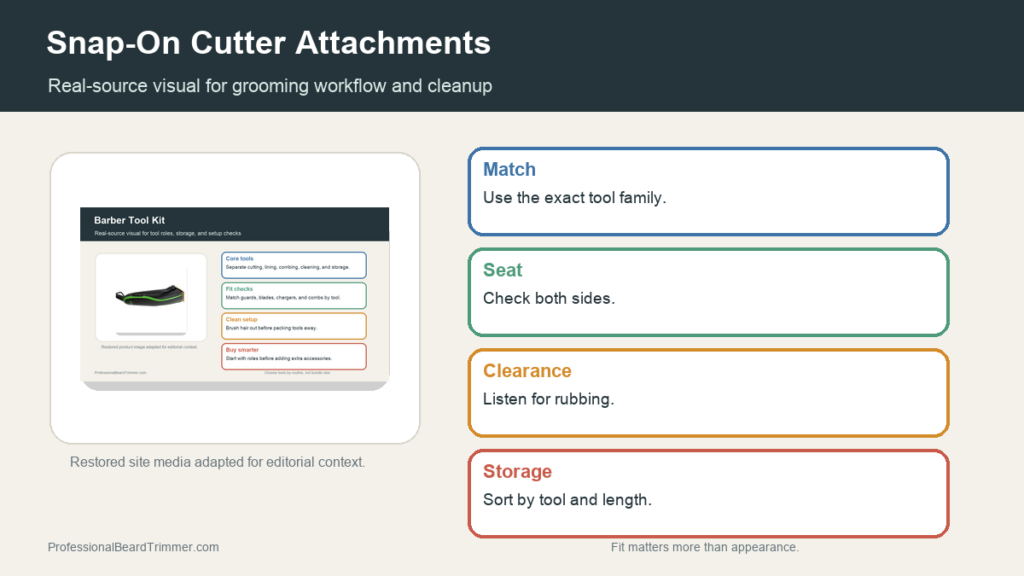
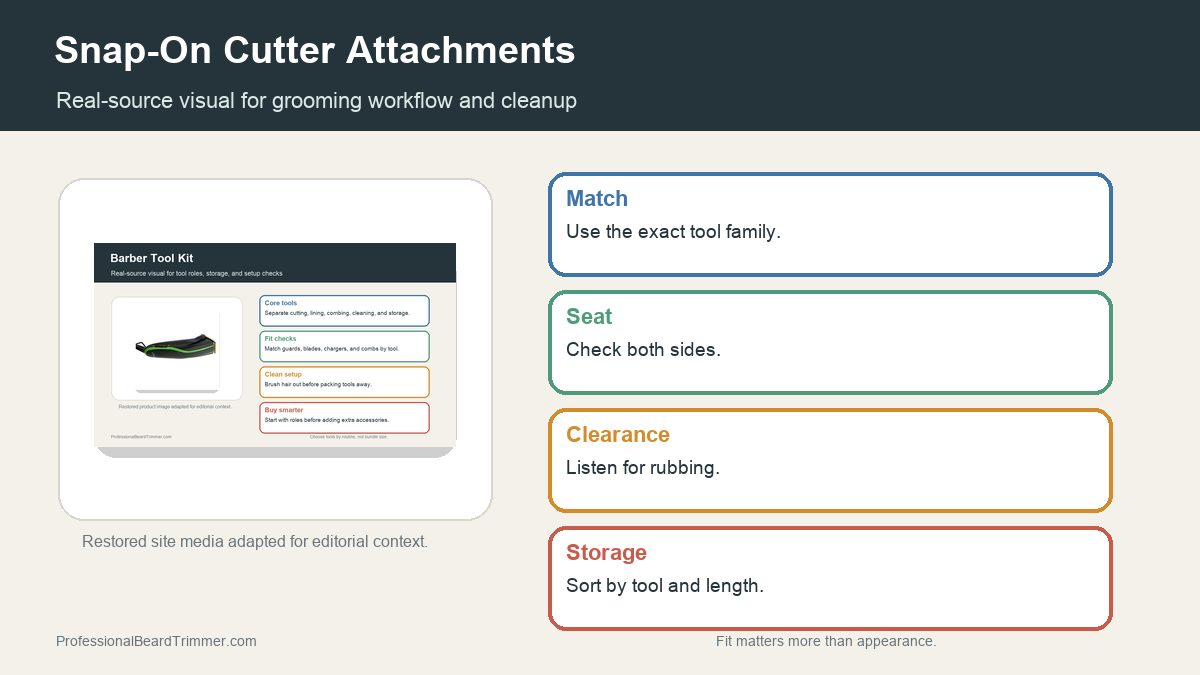
Image note: The image uses restored barber tool media for editorial context. It does not claim universal compatibility or official brand guidance.
Direct answer: Snap-on cutter attachments are useful only when they fit the exact clipper or trimmer securely. Before using one near a beard line, neckline, or haircut edge, check the model match, attachment seating, blade clearance, hair buildup, and whether the piece stays stable during a light pass.
Snap-on cutter attachment checks
| Check | What to do | Why it matters |
|---|---|---|
| Exact tool match | Use attachments made for the clipper or trimmer family | Similar-looking tools can have different mount shapes |
| Secure seating | Press the attachment on and check for rocking or lifting | Loose pieces can change the cutting length |
| Blade clearance | Confirm the cutter does not contact the guard or attachment | Poor clearance can cause noise, drag, or damage |
| Hair buildup | Brush trapped hair from the blade and attachment | Packed hair makes cutting less predictable |
| Storage | Keep attachments sorted by tool and length | Organization prevents mismatched pieces during a trim |
How to check a snap-on attachment before trimming
- Match the attachment to the tool. Read the tool label and avoid using a piece that only appears close enough.
- Seat it fully. Attach the piece and check that both sides sit evenly.
- Check blade movement. Power the tool briefly away from hair and listen for rubbing, drag, or unusual vibration.
- Use a light first pass. Test on a less visible area before cutting near a neckline, beard edge, or hairline.
- Clean before storage. Brush hair from the attachment and keep it with the matching tool or guard set.
Snap-on cutter checklist
- Model match: Prevents unsafe or uneven accessory use.
- Stable fit: Keeps length and edge control predictable.
- Clean channel: Reduces drag around the cutter and blade.
- Sorted storage: Makes the next trim faster and cleaner.
For related reference pages, compare the Wahl combs guide, the Andis guard fit guide, and the barber tool kit guide.
Frequently asked questions
Are snap-on cutter attachments universal?
No. Fit depends on the exact clipper or trimmer family, mount shape, blade size, and guard design.
What is the first thing to check?
Check that the attachment seats securely on both sides and does not rock, lift, or touch the moving blade.
Why can an attachment make a clipper drag?
Dragging can come from poor fit, trapped hair, blade contact, weak power, or using the attachment on hair that should be reduced first.
How should attachments be stored?
Store attachments clean, dry, and sorted by matching tool or length so they are not mixed with incompatible guards.