Disclosure: This site may use affiliate links. Product specifications should be checked against manufacturer or retailer pages before purchase.
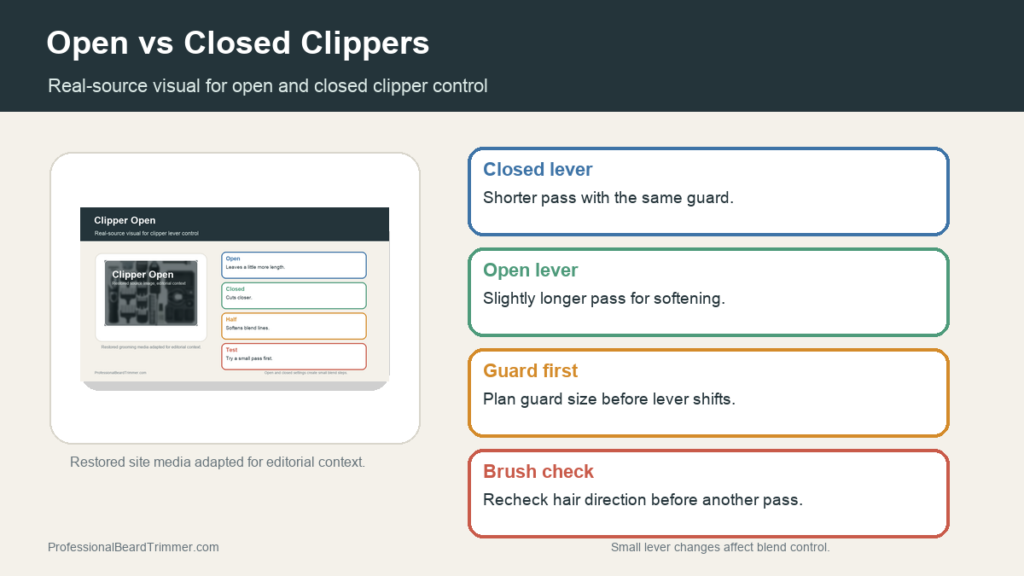
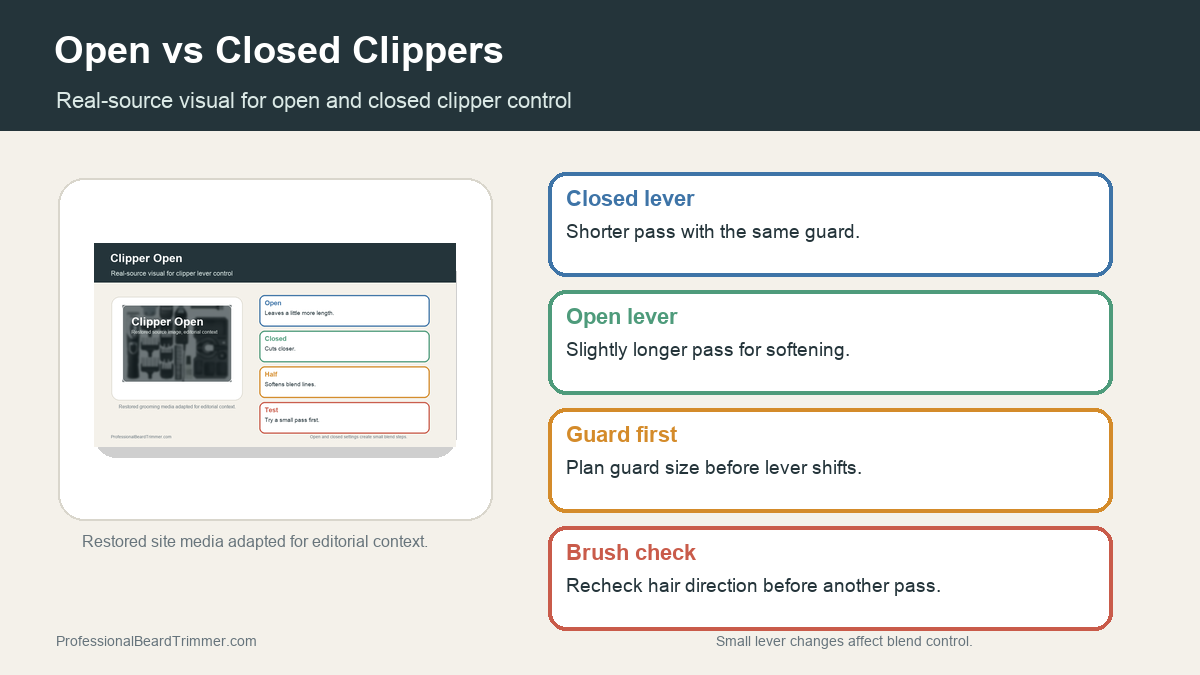
Direct answer: Open and closed clipper positions refer to the taper lever. A closed lever cuts shorter, an open lever leaves slightly more length, and the final result depends on the guard, hair density, cutting direction, pressure, and the number of passes.
For one manufacturer example, Wahl describes its lever down/open as a longer cut and up/closed as a closer cut, with about a 1/16-inch change on the models covered by its guide. Lever direction and the amount of change are not universal; use your clipper’s labels and manual. For beard-trimmer guard numbers, see the guard-size guide.
Open vs closed clipper checks
| Check | What to do | Why it matters |
|---|---|---|
| Closed lever | Use for a shorter pass with the same guard | It removes more length and can sharpen a transition |
| Open lever | Use for a slightly longer pass with the same guard | It helps soften lines during blending |
| Guard pairing | Judge lever position together with guard size | A lever change is smaller than a guard change |
| Pressure | Keep pressure light and consistent | Pushing harder can create uneven patches |
| Check passes | Brush hair down and recheck before changing settings | Hair can lift or hide uneven areas during blending |
How to control a clipper lever
- Start with the guard plan. Choose the guard first, then decide whether the lever should be open, halfway, or closed.
- Use the open setting to soften. Open the lever when a line needs a slightly longer transition.
- Close gradually. Close the lever in small steps when a shorter cleanup pass is needed.
- Brush and inspect. Brush hair back into place before deciding whether another pass is needed.
- Avoid chasing one spot. Stop and reassess if repeated passes start making the area shorter than planned.
Lever control checklist
- Guard size: Sets the main length range.
- Lever position: Fine-tunes that range for blending.
- Light pressure: Keeps cutting more even.
- Brush check: Reveals hidden lines before another pass.
For related reference pages, compare the clipper open guide, the lever open vs closed guide, and the clipper sound troubleshooting guide.
Frequently asked questions
What does open and closed mean on clippers?
It usually means the taper lever position. Closed cuts shorter with the same guard, while open leaves slightly more length.
Should beginners start open or closed?
Beginners should usually start longer, then close the lever gradually after checking the result. This lowers the chance of cutting too short too quickly.
Does the lever replace clipper guards?
No. The guard sets the main length range, while the lever fine-tunes that range for blending and cleanup.
Why do lever changes still leave lines?
Lines can remain because of pressure, guard mismatch, hair direction, poor brushing between passes, or trying to blend too much with one setting.