Disclosure: This site may use affiliate links. Product specifications should be checked against manufacturer or retailer pages before purchase.
Editorial update, June 19, 2026: This recovered page was rebuilt as a practical grooming-tool guide using restored old-site media. It does not claim hands-on lab testing, current manufacturer specifications, offers, or availability.
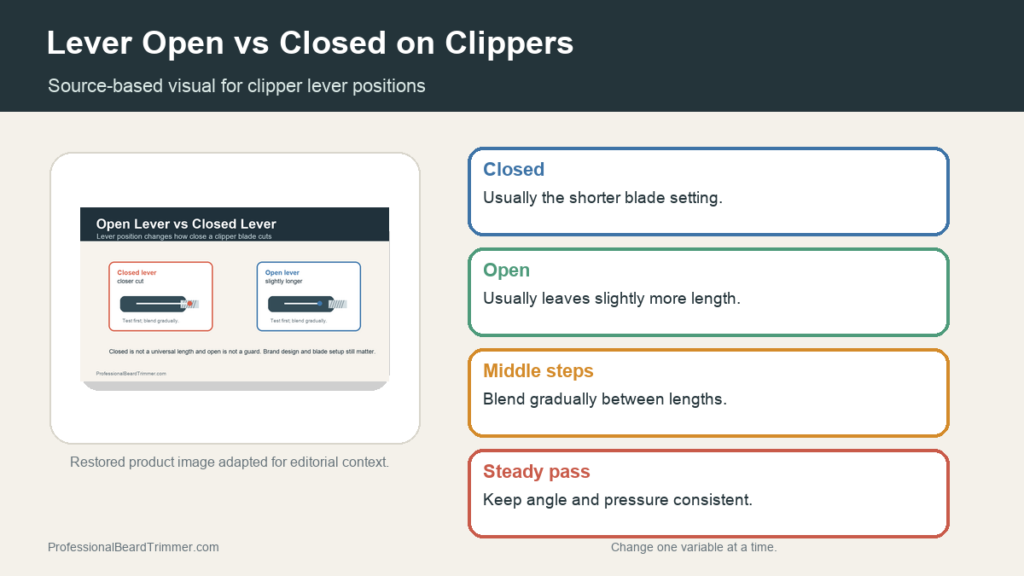
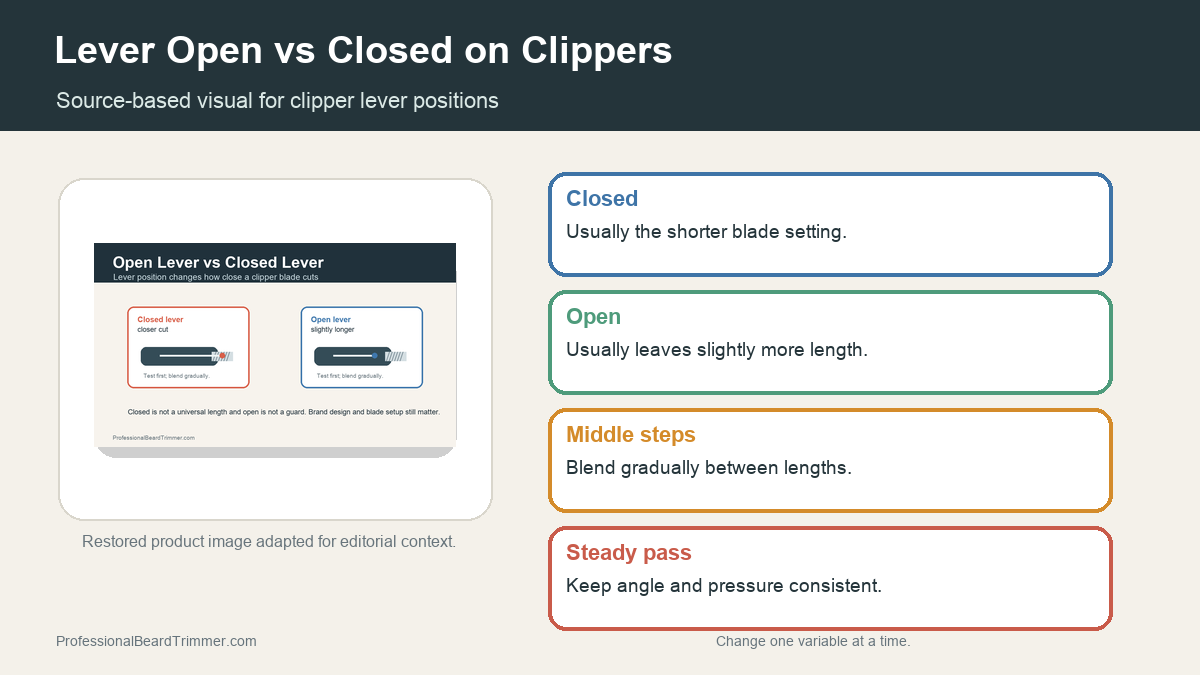
Image note: The image is a site-owned explanatory visual. It gives lever-position context and should not be treated as proof of any exact clipper length.
Direct answer: A closed clipper lever usually cuts shorter, while an open lever leaves slightly more length. In a taper or fade, the lever gives small blending steps between guard lengths; use it gradually, keep pressure light, and avoid changing both guard and lever at the same time without a plan.
Open vs closed clipper lever checks
| Check | What to do | Why it matters |
|---|---|---|
| Closed lever | Use for the shorter end of the blade range | It can tighten a blend or cleanup pass |
| Open lever | Use for a slightly longer pass | It softens lines between guard lengths |
| Middle positions | Use small lever moves between open and closed | Gradual steps reduce harsh lines |
| Guard pairing | Know whether the guard is being used open or closed | Changing both at once can confuse the blend |
| Pressure | Keep pressure steady and light | Heavy pressure can create uneven patches |
How to use the clipper lever for blending
- Choose the guard first. Start with the guard or blade length that matches the section of the haircut.
- Start longer. Use an open lever or longer guard before moving shorter on a visible area.
- Blend in small steps. Move the lever gradually instead of jumping from fully open to fully closed.
- Use consistent pressure. Keep the clipper angle and pressure steady during each pass.
- Check before shortening. Brush away loose hair and look at the blend before taking another shorter pass.
Clipper lever checklist
- Closed setting: Shorter blade position for tightening a section.
- Open setting: Longer blade position for softening a blend.
- Middle steps: Small changes help remove visible lines.
- Steady pressure: Keeps the pass predictable.
For related reference pages, compare the clipper lever guide, the open vs closed clippers guide, and the taper blade guide.
Frequently asked questions
Is open or closed shorter on clippers?
Closed is usually shorter and open is usually slightly longer. The exact difference depends on the clipper, blade, and how the lever is built.
When should I use the open lever?
Use the open lever when you want a slightly longer pass or need to soften the line between two guard lengths.
When should I use the closed lever?
Use the closed lever for a shorter pass after you have checked the area and know that tightening the blend will not cut too much.
Why do lever changes leave lines?
Lines can appear when the guard, lever, angle, pressure, or section changes too quickly. Move in small steps and brush the area before cutting shorter.