
Disclosure: This site may use affiliate links. Product specifications should be checked against manufacturer or retailer pages before purchase.
Editorial update, June 19, 2026: This recovered page was rebuilt as a practical haircut design and clipper-control guide using restored or current site media. It avoids hands-on test claims, live shopping data, score claims, medical claims, identity stereotypes, and unapproved affiliate language.
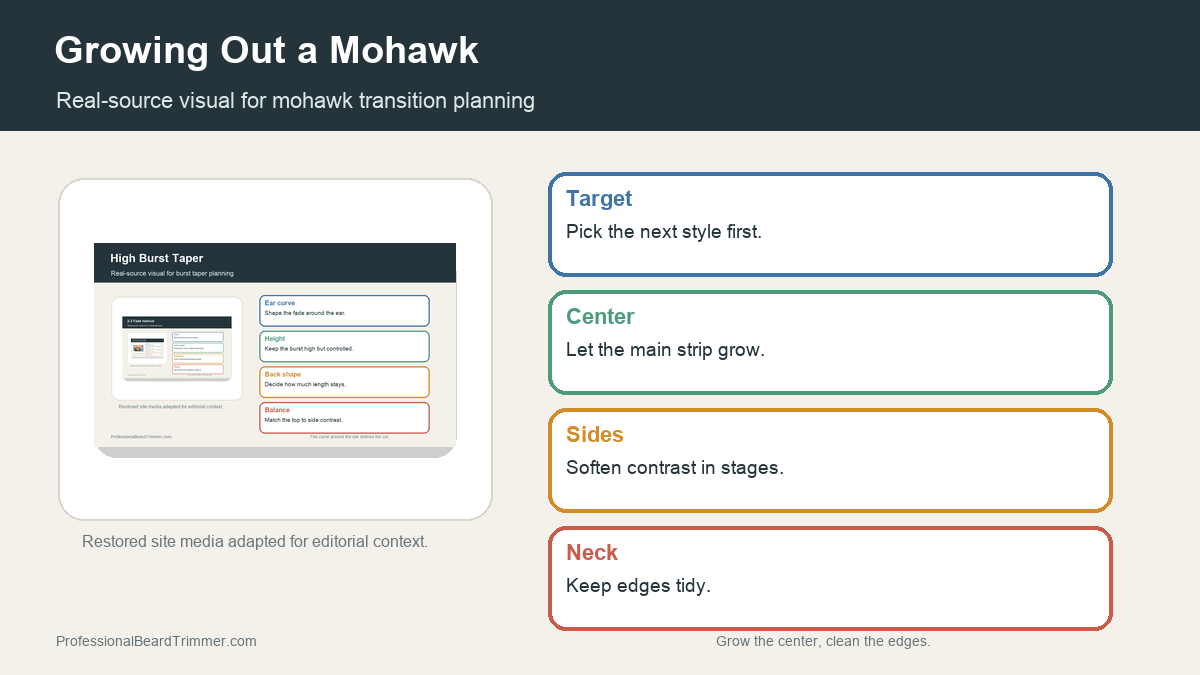
Image note: The image gives mohawk and taper transition context from restored site media. It is not a claim about a specific cut performed by this site.
Direct answer: Growing out a mohawk is easiest when the center strip is left alone, the sides are softened gradually with taper control, and the neckline is cleaned regularly so the haircut looks intentional through the awkward stage.
Mohawk grow-out checks
| Check | What to do | Why it matters |
|---|---|---|
| Center length | Avoid cutting the main strip too often | The center needs time to catch up with future styles |
| Side taper | Soften the contrast in stages | Gradual side growth looks cleaner than an abrupt shelf |
| Neckline | Keep the neck and lower edges tidy | Clean edges make the grow-out look planned |
| Transition cut | Choose a burst fade, taper, faux hawk, or textured crop step | A named transition helps with barber communication |
| Product control | Use light hold to guide uneven lengths | Heavy product can make the awkward stage look stiff |
How to grow out a mohawk without losing shape
- Decide the next target style. Choose whether the mohawk is moving toward a faux hawk, textured crop, taper, or longer top.
- Leave the center length. Trim only split or uneven ends instead of repeatedly shortening the strip.
- Blend the sides gradually. Use taper or guard changes to reduce contrast without cutting the top back down.
- Clean the neckline. Keep the neck tidy so the grow-out still looks intentional.
- Use light styling control. Guide uneven sections with light product and avoid forcing the hair into a stiff shape.
Mohawk transition checklist
- Target style: Gives the grow-out a clear direction.
- Protected center length: Prevents restarting the growth timeline.
- Gradual side blend: Keeps the haircut wearable between cuts.
- Clean neckline: Makes the transition look maintained.
For related reference pages, compare the fade mohawk guide, the burst fade mullet guide, and the haircut consultation guide.
Frequently asked questions
What is the best way to grow out a mohawk?
Keep the center length growing, soften the side contrast gradually, and maintain the neckline so the haircut looks intentional between transition cuts.
Should the sides be shaved while growing out a mohawk?
Not usually. Re-shaving the sides keeps the mohawk shape longer, while gradually tapering the sides helps the cut move toward a more blended style.
What haircut can a mohawk grow into?
A mohawk can transition into a faux hawk, burst fade, textured crop, taper, mullet-inspired shape, or longer layered top depending on length and hair texture.
How do you handle the awkward stage?
Use light product, keep the neckline clean, schedule small taper updates, and avoid cutting the center strip every time the sides feel uneven.