
Disclosure: This site may use affiliate links. Product specifications should be checked against manufacturer or retailer pages before purchase.
Direct Answer
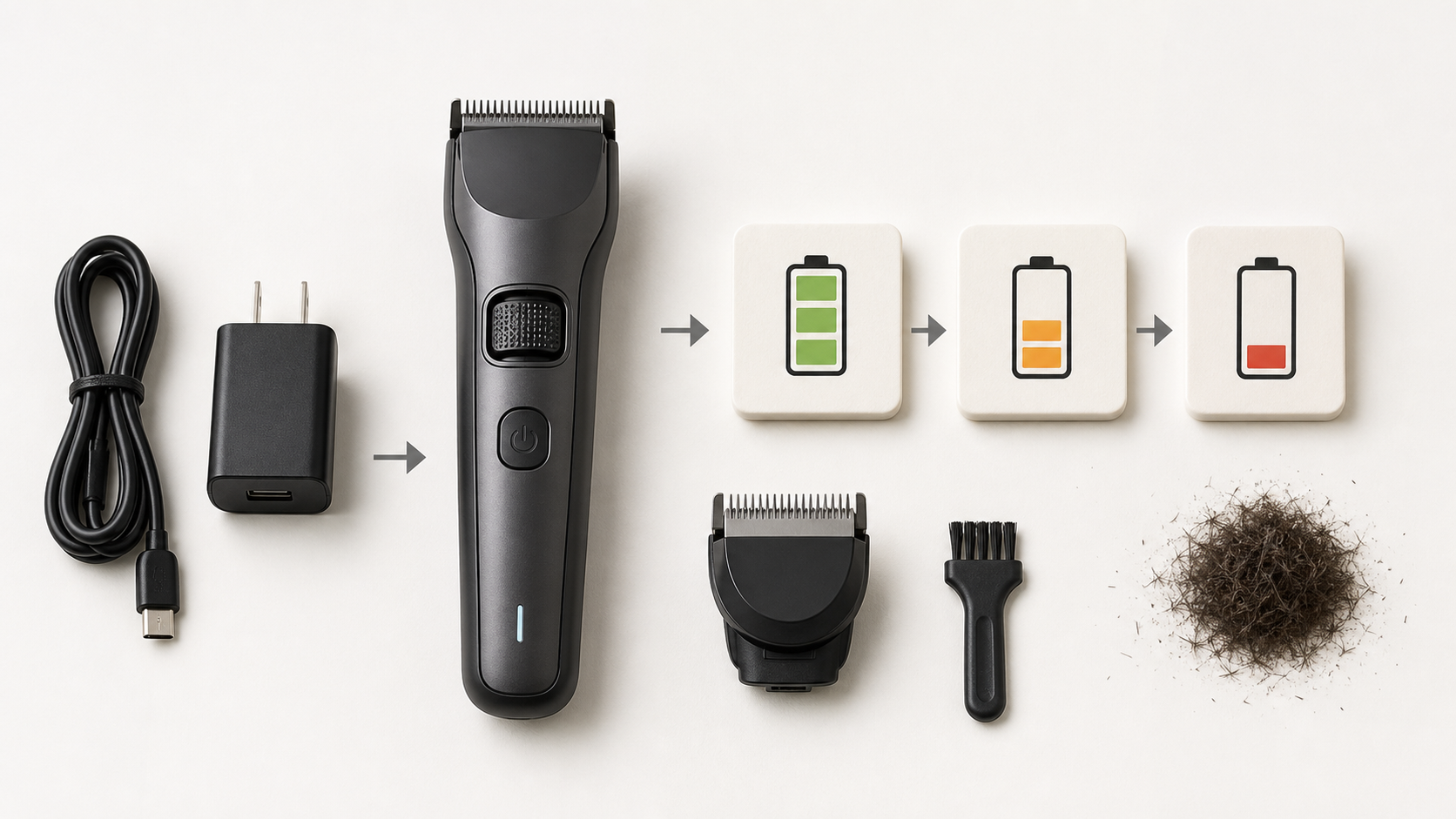
Direct answer: When a beard trimmer battery drains quickly, fully charge it with the exact approved charger, clean out hair and debris, follow the model’s blade-oiling rule, and compare runtime across similar sessions. Stop for heat, swelling, odor, leakage, or damaged charging parts. If runtime remains sharply reduced after repeatable checks, use manufacturer service rather than opening a sealed handle.
“Draining quickly” needs a repeatable comparison. A long pass through dense growth, a short edge cleanup, and leaving the motor running between passes place different demands on the tool. Establish what changed before deciding that the battery itself has failed.
Quick Battery-Drain Checklist
| Check | What to record | Next step |
|---|---|---|
| Model and charger | Complete model, approved charger, indicator pattern | Use the exact manual and charging method |
| Full charge | Starting indicator and documented charge period | Do not compare a partial charge with a full one |
| Cutting load | Hair length, density, guard, and session type | Repeat with a similar workload |
| Blade resistance | Packed hair, debris, pulling, heat, or changed sound | Clean and oil only as the manual allows |
| Storage history | Long storage, temperature exposure, charger condition | Inspect before charging or operating |
| Stop signs | Swelling, odor, leakage, excess heat, or damage | Stop use and contact the proper support route |
1. Identify the Exact Power System
Read the complete model number and regional suffix from the rating plate, packaging, or official support record. Similar-looking trimmers can use different battery types, chargers, indicator patterns, charging times, quick-charge features, corded-use rules, and water restrictions. Use the manual for that exact identity rather than a generic runtime claim.
Confirm whether the tool has a sealed rechargeable battery, a manufacturer-removable battery, disposable cells, or true corded operation. A rechargeable tool is not automatically designed to run while connected to power. The corded versus cordless trimmer guide explains the distinction, but the model manual controls actual operation.
Write down the normal indicator sequence and the advertised runtime only when it comes from the official page for the exact model. Treat that runtime as a model-specific reference under stated conditions, not a promise for every beard, blade condition, battery age, or session.
2. Start From a Verified Full Charge
Use the original undamaged charger or a manufacturer-approved replacement. Confirm a working outlet, seat the plug normally, and follow the documented charging period. Do not force a poor-fitting connector or assume that a brief indicator flash means a full charge. If fit is unstable, use the loose charger checklist before continuing.
The current Philips groomer charging guide tells owners of its listed models to use a dry charging setup, insert the correct plug fully without force, observe the charging indicator, and consult the model manual for charging time. This is a useful manufacturer example, not a universal charger or timing specification.
After the documented full charge, disconnect power if the manual requires cordless operation. Note the starting indicator and avoid changing several variables at once. If the tool does not accept charge or the indicator never behaves as the manual describes, switch to the trimmer-not-charging checks rather than repeatedly cycling the battery.
3. Make Runtime Comparisons Repeatable
Compare similar sessions, not calendar time. Record the starting charge, approximate motor-on time, guard or attachment, hair length and density, number of passes, and ending indicator. Pause the motor while changing guards or inspecting the line. A tool left running on the counter can appear to lose charge faster even though the battery behavior has not changed.
Use two or three ordinary sessions only when the tool has no stop signs. Do not deliberately run a lithium battery to shutdown, stall the blade in hair, or perform a long stress run. The goal is to determine whether usable runtime is consistently lower under comparable normal use, not to create a laboratory battery test.
Hair that is longer, thicker, denser, damp, or tangled may require more passes and motor time. Philips notes in its current battery-runs-out-quickly support page that thicker or denser hair can require more cutting power on the Philips models covered by that article. Apply the principle cautiously and do not transfer a specific Philips runtime to another tool.
4. Remove Blade Resistance
Switch the trimmer off and disconnect charging power. Remove only user-removable guards or heads according to the manual. Packed hair, skin debris, dried product, a misseated attachment, or a damaged cutter can add resistance. The same Philips support page states that accumulated hair and debris can make its groomers work harder and use more power.
Clean using the exact dry or rinse method allowed for the model. A washable head does not prove that the handle, charging port, or every attachment can be rinsed. Let approved parts dry as directed before reassembly and charging. The beard trimmer cleaning and oiling guide gives a conservative sequence for separating dry debris removal, water rules, and lubrication.
Check the model’s oil requirement. Some cutters need a small amount of approved oil; other systems specify no oil. Too little lubrication where required can increase friction, while applying oil to a no-oil or foil system can create another problem. Never oil charging contacts or the battery compartment.
After cleaning and correct reassembly, listen for a changed sound and check whether the blade moves freely without touching the teeth. Stop if the tool pulls hair, stalls, becomes unusually hot, or the head will not seat. Those symptoms need blade, attachment, or service troubleshooting before another battery comparison.
5. Review Storage and Temperature Exposure
If the problem appeared after storage, inspect the tool and charger before applying power. Look for a tightly bent cable, mixed-up adapter, dust, corrosion, moisture, cracked housing, pest damage, swelling, or residue. Do not charge a device that is visibly damaged, wet inside the port, deformed, or giving off an odor.
Bring a very cold or hot trimmer back to the operating and charging conditions specified by its manual before use. Do not accelerate warming with a heater, hair dryer, direct sun, or hot water. Avoid leaving the tool in a parked vehicle or another location with extreme temperature swings.
A long-stored rechargeable battery may no longer deliver the same usable runtime it once did, but runtime alone does not identify the failed component. Charger condition, contact stability, blade load, storage history, and battery age all need to be separated before choosing repair or replacement.
6. Separate Battery Aging From Other Faults
A consistent pattern is more informative than one short session. If the trimmer begins from a verified full charge, runs a comparable load, has a clean correctly assembled cutting system, and repeatedly stops much earlier than its own recent baseline, battery aging or an internal electrical fault becomes more plausible.
Braun’s current Beard Trimmer 5 and All-in-One Trimmer 5 support page advises owners reporting rapid drain or failure to charge to first use the original charger and allow enough time for a full charge, then follow the device-specific troubleshooting path. This supports the order of checks here without diagnosing another model.
Do not infer battery health from motor sound alone, a single indicator bar, or adapter warmth. Displays use different logic, and a dragging blade can change sound without proving an electrical fault. Record the exact behavior and provide it to manufacturer support.
7. Decide Between Service and Replacement
Contact the manufacturer or an authorized service provider when the correct full charge, normal connection, allowed cleaning, correct lubrication, and repeatable-use comparison do not restore expected behavior. Provide the complete model, serial information if requested, charger part number, indicator pattern, storage history, and the checks already completed.
Do not open a sealed handle or attempt to replace a rechargeable battery unless the manufacturer explicitly documents a user-replacement procedure for that exact model. Braun’s current help center, for example, recommends authorized service-center battery replacement for Braun devices. Opening a sealed tool can damage insulation, moisture protection, battery wiring, or fire-safety controls.
Compare authorized service cost, supported replacement parts, tool age, blade and guard availability, warranty status, and the condition of the charger and housing. The beard trimmer buying guide includes repairability and replacement-support questions. Dispose of an unusable battery-powered tool through the manufacturer or local battery and electronic-waste route, not household trash where prohibited.
Stop Conditions
- Swollen, bulging, split, leaking, or deformed handle or battery compartment.
- Unusual heat, smoke, sparks, buzzing, chemical odor, or burning smell.
- Cracked charger, exposed wire, scorched plug, loose port, or repeated charging dropouts.
- Water or cleaning liquid in a charging opening or non-washable housing.
- A blade that stalls, pulls, binds, sounds abnormal, or becomes unusually hot.
- A battery or charger identity that cannot be verified for the exact model.
Switch the tool off and disconnect it when that can be done safely. Keep it away from combustible clutter and follow manufacturer support plus local battery-disposal guidance. Do not puncture, crush, heat, freeze, short, or open the battery.
Frequently Asked Questions
Why does my beard trimmer battery drain so quickly?
First confirm a full model-specific charge, then remove allowed hair and debris, check whether the blade needs model-approved oil, and compare repeatable sessions. Dense hair, blade resistance, charging faults, battery age, or an internal fault can all affect usable runtime.
Can a dirty blade reduce beard trimmer runtime?
Yes. Philips states that accumulated hair and debris can add resistance and make a groomer motor use more power. Clean only as the exact model manual permits, because water and oil rules differ.
Should I replace the battery myself?
Not unless the manufacturer explicitly provides a user-replacement procedure for the exact model. Many rechargeable trimmers have sealed batteries; use the authorized service and disposal route instead of opening the handle.
When should I stop using a fast-draining trimmer?
Stop for swelling, deformation, leakage, unusual heat, smoke, sparks, chemical or burning odor, cracked housing, damaged charging parts, or sudden abnormal behavior. Disconnect it when safe and follow manufacturer support and local battery guidance.
Claim and Safety Boundary
This page provides general first-check troubleshooting and does not diagnose a battery, certify runtime, report product testing, or authorize internal electrical work. The exact model manual and manufacturer support route control charger compatibility, charging time, indicator meaning, cleaning, lubrication, water exposure, battery service, transport, and disposal.