
Disclosure: This site may use affiliate links. Product specifications should be checked against manufacturer or retailer pages before purchase.
Editorial update, June 18, 2026: This recovered page was rebuilt as a replacement and troubleshooting guide for guard fit problems.
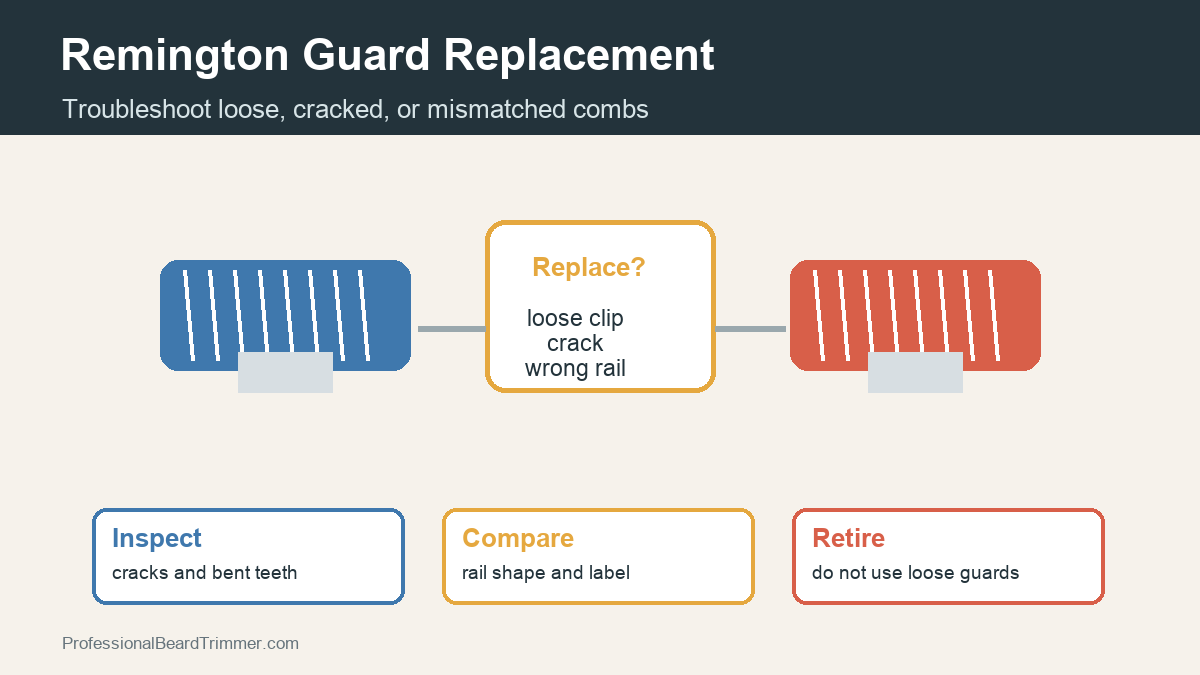
Direct answer: For Remington clipper guards, replacement is usually safer than reuse when the guard has cracked teeth, a loose clip, warped rails, or an unreadable label. Compare the old and new guard shape before trimming, then make a short test pass to confirm it does not slide, rock, or pull.
Replacement troubleshooting table
| Decision point | Use this rule | Why it matters |
|---|---|---|
| Loose clip | Do not use for a visible pass | The guard can move while cutting |
| Cracked teeth | Replace the guard | Broken teeth can catch hair or skin |
| Wrong rail shape | Compare side channels before use | A guard may look close but still fit poorly |
| Missing label | Set aside unless length is known | Unknown length makes planning unreliable |
| First use | Test lightly before full trimming | A short check catches fit problems early |
How to check a replacement guard
- Compare the old guard. Check rail shape, clip position, tooth spacing, and the printed mark.
- Inspect the new guard. Look for shipping cracks, bent teeth, or weak clip tension.
- Seat it gently. Install without forcing; a forced fit usually means the wrong shape.
- Try a short pass. Use light pressure and stop if the guard rocks, rattles, or pulls.
- Label storage. Keep replacement guards sorted so the same issue does not repeat.
Replacement checklist
- Rail match: The side channel should align cleanly with the tool head.
- Clip tension: A stable clip keeps the guard from moving mid-pass.
- Readable mark: A clear label supports repeatable length choices.
- Retirement rule: Cracked, warped, or loose guards should be replaced.
For related reference pages, compare the Remington guard length-planning guide, the trimmer guard fit guide, and the clipper bag organization guide.
Frequently asked questions
When should I replace a Remington clipper guard?
Replace it when teeth are cracked, the clip is loose, the rail is warped, or the label is no longer clear enough for safe length planning.
Can two similar guards fit differently?
Yes. Small differences in rail shape or clip position can change fit, even when two guards look similar.
For broader guard sizing and fit context, see the beard-trimmer guard sizes guide.
What should a secure guard feel like?
It should seat flat, resist side-to-side rocking, and stay in place during a light pass.
How should replacement guards be stored?
Store them by tool family and length label, away from damp tools and loose metal items that can bend teeth.