Disclosure: This site may use affiliate links. Product specifications should be checked against manufacturer or retailer pages before purchase.
Editorial update, June 18, 2026: This recovered page was rebuilt as a guard length-planning guide and avoids universal size assumptions.
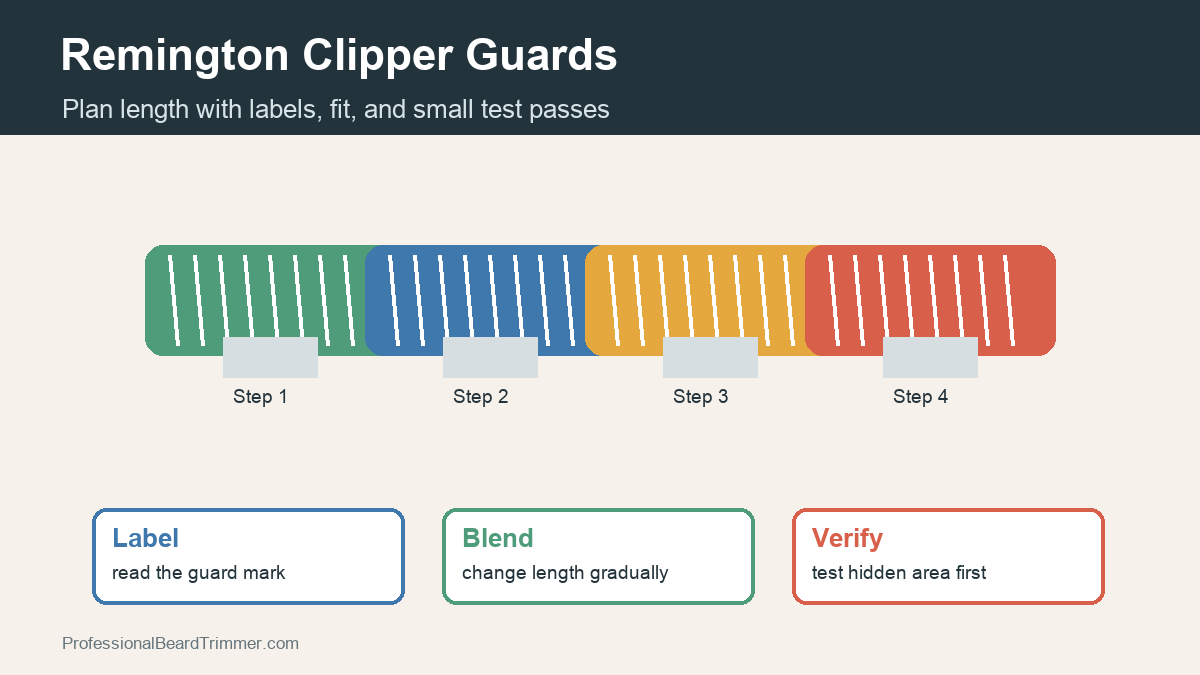
Direct answer: Remington clippers guards should be checked for exact fit, readable length labels, stable clip tension, and gradual length changes. Do not assume one guard system matches every tool. Start with a longer guard, make a small test pass, and move shorter only after the guard stays secure.
Remington guard planning table
| Decision point | Use this rule | Why it matters |
|---|---|---|
| Fit | Match the guard to the clipper head | A loose guard can create uneven patches |
| Length label | Read the number or measurement on the guard | Labels reduce guesswork before the first pass |
| Blend order | Move between nearby lengths | Large jumps can leave harsh lines |
| Pressure | Use light, even passes | Pressing hard can change the cut feel |
| Recheck | Brush hair away before going shorter | Loose hair can hide the true line |
How to plan a trim with guards
- Sort guards first. Lay guards in length order and set aside cracked or loose pieces.
- Install the longest reasonable guard. Begin longer than the final goal when you are unsure.
- Test the fit. Make one light pass where a small correction will not be obvious.
- Shorten gradually. Change one step at a time and brush hair away between passes.
- Finish with detail work. Use edging or cleanup tools only after the main length is even.
Length planning checklist
- Sorted guards: Keep labels visible before starting the trim.
- Stable clip: The guard should not slide or rock during a light pass.
- Gradual steps: Small length changes make blending easier.
- Good light: Check the line before deciding to cut shorter.
For related reference pages, compare the Remington replacement guard checklist, the guard size explainer, and the open vs closed clipper guide.
Frequently asked questions
Do Remington clipper guards use one universal fit?
No. Fit can vary by clipper or trimmer family. Confirm the exact attachment style before trimming.
Which guard should I start with?
Start longer than the final look, especially on a beard or visible haircut area. You can shorten in steps after checking the result.
Why does a guard leave lines?
Lines can come from a large length jump, heavy pressure, hair not being brushed away, or a guard that is not fully seated.
Should I use a loose guard for one quick pass?
No. A loose guard can shift while cutting and create uneven spots. Replace or refit it before use.