Disclosure: This site may use affiliate links. Product specifications should be checked against manufacturer or retailer pages before purchase.
Editorial update, June 18, 2026: This recovered page was rebuilt as a practical trimmer-guard fit guide with a neutral diagram, direct answer, safe process, and FAQ.
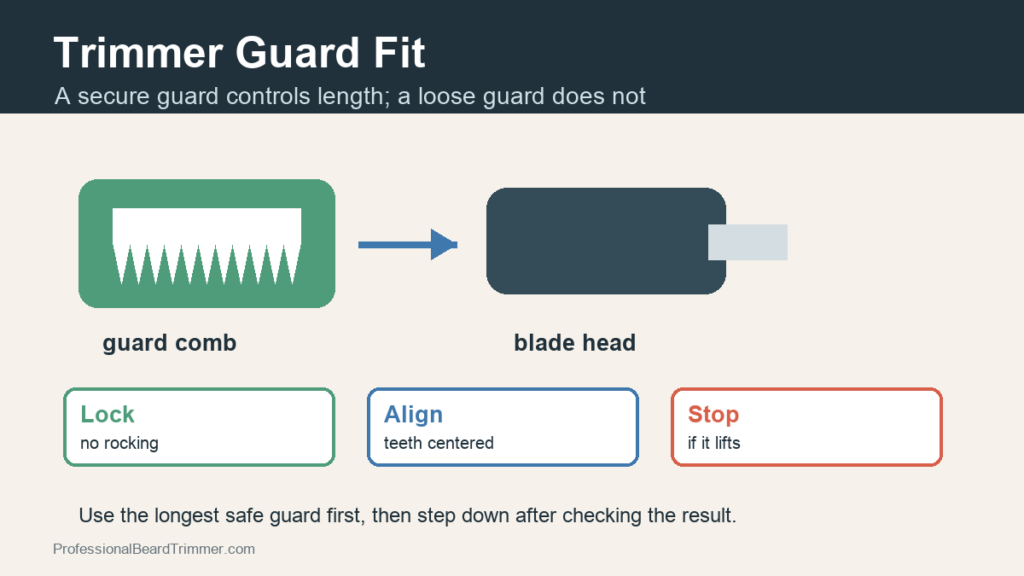
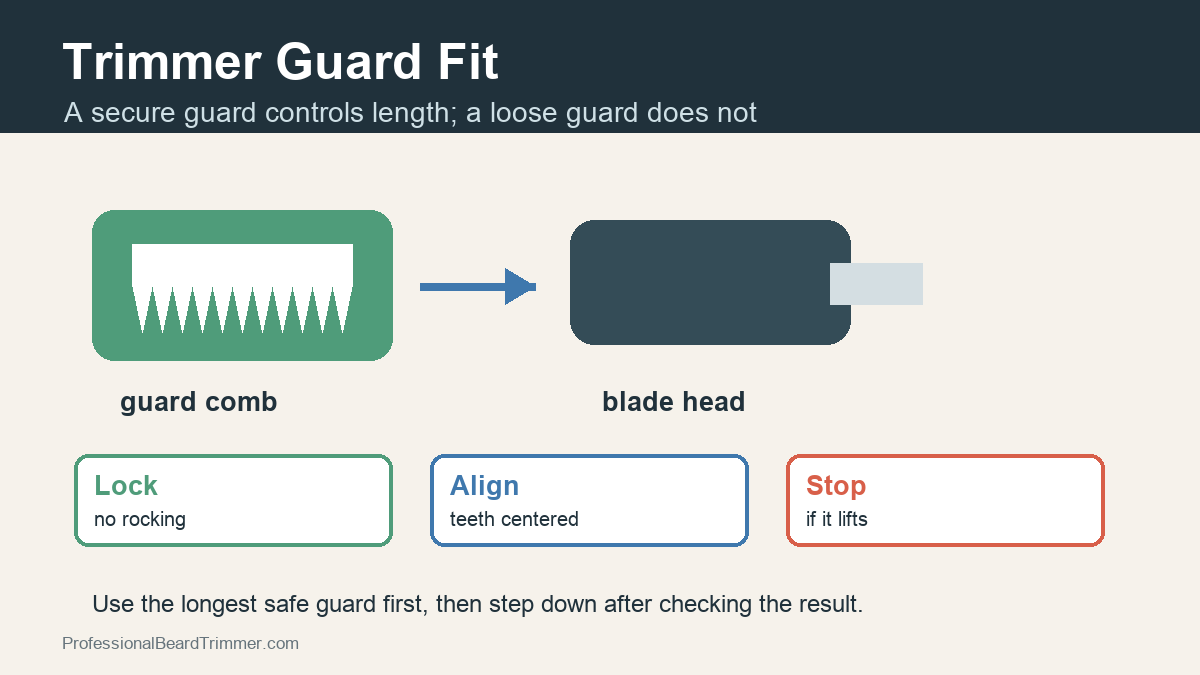
Direct answer: A trimmer guard is a comb attachment that controls how much hair reaches the blade. The right guard should lock firmly, sit flat, and match the trimmer head. If it rocks, lifts, or exposes blade corners, do not use it for beard length control.
How to judge a trimmer guard
| Question | Best answer | Why it matters |
|---|---|---|
| Does it lock on? | Use only if it clicks or seats firmly | A loose guard can shift and cut shorter than planned |
| Is it the right length? | Start longer than the final look | You can always step down after checking the first pass |
| Does it match the head? | Match the guard to the exact trimmer or clipper family | Brand names alone do not prove fit |
| Is the blade exposed? | Stop if corners or teeth are uncovered | Exposed blade corners raise the chance of uneven cuts |
| Is detail work needed? | Switch to a detail trimmer after bulk is even | Wide guards are not ideal for neckline or cheek-line borders |
How to use a trimmer guard safely
- Choose a longer guard first. Start above the target length if you are unsure how short the result will look.
- Seat the guard fully. Press it into place and check that both sides are secure before turning on the tool.
- Comb and dry the beard. Dry, combed hair feeds through the guard more evenly than damp or tangled hair.
- Use light overlapping passes. Keep the guard flat and avoid digging the front teeth into the skin.
- Finish edges separately. After bulk is even, use a shorter guard or detail blade for borders.
Guard-fit checklist
- Secure lock: The guard should not rock, lift, or slide during a pass.
- Length planning: Move from longer to shorter guards instead of starting short.
- Tool match: Guards must match the head width, clip shape, and rail position.
- Best use: Use guards for length control, not for crisp edge lines.
For related reference pages, compare the beard trimmer guards guide, the millimeter beard length guide, and the universal clipper guards fit guide.
Frequently asked questions
What does a trimmer guard do?
A trimmer guard limits how much hair reaches the blade so the cut stays closer to a chosen length. It is useful for beard bulk control, but it does not replace a detail blade for sharp borders.
Can I use any guard on any beard trimmer?
No. Guards need to match the trimmer head, clip shape, and rail width. A guard that looks similar can still sit loosely and cut unevenly.
Should I trim with or against the grain?
Use the direction that gives the controlled result you want, but test first. Against-the-grain passes usually remove more length, while with-the-grain passes can be more conservative.
Why does a guard leave patches?
Patches usually come from uneven hair direction, a loose guard, rushing the pass, or pressing at different angles. Comb first and keep the guard flat.
What should I do if the guard feels loose?
Stop and use a better-fitting guard. A loose guard is not safe for predictable length control.