Disclosure: This site may use affiliate links. Product specifications should be checked against manufacturer or retailer pages before purchase.
Editorial update, June 18, 2026: This recovered page was rebuilt as a practical guard-selection guide. It replaces old video placeholders and generic copy with a clear length diagram, compatibility checks, and safe trimming steps.
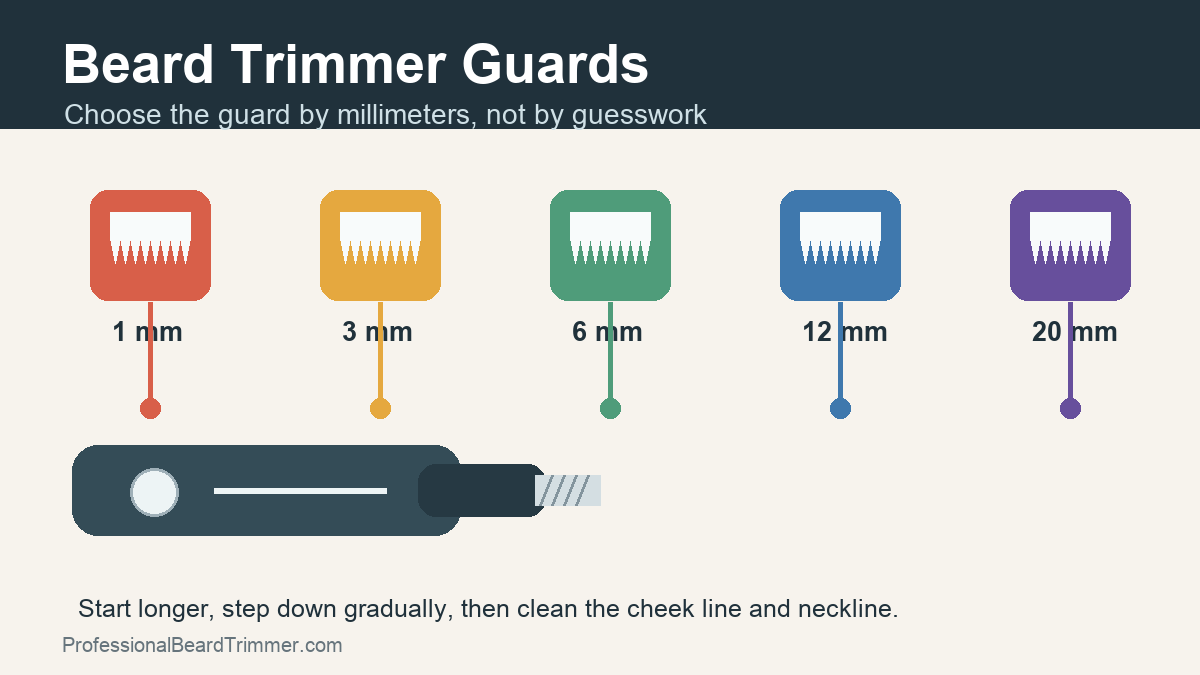
Direct answer: Beard trimmer guards are comb attachments that control how much hair remains after trimming. Choose them by millimeter length, exact model fit, and the beard style you want. Start longer than your target, trim dry hair with light passes, and step down gradually.
What beard trimmer guards actually do
A guard creates distance between the blade and the beard. A short guard leaves stubble, while a longer guard preserves more bulk for a short or medium beard. The guard does not make every beard look identical because hair density, curl, and color contrast affect the final appearance.
Guard selection table
| Guard range | Typical result | Use when | Watch out for |
|---|---|---|---|
| 0.5-1 mm | Close stubble | You want a short shadow or frequent cleanup | Patchy areas can show quickly |
| 2-3 mm | Heavy stubble | You want texture without a full short beard | Use light pressure around the jaw |
| 4-6 mm | Short beard | You want a neat daily beard with visible shape | Keep the neckline controlled |
| 9-12 mm | Fuller short beard | You want more chin and cheek coverage | Comb before trimming |
| 16-20 mm | Medium-beard maintenance | You need to reduce bulk without removing the beard shape | Scissors may still be needed for flyaways |
Compatibility checks before buying replacement guards
- Match the exact model: guard shape, rail width, and clip position can vary even within one brand.
- Check the printed length: guard numbers are not universal, so trust millimeters or inches over a number label.
- Inspect the clip: a loose guard can shift and cut unevenly.
- Check replacement support: replacement guards and combs are easier to justify when the trimmer itself has blade and battery support.
How to test a new guard
- Choose a longer guard first. Start above the final length so you can safely step down.
- Comb and dry the beard. A combed dry beard feeds through the guard more evenly.
- Use light overlapping passes. Keep the guard flat and avoid pressing the tool into the skin.
- Step down gradually. Move shorter only after checking the result in normal light.
- Finish the edges last. Clean the neckline, cheek line, and mustache after the main length is even.
For a full chart, compare the beard trimmer guard sizes guide and the 0.5mm to 20mm length chart. If the tool pulls hair, use the cleaning and oiling guide before cutting shorter.
Frequently asked questions
Are beard trimmer guards universal?
No. Guards are usually designed for a specific trimmer head or brand family. Always confirm the model fit before buying replacement guards or using a guard from another kit.
What guard should I start with?
Start longer than the final length you want. A 6 mm or 9 mm setting is safer for a first pass than jumping straight to a very short stubble guard.
To compare a 6 mm or 9 mm setting with inches, use the beard-trimmer length converter.
Why does the same guard look different on different beards?
Density, curl, color contrast, trimming direction, and pressure can all change how a millimeter setting looks after trimming.
Should I trim with or against the grain?
Trim with the grain when testing a new guard. Against-the-grain passes remove more bulk and should be used carefully after you know the result.
How do I avoid uneven cuts with guards?
Comb first, use light passes, keep the guard flat, clean the blade, and step down one setting at a time instead of forcing the guard through the beard.