Disclosure: This site may use affiliate links. Product specifications should be checked against manufacturer or retailer pages before purchase.
Editorial update, June 19, 2026: This recovered page was rebuilt as a practical men's haircut and grooming-tool guide using restored old-site media. It does not claim hands-on barber testing, current product specifications, retailer offers, or availability.
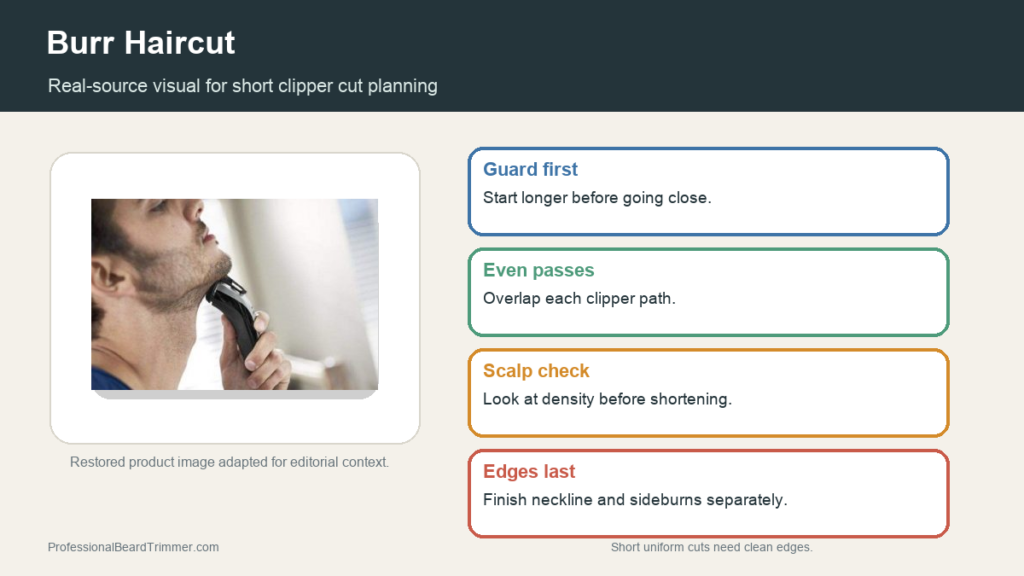
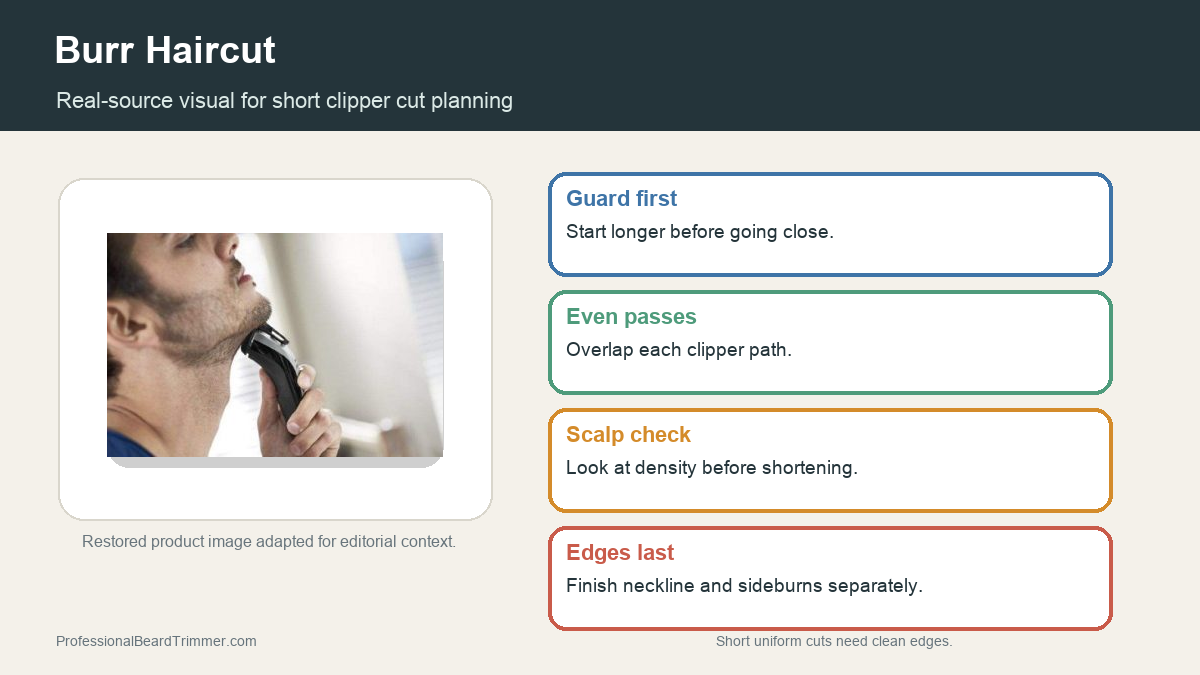
Image note: The image gives real grooming-tool context from restored site media. It is a haircut planning aid, not proof of a specific shop service or product test.
Direct answer: A burr haircut is a very short, mostly uniform clipper cut. Choose the guard by how much scalp you want visible, start longer if unsure, make overlapping passes, and clean the neckline separately. The result looks best when the head shape, hair density, and beard connection are considered first.
Burr haircut planning checks
| Check | What to do | Why it matters |
|---|---|---|
| Guard length | Start longer and step down only after checking visibility | Short cuts show mistakes quickly |
| Scalp view | Check density, cowlicks, and skin comfort before going shorter | Uniform length can expose more scalp than expected |
| Pass direction | Use overlapping passes with steady pressure | Even coverage matters more than speed |
| Neckline | Clean the neckline after the main length is even | A tidy edge makes a short cut look intentional |
| Beard connection | Blend sideburns or beard edges after the head cut | Short hair makes uneven sideburns stand out |
How to plan a burr haircut
- Choose a conservative guard. Begin with a longer guard than the final target so you can shorten the cut gradually.
- Cut in overlapping passes. Move slowly and overlap each pass so missed patches are easier to catch.
- Check the scalp view. Pause after the first full pass and look at hair density, growth direction, and visible scalp.
- Clean the edges separately. Use a detail tool or careful clipper edge work for neckline and sideburn cleanup.
- Plan upkeep. Short uniform cuts need frequent small trims to keep the length looking deliberate.
Burr haircut checklist
- Longer starting guard: Prevents an accidental too-short result.
- Overlapping passes: Reduce missed patches on a uniform cut.
- Separate edge work: Keeps the neckline and sideburns clean.
- Maintenance rhythm: Keeps a burr cut from looking grown out.
For related reference pages, compare the high and tight haircut guide, the trimmer, clipper, and shaver comparison, and the lineup tool guide.
Frequently asked questions
What is a burr haircut?
A burr haircut is a very short clipper cut that keeps most of the head at one close length. It is usually simpler than a fade but still needs careful guard choice and edge cleanup.
How short should a burr haircut be?
The right length depends on hair density, scalp visibility, head shape, and comfort. Start longer, check the look in good light, and step down only if you want a closer result.
Can a burr haircut connect to a beard?
Yes. The sideburn and beard area should be checked after the head length is set so the transition does not look abrupt.
Why can a burr haircut look patchy?
Patchiness can come from uneven passes, different growth directions, hair density changes, dull blades, or choosing a guard that exposes more scalp than expected.