
Disclosure: This site may use affiliate links. Product specifications should be checked against manufacturer or retailer pages before purchase.
Editorial update, June 18, 2026: This recovered page was rebuilt as a barber-guard size and fit guide with a neutral diagram, direct answer, safe process, and FAQ.
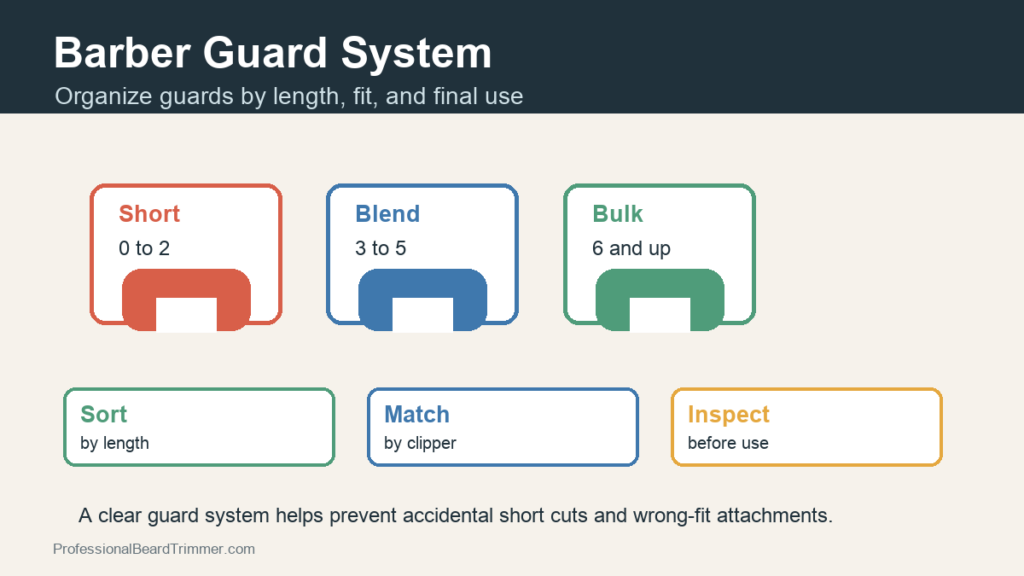
Direct answer: Barber guards are clipper comb attachments organized by length, fit, and use. Short guards are for close cutting, middle guards help blend, and longer guards reduce bulk. The most important check is not the number alone; it is whether the guard fits the exact clipper head securely.
Barber guard groups
| Question | Best answer | Why it matters |
|---|---|---|
| Short guards | Close cleanup and lower blend work | They remove length quickly and need careful testing |
| Middle guards | Blending and transition areas | They help soften lines between short and long sections |
| Longer guards | Bulk reduction and conservative first passes | They preserve more length while making the shape cleaner |
| Brand-specific guards | Use only with matching heads | Wrong-fit attachments can shift during a pass |
| Detail work | Use a trimmer or detail blade after guards | Guards control length but do not create the sharpest edge |
How to organize and use barber guards
- Sort by printed number or length. Keep short, middle, and longer guards separated before trimming.
- Match each guard to the tool. Do not mix guards across clipper families unless fit is confirmed.
- Inspect teeth and clips. Replace guards with cracked teeth, weak clips, or warped rails.
- Start with a longer guard. Use conservative passes before moving into shorter blend work.
- Clean before storage. Brush hair from the teeth and keep the set dry.
At-home guard system checklist
- Short group: Useful for close cleanup but easiest to overdo.
- Blend group: Useful for softening transitions between lengths.
- Bulk group: Useful for reducing long hair or fuller beard volume.
- Storage habit: Keep guards sorted so the wrong size is not grabbed mid-cut.
For related reference pages, compare the big clipper guards guide, the universal guard fit guide, and the guards for Wahl clippers guide.
Frequently asked questions
What are barber guards?
Barber guards are comb attachments that sit over a clipper blade to leave a more predictable length. They are commonly grouped by short, blend, and longer bulk-control uses.
Are barber guard numbers universal?
No. Numbering is familiar, but length markings and fit can vary by kit. Check printed measurements and physical fit before cutting.
Can barber guards be used on beards?
Yes, especially for fuller beards, sideburn transitions, and even bulk reduction. Use a detail trimmer afterward for borders.
How should I store clipper guards?
Store them clean, dry, and sorted by length. A labeled tray or small organizer helps prevent grabbing the wrong guard.
When should I replace a guard?
Replace a guard if the teeth are cracked, the clip feels weak, the rail is warped, or it no longer locks securely on the tool.