
Disclosure: This site may use affiliate links. Product specifications should be checked against manufacturer or retailer pages before purchase.
Direct Answer
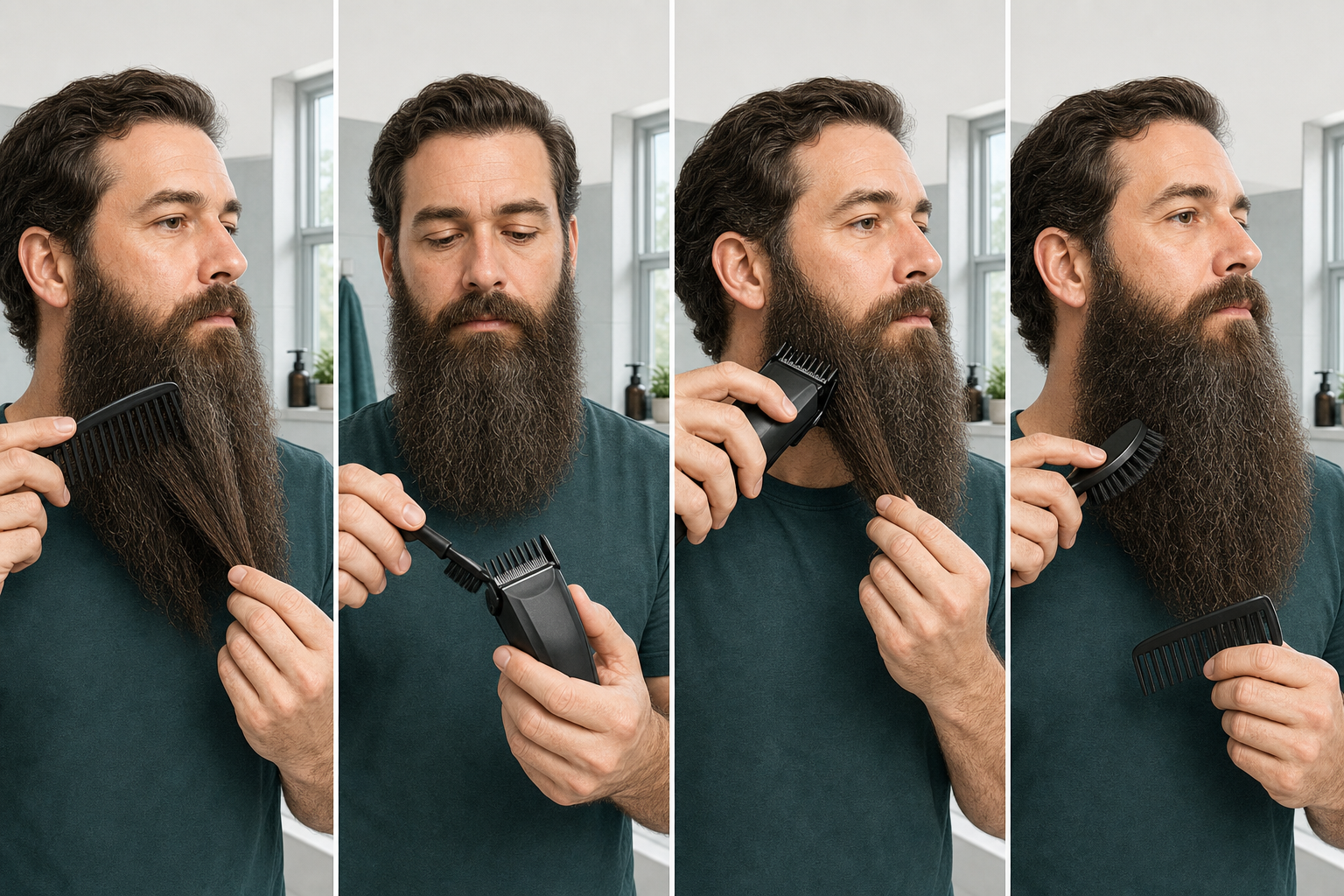
Direct answer: Trim a coarse long beard without forcing the tool by drying and releasing the beard, detangling from the ends, mapping grain and layers, and isolating one small outer section. Verify the exact trimmer, longest protected setting, guard fit, cutter condition, maintenance, and power. Use one short low-load pass, then switch off immediately if hair pulls, clear clippings, recomb, release, and reassess.
This workflow reduces avoidable load and creates clear stop points; it cannot promise a pull-free, comfortable, even, or specific result. “Coarse” describes how the hair feels or behaves in this grooming task. It does not identify hair diameter, density, curl pattern, skin condition, or the power a tool requires.
Coarse Long-Beard Decision Table
| Observation | Likely workflow question | Conservative response |
|---|---|---|
| Comb catches near the ends | Tangles or crossed strands remain | Stop and detangle end-first before using a guard |
| Guard fills with long hair after a short pass | The section or layer admission may be too large | Switch off, clear approved parts, and isolate less hair |
| Tool pulls immediately on clean released hair | Attachment, cutter, maintenance, power, or tool-role issue | Stop and troubleshoot away from the beard |
| Protected length exceeds the documented guard range | The trimmer setup cannot preserve the plan | Do not improvise a shorter guard; choose another method |
| Hair cuts only when stretched tight | The test position does not match released wear | Release the section and redesign the workflow |
Define “Coarse” as an Observation, Not a Diagnosis
Record what actually happens: strands resist a fine comb, curls interlock, the beard expands after release, a guard stops admitting hair, clippings bridge the teeth, or the cutter begins pulling. These observations can guide preparation and section size without making biological or medical claims.
Do not assume every dark, dense, curly, wiry, gray, or long beard is coarse in the same way. Hair can vary by zone. The mustache, chin, jaw, cheek, and neck may need different sectioning while still belonging to one complete long-beard shape.
Keep This Intent Separate From General Long-Beard Trimming
This page owns coarse-hair load control and pulling stop rules. The long-beard preparation guide covers the broader baseline, tool staging, and anchor map. The long-beard grain guide focuses on root, middle, and end direction. Use those foundations here without duplicating a complete ordinary trim.
The trimmer-pulling troubleshooting guide applies when the problem is primarily the equipment. This page adds the long-beard sectioning and release controls that should be in place before a cutter is asked to process coarse outer and supporting layers.
Build a Dry, Fully Released Baseline
For a dry trim, let the beard dry at the roots, between supporting layers, and through the ends. Remove bands, clips, tight collars, and prolonged hand tension. Gently place the beard in its ordinary worn position, then observe the front, both profiles, and both three-quarter views.
Philips’ current beard-trimming support guidance tells users of the covered models to wash and dry the beard and face and begin with a higher or maximum setting when learning the tool. That supports a dry, longer-first example only. The exact model manual controls whether another tool is approved for wet use.
Detangle From the Ends Without Stretching
Support the section above a snag and work through the free ends with fingers or an appropriate wide-tooth comb. Move upward only after the lower portion passes without force. Do not pull the beard straight merely to make the comb pass; that changes length, curl, layer overlap, and the final released contour.
If a knot cannot be separated gently, keep the powered tool away from it. Cutting into an unidentified knot can remove hair from several root zones at once. Record the location and resolve it as a separate detangling or small scissor task with clear visibility.
Map Grain Through Root, Middle, and End
Trace representative strands from the root zone through the middle and released end. Long coarse hair may cross from cheek to jaw, jaw to chin, or neck into the lower silhouette. The direction at the visible end may not match the root direction that controls guard entry.
Map only enough strands to understand the section. Repeated pulling and straightening can create a false baseline. Use the grain map to decide which way a guard can meet the outer section without forcing hidden hair from another zone into the same pass.
Separate Outer, Supporting, and Crossing Layers
The outer layer carries much of the visible contour. Supporting layers create body beneath it. Crossing hair begins in one zone and rests in another. Lift and release these functions separately before choosing a section for powered trimming.
A guard that admits the outer layer cleanly may overload when support hair is pushed underneath it. The long-beard mistake guide explains hidden-layer admission and crossing-hair ownership. Keep non-target layers outside the cutting path rather than compressing them together.
Protect the Central Chin and Jaw Corners
Mark the lowest central chin point, forward projection, chin width, both jaw-corner turns, and lower side-to-chin connections. These anchors should remain outside the first coarse-hair test unless one is the explicitly mapped target.
Coarse hair can spring outward after support is removed. That release is not permission to shorten a structural anchor repeatedly. Protect the overall geometry first, then decide whether one outer projection truly remains beyond the intended silhouette.
Choose One Small Outer Target
Select a section that remains outside the intended contour after detangling, gentle recombing, and full release. Keep its root, middle, end, neighboring support boundary, and protected anchor visible. The section should be small enough that the guard can enter without compressing a bundle.
Do not begin with the densest area merely because it looks difficult. Begin with a low-visibility outer target whose ownership and protected floor are clear. Leave the opposite side untouched as a reference during the first test.
Verify the Tool Category and Exact Model
Confirm whether the device is a beard trimmer, hair clipper, multi-groomer, detail trimmer, or another cutter. A tool can power on and still be unsuitable for preserving the required long-beard length or admitting the section through its available guards.
The long-beard trimmer buying guide separates model identity, guard range, attachment fit, power system, cleaning, parts support, and seller terms. Do not transfer a feature, setting, washability claim, or capacity claim from a similar model or product family.
Set a Protected Length Floor
Write the shortest acceptable released length for the target section. Compare that floor with the exact guard or adjustment range. Guard numbers are not universal measurements, and a documented remaining-hair length does not guarantee that every long coarse strand will enter the comb.
The long-beard guard guide explains shortest-layer protection, outer-layer admission, and longer-first calibration. If the verified longest setting is already shorter than the protected floor, the setup fails before the tool touches hair.
Inspect the Guard and Cutter With Power Off
Disconnect charging power where instructed. Inspect cutter teeth, stationary teeth, guard teeth, rails, clips, locks, adjustment control, housing, cord, connector, and battery condition. Remove approved attachments only as the exact manual permits.
Stop for bent, chipped, corroded, misaligned, loose, cracked, or contaminated parts. Confirm that the guard is identified for the model and locks evenly on both sides. A visually similar attachment can alter admission or move during a pass.
Clear Hair and Follow Model-Specific Maintenance
Compacted hair can obstruct a guard or cutter. Brush, rinse, dry, or lubricate only as the exact instructions allow. “Washable head,” “rinseable attachment,” “wet and dry,” and “waterproof” are different statements, and some cutter systems require oil while others do not.
Wahl’s current trimmer-care guidance identifies pulling as a possible sign of blade wear and discusses cleaning and oiling for the covered Wahl tools. Use that as a troubleshooting example, not a universal oil amount, schedule, wash method, blade-life claim, or proof that maintenance will solve every pull. The cleaning and oiling guide keeps those model boundaries explicit.
Check Power Before Hair Contact
Charge, install batteries, or connect power only as documented. A weak or unstable power state may complicate troubleshooting, but a full indicator does not prove cutting capacity, battery health, or suitability for coarse long hair.
Switch on away from the beard. Stop for abnormal rattle, impact, surging, slowing, odor, smoke, heat, or attachment movement. Do not substitute a charger because the connector fits, and do not use a corded unit near water contrary to its instructions.
Rehearse Guard Contact on the Released Section
With power off, place the guard against the target only in the orientation permitted by the manual. Check whether teeth can meet the outer hair without dragging support layers, crossing hair, a jaw corner, or the central chin into the path.
If the section must be squeezed, twisted, or stretched to fit, reduce the section or reject the setup. A dry rehearsal cannot prove the cutter will work, but it can expose an overloaded path before hair reaches moving teeth.
Do Not Tension Hair to Make It Feed
Use light control only to keep the target visible. Pulling the ends tight can make a guard appear to pass easily while storing tension in the strands. When released, the cut ends may return to different positions and create an unexpected contour.
Do not ask another person to hold a large bundle under tension while the trimmer follows it. If the target cannot remain identifiable without tension, switch to a different sectioning method or stop.
Make One Short, Low-Load Pass
Start with the verified longer setting and a small low-visibility outer target. Keep the guard in its documented contact orientation and use one short controlled pass. Let the cutter process the admitted hair without extra pressure, scooping, rocking, repeated tapping, or a rapid second pass.
An older Wahl trimmer manual available through the manufacturer’s official document route tells users not to force the blade through hair. That supports the stop-and-reassess principle for the covered tool; it is not a speed, pressure, direction, capacity, or compatibility specification for another model.
Stop at the First Pull
Switch off immediately when hair catches, the tool stalls, the guard jumps, the section moves unexpectedly, or the user feels a pull. Do not complete the stroke, press harder, change angle while powered, or run repeatedly over the same trapped hair.
Support the beard before withdrawing the tool. Remove the guard only after power is off and according to the manual. Confirm that no strand remains wrapped around a moving part. A stop is a successful control decision, not a failed trim.
Troubleshoot Pulling Away From the Beard
Check one variable at a time: remaining tangles, section size, crossing-hair admission, guard blockage, guard identity and lock, cutter cleanliness, tooth damage, alignment, required lubrication, power state, and whether the tool category can preserve the planned length. Record the finding before another test.
Do not assume a more powerful setting, closer guard, or extra pressure is the answer. If pulling recurs after the exact maintenance and setup checks, stop using that arrangement and contact the manufacturer or a qualified service route where appropriate.
Clear Clippings Between Every Test
Loose coarse clippings can bridge guard teeth, sit inside the cutter, or hold uncut strands away from their released position. Switch off, remove approved attachments if needed, and clear them with the documented brush or rinse method.
Do not tap a powered head on a sink, counter, or hard surface. Dry every rinsed component as instructed before reassembly. A clear guard improves observation but does not authorize a larger section or another pass without full reassessment.
Recomb, Release, and Check the Whole Shape
Gently recomb from roots through ends without stretching. Release the outer, supporting, and crossing layers, remove clips, restore normal clothing clearance, and let the beard settle. Compare the complete silhouette before inspecting the small target.
If the target no longer projects, stop. If it remains but the surrounding layers or anchors changed, stop and remap. The long-beard touch-up guide limits maintenance to one clearly owned target rather than turning a test into a full trim.
Use a Strict Correction Budget
Allow one initial pass, one complete clipping-clearance and release cycle, and at most one additional justified correction on the same target. Do not move the second correction to the opposite side, a hidden support layer, neckline, mustache, jaw corner, or central chin.
If the correction requires a different guard, several directions, multiple layers, or both sides, schedule a fully mapped long-beard trim. A strict budget preserves information and remaining length when the coarse-hair behavior is still uncertain.
Know When Scissors Are a Separate Better-Fit Workflow
Scissors may be considered when the protected length exceeds the guard range, a few visible ends cannot enter a guard without tension, or powered trimming continues to pull after correct inspection and maintenance. This is a method boundary, not a claim that scissors are safer or easier.
The scissors versus clippers guide compares roles. Use adequate light, isolate very small visible sections, keep blades away from skin and hidden layers, and stop when ownership is uncertain. Do not combine a new scissor technique with an unresolved powered-tool problem in one pass.
Stop Conditions
Stop for pulling, snagging, stalling, abnormal noise, odor, smoke, heat, impact, guard movement, damaged teeth, loose parts, cracked housing, damaged power components, uncertain wet-use status, or a section that cannot be isolated without tension.
Also stop for painful, broken, bleeding, swollen, infected-looking, or otherwise concerning skin and seek appropriate care. This page does not diagnose a skin or hair condition, prescribe treatment, or instruct a user to trim through discomfort.
Coarse Long-Beard Checklist
- Define coarse-hair behavior with observable words.
- Dry and fully release the beard for a dry trim.
- Detangle end-first without stretching.
- Map grain, outer layers, support layers, and crossing hair.
- Protect the central chin, jaw corners, and untouched reference.
- Choose one small outer target and a protected length floor.
- Verify the exact tool, guard, cutter, maintenance, and power.
- Rehearse admission with power off and no compression.
- Make one short low-load pass and stop at the first pull.
- Clear clippings, recomb, release, and use a strict correction budget.
Frequently Asked Questions
Why does a trimmer pull a coarse long beard?
Pulling can involve tangles, an overloaded guard, compacted clippings, a loose or incompatible attachment, a dirty or damaged cutter, missing model-required lubrication, weak power, or an unsuitable cutting setup. Switch off at the first pull and inspect rather than forcing another pass.
Should I trim a coarse long beard while it is wet?
Use only the wet or dry method documented for the exact tool. For a dry workflow, let the roots, support layers, and ends dry and release fully before judging length. Wet hair can change the visible silhouette and does not prove that a powered trimmer may contact water.
Should I press harder when a trimmer will not cut coarse hair?
No. Stop, switch off, and check section size, tangles, guard admission, clipping buildup, attachment fit, cutter condition, power, and exact-model maintenance instructions. Pressure can collapse layers into the cutting path without correcting the underlying problem.
When should I use scissors instead of a guarded trimmer?
Consider a separate scissor workflow when the protected length exceeds the verified guard range, the section cannot enter the guard without tension, or powered trimming repeatedly pulls after correct maintenance. Scissors require their own visibility, control, and small-section safeguards.
Sources and Claim Boundary
- Philips beard-trimming support guidance for covered-model dry preparation and longer-first familiarization.
- Wahl trimmer-care guidance for covered-tool cleaning, oiling, wear, and pulling troubleshooting context.
- Wahl manufacturer-hosted trimmer manual for the covered tool’s do-not-force instruction and maintenance context.
Claim boundary: This page provides a generic coarse long-beard preparation, sectioning, low-load test, pulling-stop, and reassessment workflow. It does not define a biological hair type; diagnose hair, skin, or tool faults; prescribe a universal guard, direction, pressure, speed, pass count, wet-use method, oil amount, maintenance schedule, or replacement interval; rank products; report hands-on testing; promise comfort, no pulling, evenness, safety, power, recovery, or a result; or replace exact-model instructions and qualified care.