
Disclosure: This site may use affiliate links. Product specifications should be checked against manufacturer or retailer pages before purchase.
Direct Answer
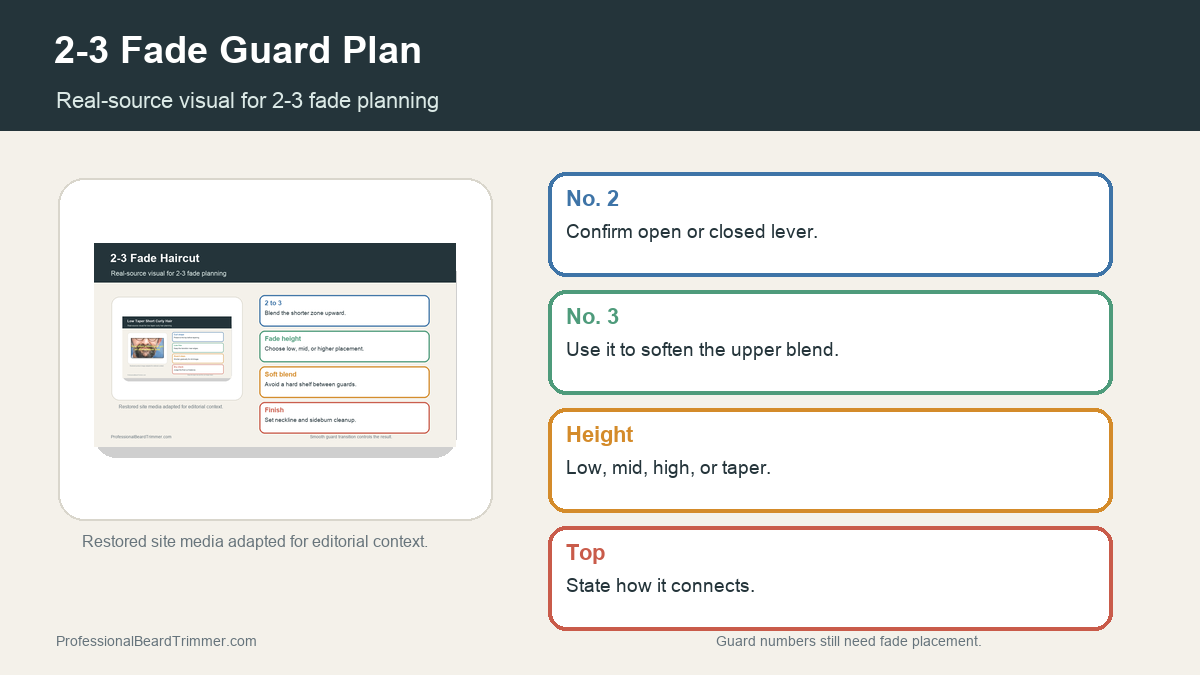
A 2-3 fade uses a #2 guard as the shorter lower zone and a #3 guard as the longer upper-side zone, with the transition softened between them. Decide the fade height and top length first, verify the millimeter value of each guard, and leave enough space between guide lines to blend without pushing the fade higher than planned.
What a 2-3 Fade Means
The name describes two working lengths, not one universal finished haircut. A #2 guard is commonly shorter than a #3, but guard numbers and actual millimeter lengths can vary by clipper system, blade position, and manufacturer. Check the attachment marking or manual before cutting. The lower sides normally use the shorter setting, while the upper sides retain more length so the fade can connect to the top.
Use the guard-size guide to understand why guard numbers are not interchangeable across every tool. The length chart is a separate reference for comparing labeled millimeter settings.
Plan the Zones Before Cutting
| Zone | Starting choice | Planning check |
|---|---|---|
| Lower sides and back | #2 or its confirmed length | Set the shortest visible zone without taking it higher than intended |
| Upper sides | #3 or its confirmed length | Keep enough room to connect the sides to the top |
| Transition | Lever positions or an intermediate setting | Use small adjustments instead of creating a new hard line |
| Top | Separate scissor or guard decision | Choose the final silhouette before removing bulk |
A low 2-3 fade keeps the transition near the ear and neckline. A mid version raises the contrast toward the temple area. A high version removes more side weight and leaves less space for correction. If the desired result is subtle, start lower and longer. Removing additional length is easier than rebuilding a transition that has already been pushed too high.
Basic Blend Sequence
- Confirm the target shape. Choose low, mid, or high placement and decide how much length stays on top.
- Set the longer upper zone. Use the #3 area to establish the side shape and preserve room near the top connection.
- Create the shorter lower zone. Work with the #2 below the planned transition, using controlled upward strokes.
- Soften the line. Use the clipper lever, corner of the blade, or an intermediate attachment supported by the tool.
- Cross-check both sides. Compare fade height, temple balance, and the curve around the back before detailing edges.
Work in small sections and brush loose hair away so the remaining dark areas are visible. A dark patch does not always require a shorter guard; it can come from hair direction, head shape, or uneven pressure. Recheck the area from more than one angle before removing additional length.
How to Ask a Barber for a 2-3 Fade
State the fade height, the shortest and longest side lengths, the amount to keep on top, and the preferred neckline and sideburn finish. A useful request is: “Keep the fade low, use a #2 at the bottom and blend into a #3 on the upper sides, keep the top length, and avoid taking the transition above the temple.” Bring a reference image and point to the placement and silhouette you want rather than relying on guard numbers alone.
The barber terms guide explains fade height, taper, lineup, bulk, and neckline language. For a broader consultation framework, see how to ask for a fade.
Common 2-3 Fade Problems
The transition looks like a hard band
Return to the boundary with a small lever adjustment or supported intermediate setting. Use short corner strokes and stop frequently to compare the surrounding area. Do not chase one line upward across the entire head.
The fade keeps moving higher
This usually happens when each correction creates another guide line above the last one. Pause, restore the planned zone map, and work only on the visible boundary instead of recutting the whole upper section.
The two sides do not match
Compare fixed landmarks such as the top of the ear, temple, and occipital curve. Match placement and shape rather than counting strokes. Hair density and growth direction can make equal guard settings look different.
Frequently Asked Questions
Is a 2-3 fade the same as a number 2 haircut?
No. A uniform #2 cut uses one main length, while a 2-3 fade transitions from a shorter #2 zone into a longer #3 zone and then connects to the top.
Should the #2 or #3 go first?
Either workflow can be controlled, but establishing the longer upper zone first can make the available blend space easier to see. The important point is to define the zones before shortening the transition.
Can a beard trimmer make a 2-3 fade?
Only if its guards, blade width, lever or intermediate settings, and motor are suitable for head hair. A hair clipper is usually easier for bulk side work; verify the tool instructions and actual guard lengths.