
Disclosure: This site may use affiliate links. Product specifications should be checked against manufacturer or retailer pages before purchase.
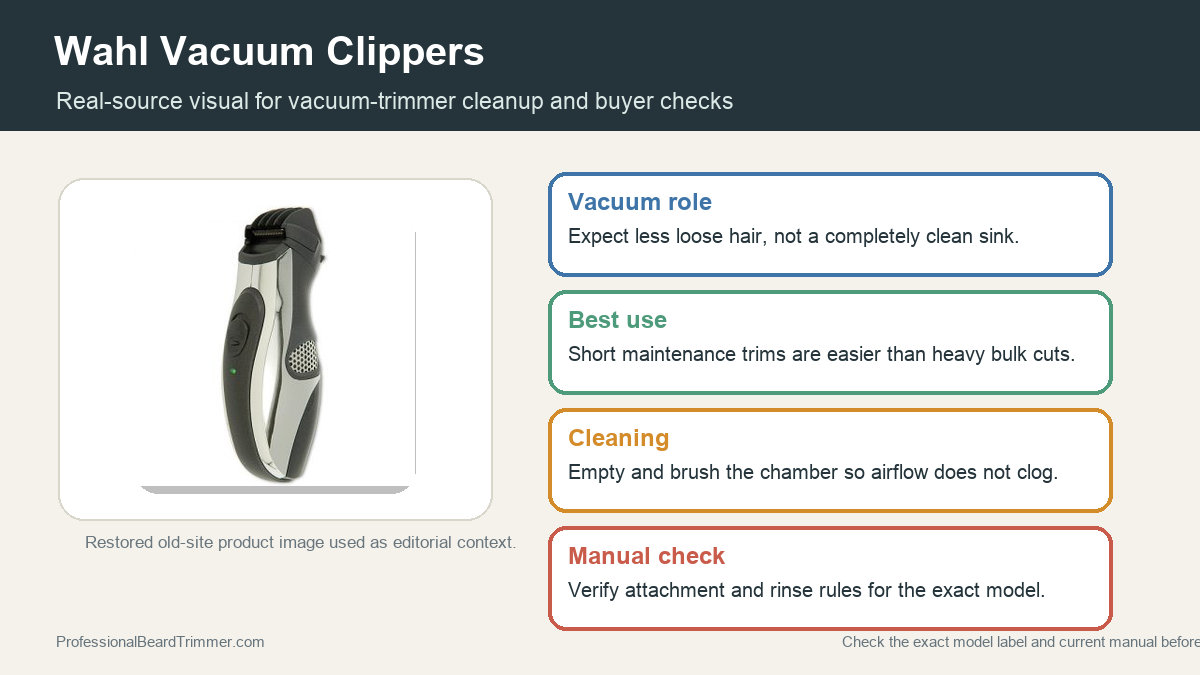
“Wahl vacuum clippers” describes a feature family rather than one identifiable beard tool. Wahl’s history distinguishes the earlier Vac Clipper from the Trim N Vac beard-and-mustache product introduced in 2001. A buying comparison needs the actual model, because collecting scalp-hair clippings and maintaining a chosen beard length are different tasks.
Identify what is doing the collecting
Before valuing a second-hand setup, establish whether the package has an integrated collection system or depends on separate equipment. Ask for a photograph of the complete connected arrangement and its model label. A bare cutting handle does not prove that a collection path, connector or required chamber is included.
Then identify the cutting system. A clipper’s taper lever and haircut guards do not automatically provide closely spaced stubble settings. For a 3 mm beard, the relevant question is whether the installed blade has a securely fitting 3 mm guide, not whether the advertisement mentions a powerful vacuum.
Keep three costs separate
- Cutting parts: the blade and useful guards.
- Collection parts: the components required to capture and hold clippings.
- Power and servicing: the correct electrical version and a documented repair route.
If the collection function cannot be demonstrated, price the purchase as an unresolved repair project rather than a verified low-mess grooming solution. Historical use of vacuum clipping technology, including specialist applications, does not establish the performance or suitability of a household listing.
Where should a beard buyer start?
Use the Trim N Vac guide for the beard-oriented concept, then find instructions for the actual unit. For ordinary trimming versus haircutting, see the tool comparison.
Sources: Wahl history and manual finder. No universal model specification, capture rate or hands-on result is asserted.