Disclosure: This site may use affiliate links. Product specifications should be checked against manufacturer or retailer pages before purchase.
Editorial update, June 19, 2026: This recovered page was rebuilt as a practical men's grooming and styling guide using restored or current site media. It avoids hands-on test claims, live shopping data, score claims, treatment claims, and brand-owned imagery.
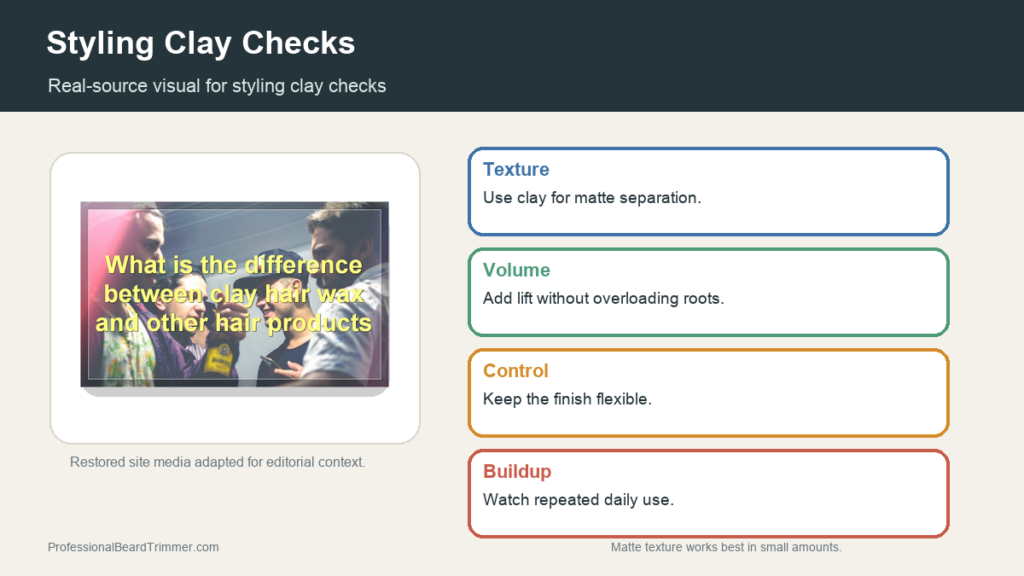
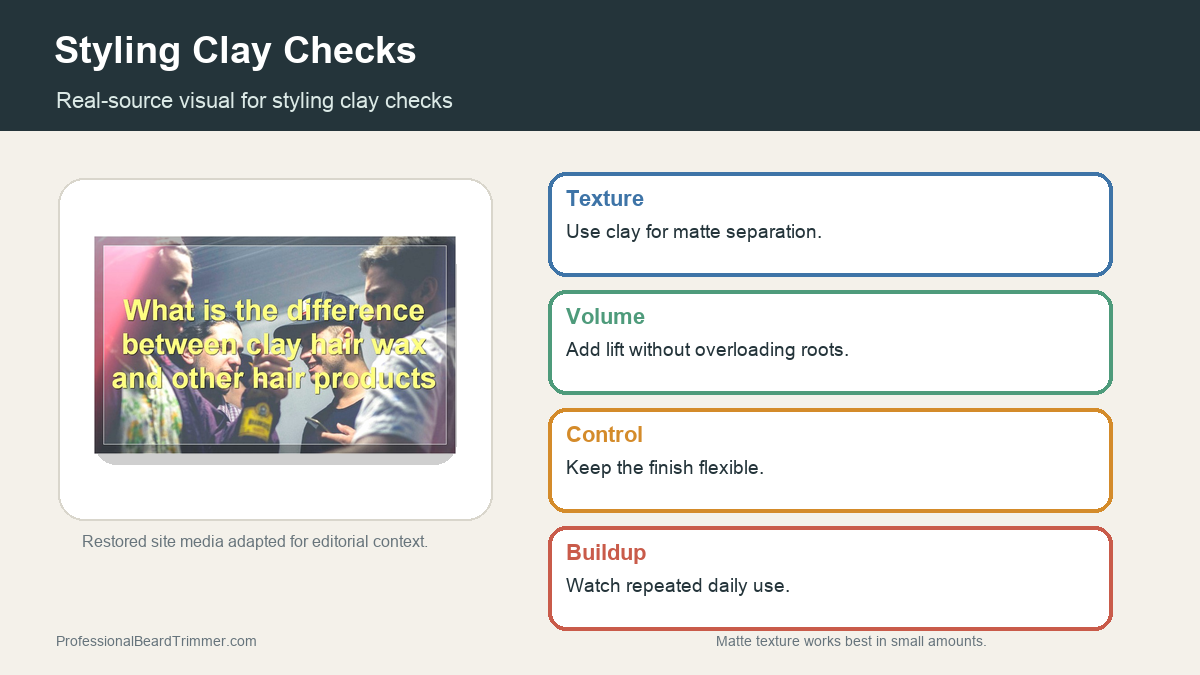
Image note: The image gives styling-clay context from existing site media. It is not a retailer listing, official label, or hands-on product test.
Direct answer: Styling clay is best for matte texture, separation, and volume when hair should look controlled but not glossy. The main checks are hold level, hair thickness, application amount, washout, and whether the product leaves hair flexible instead of stiff.
Styling clay selection checks
| Check | What to do | Why it matters |
|---|---|---|
| Texture | Use clay when the style needs separation or piecey movement | Clay is usually stronger for texture than shine |
| Volume | Apply lightly near roots or mid-lengths when lift is needed | Too much product can flatten volume |
| Hair thickness | Use lighter amounts on fine hair and stronger hold on thick hair | The same product can behave differently by hair type |
| Finish | Choose matte or natural finish for low-shine styles | Finish changes how dense the hair appears |
| Washout | Check for buildup after repeated use | Heavy buildup makes matte styles look dull |
How to style hair with clay
- Dry the hair first. Clay usually shows texture best on dry or nearly dry hair.
- Use a small amount. Warm a small amount between the palms until it spreads evenly.
- Work through the middle. Apply through the middle and back before shaping the visible front.
- Build texture with fingers. Pinch, lift, or rake lightly for separation instead of flattening the hair.
- Stop before it feels heavy. Add more only if the style lacks control after the first pass.
Styling clay checklist
- Matte texture: Keeps the style natural and low shine.
- Volume support: Helps short and medium styles look fuller.
- Flexible control: Avoids a crunchy gel-like finish.
- Buildup check: Keeps regular styling from becoming dull or heavy.
For related reference pages, compare the grooming clay guide, the hair paste guide, and the clay hair wash guide.
Frequently asked questions
What is styling clay best for?
Styling clay is best for matte texture, volume, separation, and casual control without a shiny or hard finish.
Is styling clay better than paste?
Clay is usually better for matte texture and volume, while paste is often more pliable and easier to restyle. The better choice depends on finish and hair thickness.
Can styling clay make hair look thicker?
It can make hair appear fuller by adding texture and separation, but it is a styling effect, not a treatment or permanent change.
How do I avoid using too much clay?
Start with a small amount, spread it fully between your hands, apply from the middle and back first, and add more only if the style still needs control.