Disclosure: This site may use affiliate links. Product specifications should be checked against manufacturer or retailer pages before purchase.
Editorial update, June 19, 2026: This recovered page was rebuilt as a practical haircut, fade, and clipper-planning guide using restored or current site media. It avoids hands-on test claims, live shopping data, score claims, and unsupported barber-service claims.
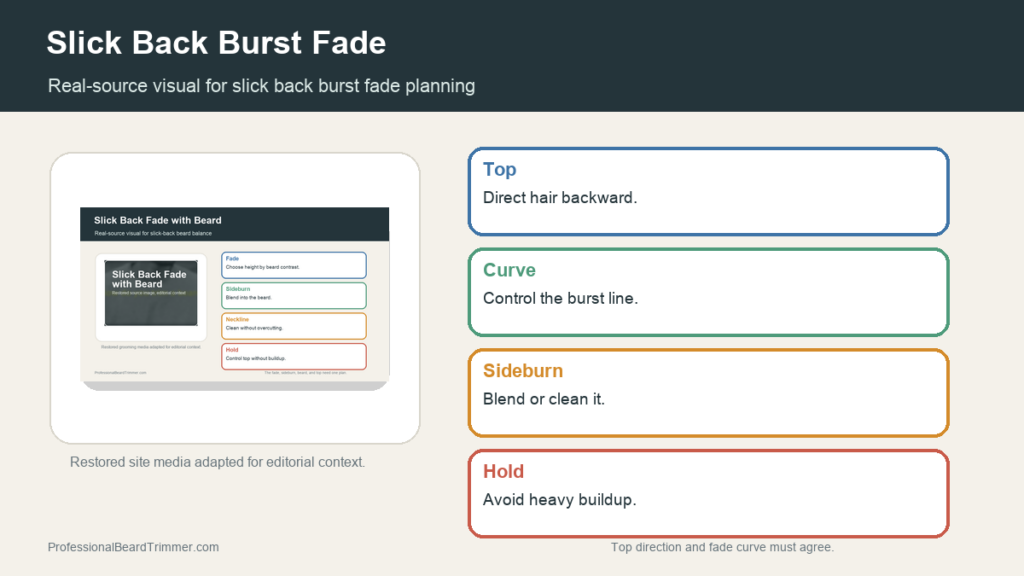
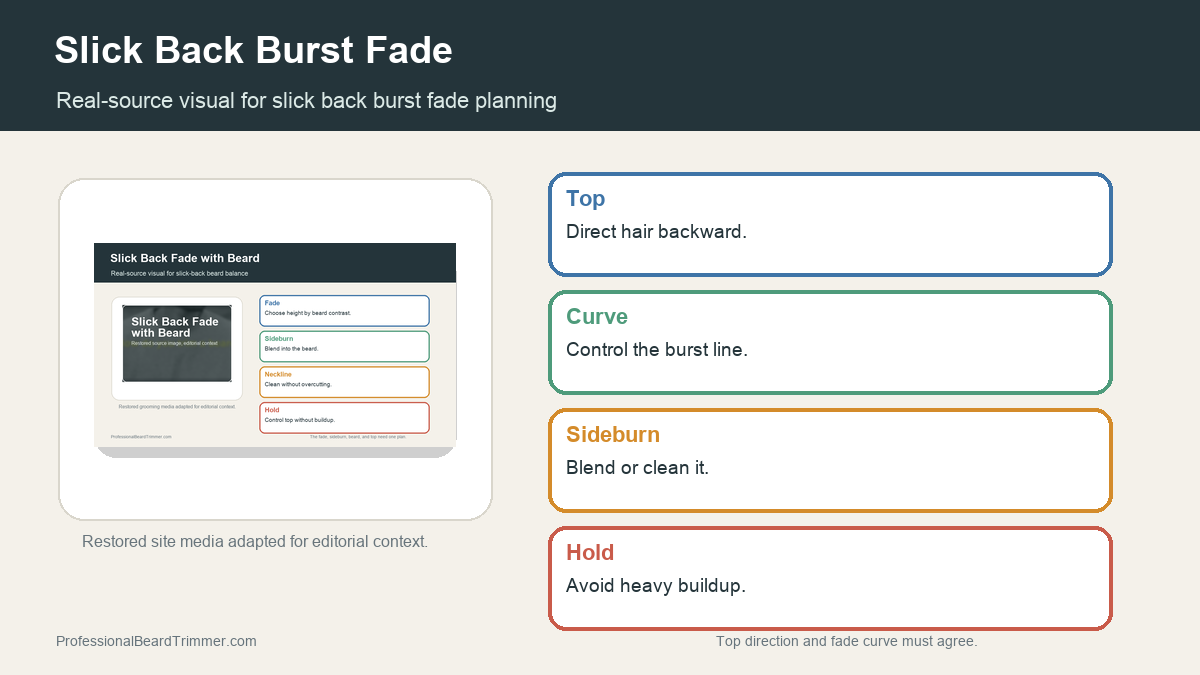
Image note: The image gives slick-back and fade context from existing site media. It does not claim a specific barber result or product performance.
Direct answer: A slick back burst fade needs enough top length to direct hair backward, a clear burst curve around the ear, and a sideburn plan if facial hair is present. Keep the fade from cutting too far into the slick-back weight.
Slick back burst fade checks
| Check | What to do | Why it matters |
|---|---|---|
| Top direction | Confirm the hair should move back, not forward | The top pattern sets the style |
| Burst curve | Map the fade around the ear | The curve gives the cut its shape |
| Sideburn blend | Connect side hair into beard or clean skin | The sideburn area affects balance |
| Hold level | Use controlled product without buildup | Heavy product can collapse the slick back |
| Neckline | Clean lightly after the shape is checked | Overcutting can break the back flow |
How to plan a slick back burst fade
- Set the top direction. Confirm that the top should comb or style backward before the fade is planned.
- Map the burst curve. Choose how the fade should wrap around the ear.
- Blend sideburns. Decide whether sideburns connect into facial hair or stay clean.
- Check the profile. Look from the side so the top weight and fade curve feel balanced.
- Finish with light hold. Use enough control for direction without creating heavy buildup.
Slick back burst fade checklist
- Backward top flow: Keeps the slick-back shape clear.
- Controlled burst curve: Shapes the fade without cutting into the top.
- Sideburn plan: Connects the fade to beard or clean skin.
- Light product control: Supports the top without flattening it.
For related reference pages, compare the slick back fade with beard guide, the blowout taper slick back guide, and the fade consultation guide.
Frequently asked questions
What is a slick back burst fade?
It is a slick-back top paired with a curved burst fade around the ear and controlled side blending.
How much top length is needed?
Keep enough top length to direct the hair backward. If the top is too short, the slick-back effect becomes weak.
Can it work with a beard?
Yes. Ask how the sideburn area will connect into facial hair so the fade and beard look planned.
What product should I use?
Use a light-to-moderate hold product that controls direction without heavy buildup.