
Disclosure: This site may use affiliate links. Product specifications should be checked against manufacturer or retailer pages before purchase.
Editorial update, June 19, 2026: This recovered page was rebuilt as a practical facial-hair trimming and styling guide using restored or current site media. It avoids hands-on test claims, live shopping data, score claims, medical claims, identity stereotypes, and unapproved affiliate language.
Image note: The page keeps the old slug but uses style-based language. It focuses on beard and mustache line planning, not assumptions about nationality or identity.
Direct answer: Classic Italian-inspired facial hair should be planned around balance: a neat mustache, controlled cheek line, clean neckline, and sideburn blend that matches the haircut and beard density.
Classic facial hair balance checks
| Check | What to do | Why it matters |
|---|---|---|
| Mustache balance | Match width and density to the beard or stubble | The mustache should support the full face shape |
| Cheek line | Clean only stray growth above the chosen line | Overcut cheek lines can look harsh |
| Neckline | Keep the neckline intentional but not too high | A high neckline can shorten the beard shape |
| Sideburn blend | Blend sideburns into beard or haircut length | The transition keeps the style cohesive |
| Tool hygiene | Use clean blades before edge work | Clean tools reduce pulling and uneven contact |
How to plan classic facial hair lines
- Choose the face frame. Decide whether the style should look short, full, angular, or softer.
- Set the mustache line. Clear the lip line and match mustache width to the beard.
- Clean the cheek line. Remove stray hairs without pushing the line too low.
- Check the neckline. Clean the neck gradually and keep the line below the jaw shadow.
- Blend the sideburns. Use light passes so sideburns connect naturally into the haircut or beard.
Classic facial hair checklist
- Balanced mustache: Keeps the center of the style intentional.
- Natural cheek line: Avoids an over-shaped look.
- Controlled neckline: Defines the beard without cutting too high.
- Sideburn transition: Connects facial hair to the haircut.
For related reference pages, compare the triangle mustache guide, the short beard styles guide, and the beard fade guide.
Frequently asked questions
What makes classic facial hair look balanced?
Balanced facial hair has a mustache, cheek line, neckline, and sideburn transition that look planned together instead of trimmed as separate parts.
Should cheek lines be very sharp?
Not always. A clean but natural cheek line often looks better than cutting the line too low or too hard.
How high should the neckline be?
The neckline should stay low enough to support the jaw and beard shape. Cutting too high can make the beard look thin.
What tool helps with classic facial hair lines?
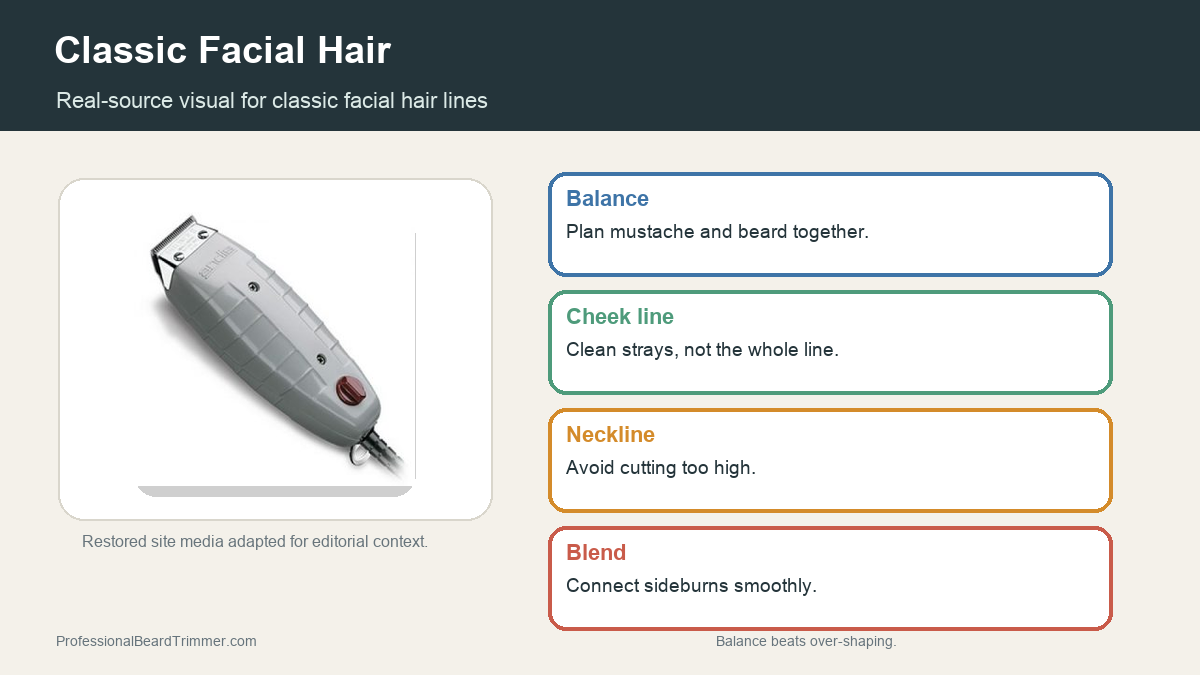
A clean detail trimmer helps with cheek line, mustache edge, sideburn, and neckline cleanup.