
Disclosure: This site may use affiliate links. Product specifications should be checked against manufacturer or retailer pages before purchase.
Direct Answer
Direct answer: A rechargeable beard trimmer can usually travel as a portable electronic device, but international rules depend on the installed battery, spare batteries, route, security authority, and airline. Prefer carry-on packing, switch the tool fully off, prevent accidental activation, protect the blade and housing, keep spare lithium batteries and power banks in the cabin, and verify current airline rules before departure.
A trimmer is not only a grooming tool when it enters air transport. It may also be a battery-powered portable electronic device. Security screening rules decide whether the tool is permitted through a checkpoint, while dangerous-goods rules address the battery and airline policies can be stricter. A rule that applies on one leg may not control a connection or return flight.
Beard Trimmer Flight Checklist
| Check | What to verify | Preferred action |
|---|---|---|
| Tool identity | Exact model, installed battery type, voltage, charger, and manual | Save the manual or support page before travel |
| Security rule | Departure, transit, and arrival authority guidance | Check each jurisdiction, not only the first airport |
| Airline rule | Portable-device, lithium-battery, and baggage restrictions | Use the operating carrier’s current policy |
| Carry-on packing | Tool fully off and protected from activation and damage | Use a fitted case or secured compartment |
| Spare battery | Installed versus removable spare battery | Keep spares in carry-on with terminals protected |
| Gate check | Whether the cabin bag will be moved to the hold | Remove required batteries, power banks, and devices first |
Start With the Exact Battery Configuration
Read the model label and manual before packing. Determine whether the trimmer uses a sealed rechargeable lithium-ion battery, removable rechargeable battery, disposable alkaline cells, or no battery at all. Record the battery’s watt-hour rating when it is stated. Do not guess from the connector, advertised runtime, or product family.
An installed battery is part of the portable electronic device. A battery removed from the tool becomes a spare battery and is handled differently. A power bank is also treated as a spare battery because its purpose is to supply power to another device. Keep the charger or USB cable separate from the battery classification: a cable has no battery, while a wall adapter may still need the correct regional plug and voltage.
If the battery is swollen, leaking, recalled, damaged, unusually hot, or associated with scorch marks or odor, do not pack the tool. The official FAA PackSafe guidance for portable electronic devices says damaged or recalled batteries and devices likely to spark or generate dangerous heat must not be carried unless made safe under the applicable rule.
Carry-On vs Checked Baggage
Carry-on is the clearer default for a normal rechargeable trimmer because the device remains accessible if a battery problem develops. The FAA recommends that portable electronic devices containing lithium batteries be carried in cabin baggage. IATA likewise recommends keeping electronic devices in carry-on baggage and checking with the airline before placing one in a suitcase.
If an airline permits the trimmer in checked baggage, the FAA requires a lithium-battery portable electronic device to be completely powered off, not left in sleep or standby mode, and protected against accidental activation and damage. A travel lock can help when the manufacturer documents it, but a lock does not replace physically protecting the power switch and packing the tool so pressure cannot turn it on.
U.S. TSA’s What Can I Bring list identifies electric razors as allowed in both carry-on and checked bags. That is U.S. checkpoint guidance, not a universal international ruling, and the final checkpoint decision remains with the security officer. A beard trimmer with unusual attachments, loose blades, fluids, or a damaged battery may raise separate issues.
Spare Batteries and Power Banks Stay in the Cabin
Do not place a loose spare lithium battery or power bank in checked baggage. FAA guidance requires spare lithium metal and lithium-ion batteries to remain in carry-on baggage. Protect each spare from damage and short circuit by using its retail package, an appropriate battery case, or another method that isolates exposed terminals.
The IATA portable electronic device guidance also lists spare batteries and power banks as carry-on-only items. Battery size and quantity limits can apply, and larger batteries may require airline approval. Most beard trimmers use much smaller batteries than large power tools, but the exact label and carrier policy are the evidence; do not infer compliance from the product category alone.
Do not carry an unmarked replacement battery if its identity and rating cannot be verified. Do not tape a damaged battery, place it loose beside metal objects, or use a spare that the trimmer manufacturer has not approved. Battery transport rules and device compatibility are separate checks, and both must pass.
Protect the Trimmer From Accidental Activation
Clean loose hair from the tool using the model-approved dry method, switch it fully off, and engage the documented travel lock if one exists. Fit the correct blade cap or guard so the cutting teeth cannot strike the case. Do not rely on a soft pouch alone when another packed object can press the power button.
Use a fitted case, padded organizer, or rigid compartment that prevents movement. Store the charger and cable so plugs cannot scrape the blade, housing, or battery label. Keep guards supported so their teeth do not bend. A damaged guard can change cutting length after arrival even when the trimmer itself survives the trip.
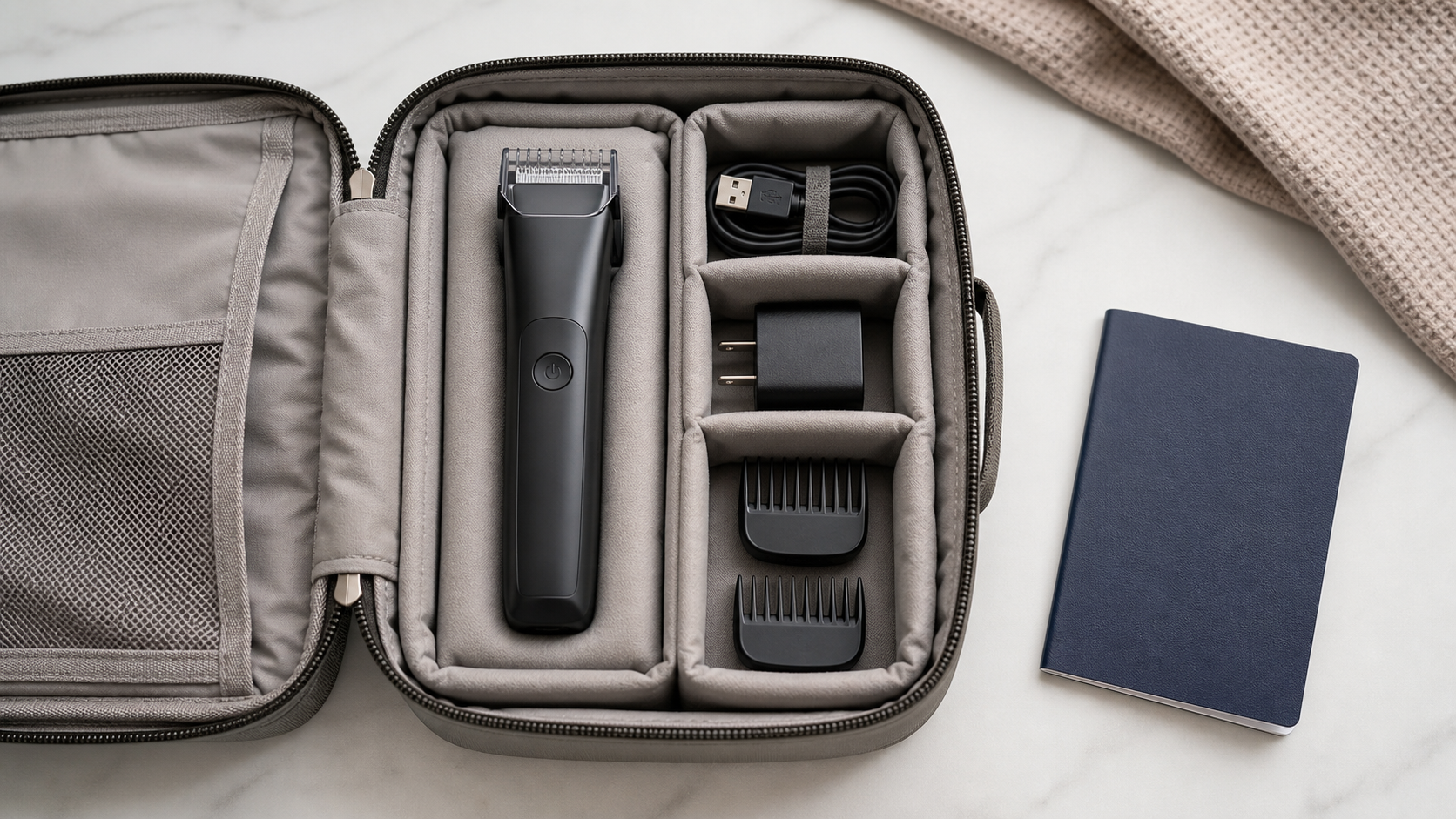
The image on this page illustrates a generic packing arrangement, not an airline-approved container or a tested product setup. Follow the exact tool manual and carrier rules. The travel beard trimmer buying guide explains model and charger checks before purchasing a tool for frequent trips.
Plan for a Gate-Checked Carry-On
A cabin bag may be transferred to the aircraft hold because of aircraft size, boarding conditions, or space limits. Pack so required items can be removed quickly. The FAA states that spare lithium batteries and power banks must be removed from a carry-on bag that is checked at the gate or planeside and kept with the passenger in the cabin.
IATA’s current traveler guidance goes further by advising passengers to remove lithium devices and batteries when hand luggage is taken at the gate for loading into the hold. Follow the operating airline’s instructions at that moment. Keep the trimmer, spare batteries, and power bank in an accessible organizer rather than underneath clothing that must be unpacked at the gate.
Do not argue from a screenshot of a general rule when crew or security staff apply a current route-specific requirement. Ask the airline before travel when the tool has a removable battery, unusual charging case, or missing watt-hour label.
International Itineraries Need Multiple Checks
For an international trip, review the departure security authority, every transit airport, the destination authority, and each operating airline. A ticket sold by one airline may include a flight operated by another carrier. Use the operating carrier’s baggage and dangerous-goods policy for that segment.
Rules can change after this page is published. Save current official pages close to departure and note the date checked. If a country does not list beard trimmers specifically, look for portable electronic devices, lithium batteries, electric razors, grooming appliances, removable blades, and liquids or aerosols. Contact the authority or airline when the category remains unclear.
Adapters do not convert voltage unless explicitly designed to do so. Check the charger’s input range and the destination supply before plugging it in. The trimmer-not-charging first checks explain how to verify the exact charger and power source without improvising an electrical repair.
Pack Oil and Cleaning Products Separately
Clipper oil, disinfectant, aerosol coolant, and cleaning fluids are not part of the trimmer’s battery allowance. They may be regulated as liquids, aerosols, flammable materials, or dangerous goods. Check the product label, safety data where applicable, security liquid limits, and the airline’s dangerous-goods rules.
For a short trip, the safest option may be to clean and oil the tool before departure, wipe away excess, and leave nonessential chemicals at home. Do not transfer an unknown fluid into an unlabelled container. The cleaning and oiling guide covers general maintenance, while the exact manual controls whether that trimmer needs oil at all.
At the Airport and on the Aircraft
Keep the device switched off during screening unless an officer asks you to power it on. Be prepared to remove the organizer for inspection. Do not use or charge the trimmer on the aircraft unless the airline explicitly permits it; grooming in a seat or lavatory creates hygiene, disposal, and safety problems even when the device itself is allowed in baggage.
If the trimmer or any battery becomes hot, swells, smokes, sparks, or smells abnormal during the journey, stop handling it unnecessarily and alert airline or airport staff immediately. Do not place a heating lithium device back into a closed bag or try to cool it with water.
Frequently Asked Questions
Can I bring a beard trimmer in carry-on luggage?
U.S. TSA guidance lists electric razors as allowed in carry-on bags, while battery and airline requirements still apply. Keep the trimmer switched off, protected from accidental activation and damage, and confirm the current rules for every country, airport, and airline on the itinerary.
Can a rechargeable beard trimmer go in checked baggage?
Rules vary, but FAA guidance says a portable electronic device containing a lithium battery in checked baggage must be completely switched off and protected from accidental activation and damage. Carry-on is generally preferred, and the airline may impose stricter rules.
Where should I pack a spare trimmer battery or power bank?
FAA and IATA guidance requires spare lithium batteries and power banks to stay in carry-on baggage, protected from damage and short circuit. A removable battery is not treated the same as a battery installed in the trimmer.
What if my carry-on bag is checked at the gate?
Before the bag goes into the hold, remove spare lithium batteries and power banks. IATA also advises removing lithium devices when hand baggage is gate-checked; confirm the airline’s procedure and keep required items accessible.
Claim and Rule Boundary
This page summarizes general U.S. FAA, U.S. TSA, and IATA passenger guidance checked in July 2026. It is not legal advice, an airline approval, or a guarantee that a tool will pass every checkpoint. Rules, enforcement, routes, battery limits, and carrier policies can change. Verify the exact device, current authorities, transit points, operating airlines, and local requirements before every trip.