
Disclosure: This site may use affiliate links. Product specifications should be checked against manufacturer or retailer pages before purchase.
Editorial update, June 19, 2026: This recovered page was rebuilt as a practical haircut design and clipper-control guide using restored or current site media. It avoids hands-on test claims, live shopping data, score claims, medical claims, identity stereotypes, and unapproved affiliate language.
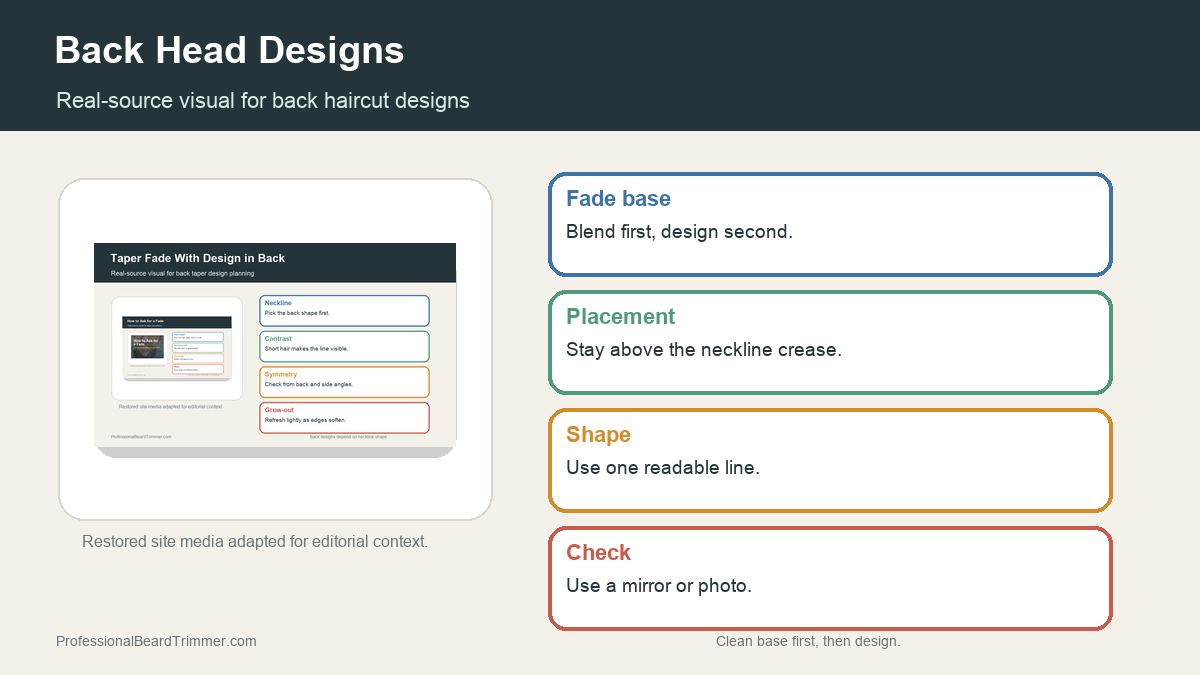
Image note: The image gives back-of-head design context from restored site media. It is an editorial guide image, not proof of a specific barber service or product test.
Direct answer: Designs on the back of the head look cleaner when the fade or taper base is finished first, the line sits above the neckline crease, and the design stays simple enough to refresh without over-widening the cut.
Back-of-head design checks
| Check | What to do | Why it matters |
|---|---|---|
| Fade base | Finish the taper or fade before cutting lines | The design needs a clean visual background |
| Neckline space | Place the design above folds, collars, and neckline movement | Low placement can blur quickly or feel irritated |
| Line shape | Use one strong shape instead of many tiny details | Simple lines stay clearer between cuts |
| Mirror check | Check symmetry with a mirror or photo before deepening | Back designs are hard to judge from one angle |
| Upkeep | Refresh small edges instead of recutting the whole area | Repeated widening can make the design messy |
How to plan a design on the back of the head
- Set the fade base. Blend the back and side lengths before adding any design line.
- Choose the design zone. Keep the design above the natural neckline and away from collar rub.
- Cut the main line first. Start with the strongest line and add detail only if it remains readable.
- Check both sides. Use a mirror or photo to check balance before cutting deeper.
- Clean lightly. Brush loose hair away and refine the line with short controlled trimmer passes.
Back design haircut checklist
- Finished fade base: Keeps the design from looking like a random gap.
- Neckline-safe placement: Reduces rubbing and fast blur near collars.
- Readable main line: Makes the design visible without overcutting.
- Photo check: Helps confirm balance on a hard-to-see area.
For related reference pages, compare the neck design guide, the taper design ideas guide, and the fade consultation guide.
Frequently asked questions
Where should a back-of-head haircut design sit?
It should usually sit above the natural neckline and collar area so the line stays visible and does not blur immediately from movement.
Should a fade be cut before the design?
Yes. The fade or taper base should be finished first because the design depends on a clean, even background.
Are complex back designs harder to maintain?
Yes. Tiny details can blur quickly, so one clean line or a simple shape is usually easier to refresh.
How often does a back design need a touch-up?
Touch-up timing depends on hair growth, but small design lines often need attention before the surrounding haircut fully grows out.