
Disclosure: This site may use affiliate links. Product specifications should be checked against manufacturer or retailer pages before purchase.
Editorial update, June 18, 2026: This recovered page was rebuilt as a material tradeoff guide without brand-specific claims or invented testing.
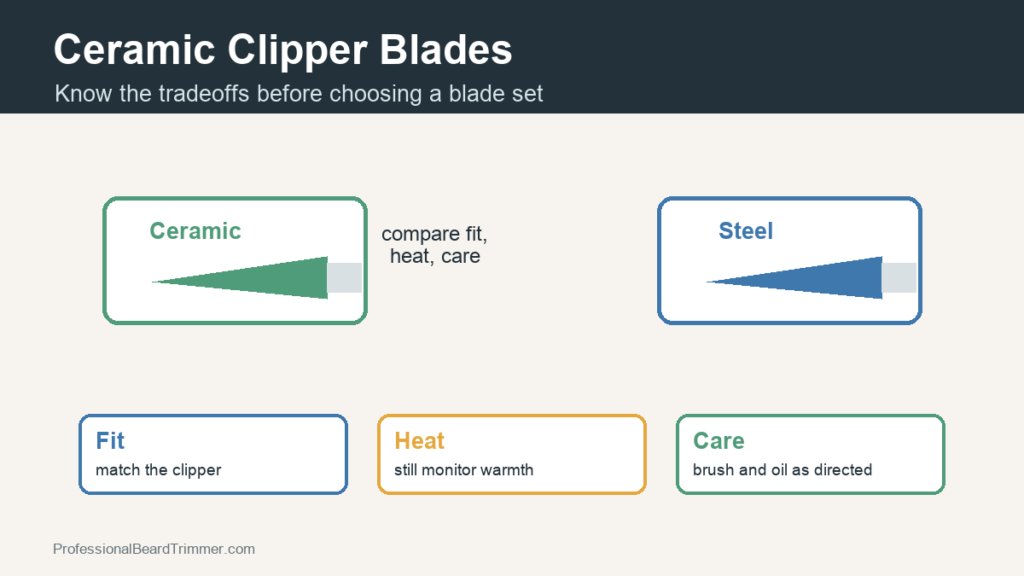
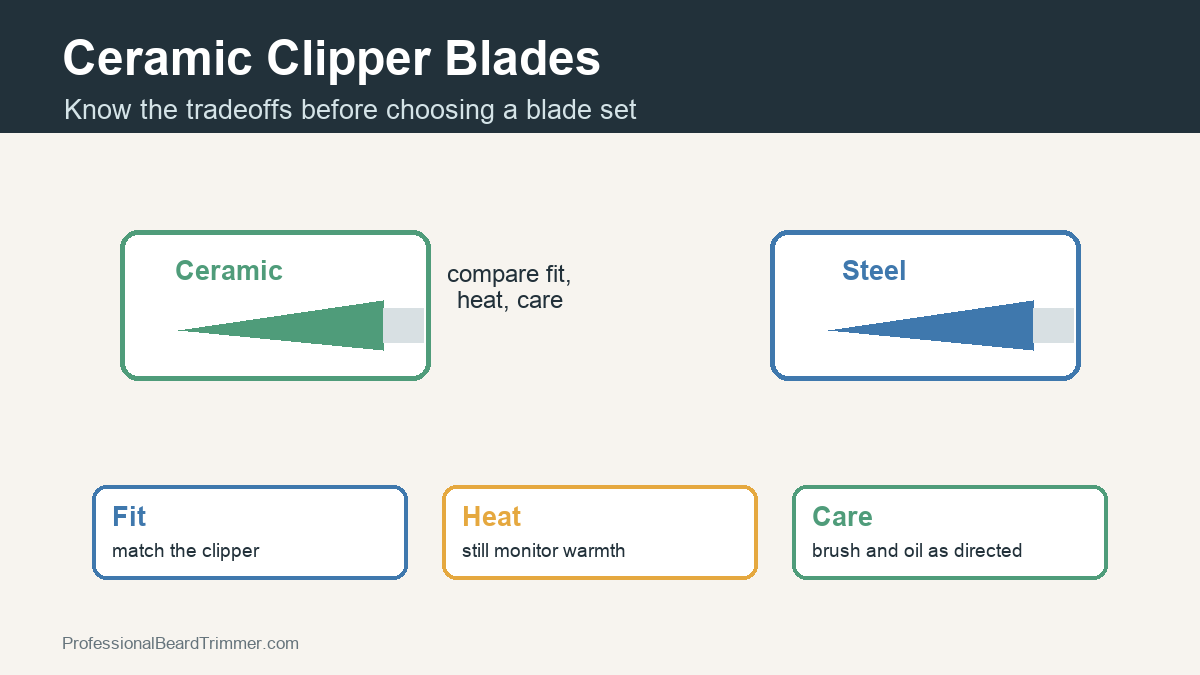
Direct answer: Ceramic clipper blades can be useful when they fit the exact clipper and are maintained correctly, but the material alone does not guarantee a better haircut. Check compatibility, inspect blade alignment, monitor warmth, and follow the maker cleaning and oiling instructions before treating ceramic as an upgrade.
Ceramic blade decision table
| Decision point | Use this rule | Why it matters |
|---|---|---|
| Compatibility | Match the exact model or blade system | A wrong-fit blade can chatter, pull, or sit misaligned |
| Heat | Monitor warmth during longer sessions | Ceramic may behave differently, but no blade should feel unsafe |
| Durability | Inspect teeth and edges before use | A chipped blade is not a grooming shortcut |
| Maintenance | Clean and oil as directed | Material does not remove normal maintenance needs |
| Use case | Choose based on the cut and tool | A good steel blade can be better than a mismatched ceramic blade |
How to evaluate a ceramic blade set
- Confirm fit first. Use model-specific documentation or packaging before installing a replacement blade.
- Inspect the edge. Look for chips, bent teeth, uneven alignment, or visible debris.
- Install carefully. Seat the blade flat and tighten only according to the tool design.
- Test on a small area. Check for pulling, heat, and uneven cutting before a full trim.
- Clean after use. Brush hair out and use the care routine recommended for that blade system.
Blade-fit checklist
- Exact fit: Material does not compensate for the wrong blade shape or screw pattern.
- Smooth feel: Stop if the blade pulls, rattles, or heats unusually.
- Care routine: Clean and oil when the blade system requires it.
- No product claims: Treat ceramic as a tradeoff, not a universal upgrade.
For related reference pages, compare the blade replacement guide, the blade sharpener guide, and the maintenance guide.
Frequently asked questions
Are ceramic blades always better than steel?
No. Blade fit, alignment, sharpness, and maintenance matter more than the material label. Ceramic can be useful in some setups, while steel may be more practical in others.
Can ceramic blades still pull hair?
Yes. Pulling can come from dullness, debris, poor alignment, weak motor speed, dry hair, or the wrong blade for the tool.
Do ceramic blades need oil?
Follow the blade and clipper maker instructions. Many clipper systems still need cleaning and lubrication even when a blade uses ceramic components.
Should I sharpen ceramic blades at home?
Avoid improvised sharpening. If a blade is chipped, misaligned, or pulling after cleaning, use a qualified service or replace the part.