
Disclosure: This site may use affiliate links. Product specifications should be checked against manufacturer or retailer pages before purchase.
Direct Answer
Direct answer: Choose a foil shaver for barber work by verifying its role as a close-finishing tool, the exact foil and cutter system, replacement-part availability, corded or cordless operation, cleaning limits, foil protection, handling, and service support. Compare current manuals and parts by model. Do not treat price, foil color, motor claims, ratings, or “professional” labeling as proof of fit.
Barber Foil Shaver Selection Table
| Check | Evidence to verify | Do not assume |
|---|---|---|
| Finishing role | Manual guidance for hair length, direction, skin contact, and pre-trimming | A foil replaces a clipper or trimmer for bulk removal |
| Foil system | Exact foil-head and cutter-bar part numbers for the model | Similar-looking foils or cutters interchange |
| Power | Approved supply, voltage, corded-use rule, charge indicators, and battery service path | A fitting plug or USB cable is compatible |
| Cleaning | Model-specific brush, rinse, drying, and lubrication instructions | A removable foil makes the complete handle washable |
| Workflow | Grip, switch placement, head width, noise policy, charging station, and storage fit | One shaver suits every client, area, or service pace |
| Support | Current foil, cutter, guard, charger, manual, service, and return routes | Replacement parts remain available for the tool’s full life |
Start With the Finishing Task
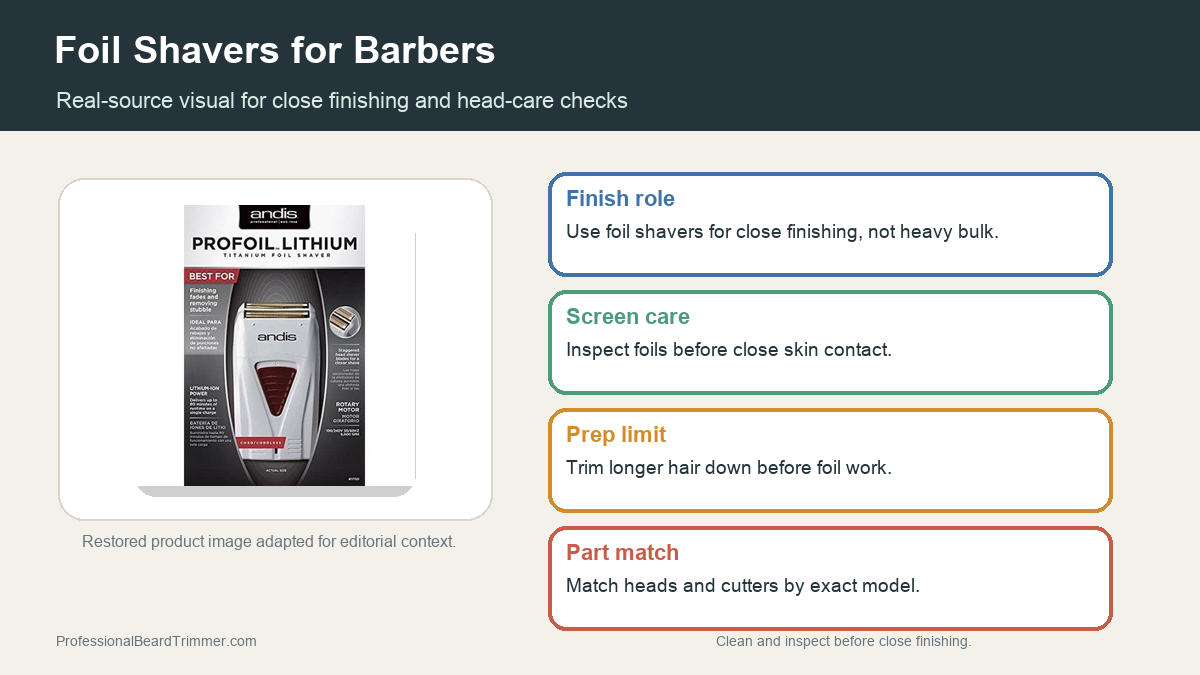
A foil shaver is generally a close-finishing tool. In barber workflows it may follow a clipper or trimmer on already-short hair, refine the lowest area of a bald fade, or finish selected facial or scalp zones when the exact manual permits. It should not be chosen as the first tool for long, dense, tangled, or bulk hair unless the manufacturer documents that use.
The official Wahl electric-shaver use guidance tells users not to press foil heads hard and describes working primarily against growth while maintaining appropriate contact. A Wahl operating manual also directs users with longer growth to reduce it before using the foil. These are Wahl instructions; they establish why finishing role and preparation must be verified, not a universal pass count or length threshold for every shaver.
Use the site’s trimmer, clipper, and shaver comparison to separate bulk reduction, outlining, length maintenance, and close finishing. Buying a foil shaver before defining the service can create an unnecessary tool overlap or force it into tasks it was not designed to perform.
Compare Foil and Cutter Architecture
The perforated foil is a thin protective surface above moving cutters. A single-foil, dual-foil, staggered, independently suspended, or pivoting design can change head width, contour response, cleaning access, and replacement cost. Product language should be matched to the exact manual and parts diagram rather than interpreted as a guaranteed finish.
Inspect how the foil head releases, how cutter bars seat, whether individual foil cartridges or a complete head are replaced, and whether the manufacturer requires foils and cutters to be changed together. Confirm every part number against the complete model and regional suffix.
The official Andis ProFoil product page is an example of a manufacturer documenting a specific professional finishing shaver. The Wahl Professional Vanish page documents another model with replaceable foil components. These pages verify only their named models; they do not prove that another Andis, Wahl, or unbranded foil system shares parts, runtime, voltage, construction, or results.
Check Foil Condition Before Every Service
With the shaver switched off and disconnected from charging power, inspect the foil under even light. Look for dents, punctures, tears, corrosion, loose edges, distortion, or an uneven seat. Check that the head locks securely and does not rock. A damaged or poorly seated foil is a stop condition.
Do not press, brush, scrape, or tap directly on a delicate foil unless the exact instructions permit it. Wahl’s official electric-shaver cleaning guide tells users to remove the foil head with the tool off and warns against tapping the foil surface. It also separates foil-head handling from cutter-bar cleaning.
Keep the supplied foil guard in place during storage and transport. A drawer containing loose guards, combs, cords, clips, or metal tools can deform the foil even when the shaver is not running. A protective cap does not substitute for a structured case when the tool travels in a mobile kit.
Verify Replacement Parts Before Buying
Search the manufacturer’s current support or parts channel for the exact model. Confirm the foil head, individual foil cartridges if applicable, cutter bars, cap, charger or power supply, cleaning accessories, and any stand. Record whether components are sold separately or only as a set.
Replacement intervals vary with the manufacturer, model, use pattern, foil condition, cleaning, and hair preparation. Do not convert one manual’s interval into a universal schedule. Replace a visibly damaged component immediately and use only parts listed for the model.
A lower initial price can be offset by unavailable or costly proprietary parts, while a higher price does not guarantee support. Compare the current replacement path and return terms without publishing a live price, stock, warranty, or cost-per-service claim.
Evaluate Power and Charging
Record whether the model is cordless only, corded and cordless, or must remain off while charging. Check the approved power supply, input voltage, output, polarity, connector, regional plug, charge indicator behavior, and travel lock where provided. Never infer electrical compatibility from connector shape.
For a shared station or busy workflow, consider how the tool returns to charge, whether the stand is stable, and how cables remain separated from wet or contaminated work areas. Verify whether continuous docking, periodic charging, or battery storage has a model-specific instruction.
Published runtime and charging claims describe controlled manufacturer specifications for a named model, not guaranteed shop performance. Battery age, temperature, storage, maintenance, and load can affect operation. Stop using a tool with a swollen battery, cracked housing, damaged cable, loose port, unusual smell, or persistent heat.
Match Handling to the Service
Assess head width, body diameter, grip texture, switch location, balance, vibration, and the ability to keep the foil flat with light pressure. A wide head may cover large finishing zones efficiently, while a narrower system may offer different access around curves. Neither is universally better.
Consider glove use, hand size, wrist posture, visibility around the head, and whether the switch can be operated without changing grip. Product dimensions help screen candidates, but a listing cannot prove comfort through a full working day. Use a lawful return or demonstration route when handling fit matters.
Noise and vibration can also affect client communication and sensory comfort. Do not publish an unmeasured “quiet,” “low vibration,” or “all-day comfort” claim. Compare documented design information and establish a service policy that allows clients to pause or decline a close-finishing step.
Keep Preparation and Pressure Conservative
Follow the exact manual for dry or wet preparation. If the model is intended for dry finishing, remove bulk hair first and ensure the area is clean and fully dry. Do not assume a rinseable foil head means the complete shaver can be used on wet skin or near water.
Use light pressure and avoid repeatedly scrubbing one area. The Wahl use guide linked above explicitly warns that hard pressure can damage the foil and does not produce a closer result. A manufacturer’s technique for one model should not be copied to another head system without checking its instructions.
Client comfort and consent control. Stop when the client asks, when the area becomes painful, when the foil feels abnormal, or when repeated passes are needed to chase a small visual difference. This page does not diagnose or promise prevention of irritation, bumps, or other skin conditions.
Build a Cleaning and Turnaround Process
Before purchase, map every step required between services: switch off, disconnect power, remove loose hair, release the foil head, clean the approved components, apply any permitted disinfecting or sanitation process, dry fully, inspect, reassemble, and protect. Follow applicable local rules and the exact manufacturer instructions.
Water limits differ by model. Some components may be brush-clean only, some removable heads may be rinseable, and some complete tools may support wet use. Do not immerse or rinse a powered handle unless the exact documentation permits it. Keep charging equipment dry.
The trimmer cleaning and oiling guide supplies a general maintenance framework, while the barber cleaning supplies checklist separates product ownership from correct preparation, contact time, drying, and protected storage. Neither overrides shaver-specific foil and cutter instructions or local professional rules.
Separate Personal and Professional Evidence
A product page can document dimensions, power type, included parts, compatible replacements, and intended category. It cannot prove how a particular tool performs in your shop, with every client, after months of use, or under your cleaning schedule. Reviews and ratings are uncontrolled reports rather than standardized comparisons.
When evaluating a candidate, record the exact source and date for each specification. Distinguish manufacturer statements from your own later operating observations. Do not claim hands-on testing, measured closeness, runtime, durability, throughput, or client preference until a documented method and real evidence exist.
Professional Purchase Checklist
- Define the exact close-finishing zones and the tool that will reduce bulk hair first.
- Record the complete model and regional suffix from an official source.
- Match foil-head and cutter-bar part numbers to that model.
- Confirm whether individual foils, cutters, or a complete head are replaced.
- Verify corded-use, charging, voltage, connector, and battery-service rules.
- Read model-specific preparation, pressure, direction, cleaning, drying, and oiling instructions.
- Inspect handling, switch, head width, storage guard, stand, and workstation fit.
- Check current parts, service, seller identity, package completeness, and return terms.
- Reject damaged foils, mismatched power parts, unclear identities, or unsupported wet-use claims.
Frequently Asked Questions
Can a foil shaver replace a trimmer in a barber kit?
Usually not for the same task. A trimmer can outline or reduce hair before close finishing, while a foil shaver is generally used after hair is already short. Verify the exact manual and intended service.
Should barbers choose a single-foil or dual-foil shaver?
Choose by head width, contour access, cutter design, handling, replacement system, cleaning, and task fit. The number of foils alone does not prove a closer, faster, or more comfortable result.
Can every foil shaver head be rinsed?
No. Water limits are model-specific. A removable head may be rinseable while the handle must stay dry, and another model may require brushing only. Follow the exact cleaning instructions.
When should a foil or cutter be replaced?
Replace damaged components immediately and follow the model’s documented inspection and replacement guidance. Do not use another manufacturer’s interval or fit a similar-looking part.
Sources and Claim Boundary
Primary references reviewed in July 2026 are Wahl’s electric-shaver use and cleaning guidance, the Wahl Professional Vanish product page, and the Andis ProFoil product page linked above. Brand pages are exact-model examples, not proof of cross-model compatibility or universal results. This page is a non-ranking selection and workflow guide. It reports no hands-on testing, measured closeness, speed, runtime, durability, comfort, current price, stock, rating, warranty, or service availability.