
Disclosure: This site may use affiliate links. Product specifications should be checked against manufacturer or retailer pages before purchase.
Direct Answer
Direct answer: Find a fade barber near you by defining the fade height and finish you want, checking current professional and shop credentials where your jurisdiction provides them, reviewing several recent examples on similar hair, and asking the same consultation and sanitation questions before booking. Verify current services, prices, hours, accessibility, and policies directly instead of relying on an old “best” list or rating.
Fade Barber Search Checklist
| Check | Useful evidence | Do not assume |
|---|---|---|
| Service definition | Fade height, transition, top length, outline, and beard connection | “Fade” means the same result to every person |
| Current credentials | Your state, provincial, or national regulator’s current lookup | A booking profile proves an active license |
| Relevant portfolio | Several recent cuts on comparable hair, density, and starting length | One edited photo predicts your result |
| Consultation | Repeatable lengths, reference points, and an agreed fallback plan | A reference photo supplies every measurement |
| Sanitation | Visible between-client tool, towel, cape, hand, and station processes | Owning disinfectant proves correct use |
| Booking fit | Current service scope, timing, access, price, deposit, and cancellation terms | Directory details remain current |
Define the Fade Before Searching
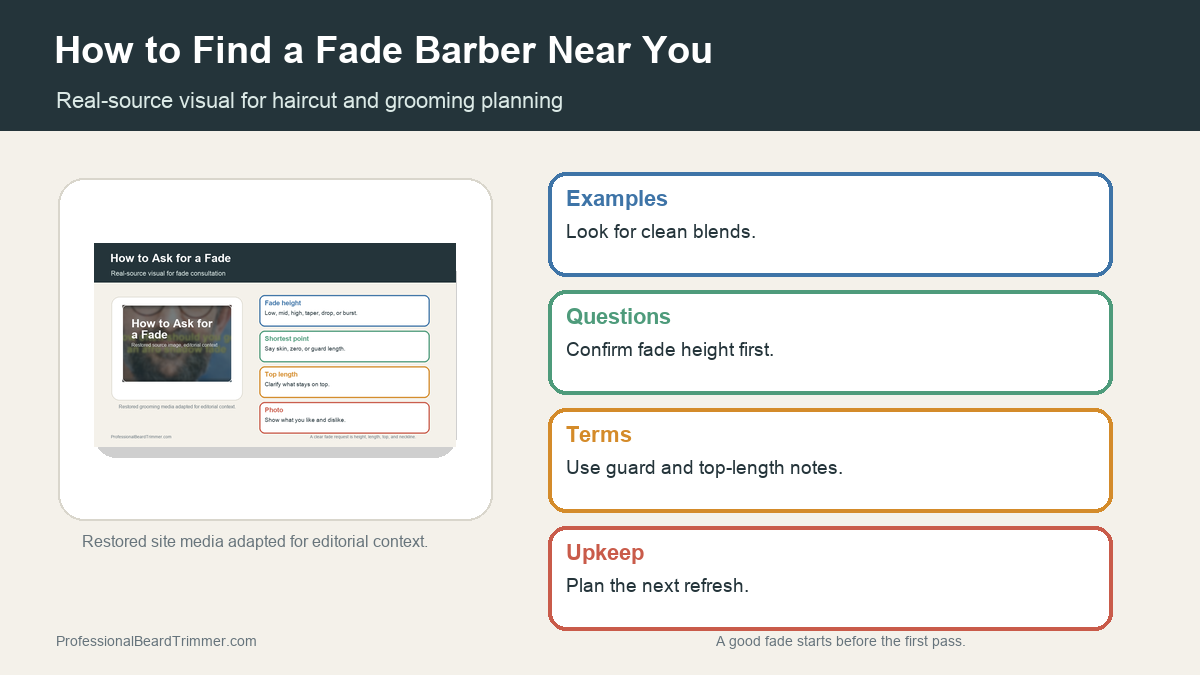
A useful search starts with a practical service description. Decide whether the fade should begin low, around the temples, or higher on the head; whether the shortest area should show skin or retain visible hair; how gradually it should transition; and how much length should remain on top. Also identify the neckline, sideburn, temple, and around-the-ear finish.
Terms such as low fade, mid fade, high fade, skin fade, taper, drop fade, and burst fade describe different structures, but photos and local vocabulary vary. Use a reference image to show direction, then ask the barber to translate it into starting length, transition area, top treatment, and outline. The site’s taper and fade guide helps separate two commonly confused requests.
If a beard is part of the service, define whether the sideburn should blend into the beard, remain visually separate, or preserve fullness. State the target cheek, chin, mustache, and neckline lengths before cutting starts. A fade specialist may not automatically include detailed beard shaping in the haircut service.
Build a Local Shortlist
Search current maps, professional directories, referrals, shop sites, and individual portfolios using your town, neighborhood, or postal area plus the exact service. Create a shortlist rather than choosing the first result. Confirm that each profile belongs to the same person and location shown by the booking channel.
Look for recent work across several clients, not only a single showcase image. Useful examples show both sides, the back, the transition in ordinary light, and the top connection. Prioritize examples with hair texture, density, hairline, head shape, and starting length reasonably close to yours.
Directory position, review count, star rating, follower count, awards, and “best barber” wording are not controlled evidence of current service fit. Reviews can identify questions to ask, but they do not establish credentials, sanitation, availability, or a predictable result. Avoid repeating unverified allegations about a person or shop.
Verify Credentials in Your Jurisdiction
Use the official regulator for the place where the service will occur. Requirements and terminology differ between states and countries, and some systems distinguish an individual barber credential from a shop or establishment credential. Search the current professional name and location, record the date checked, and contact the regulator when a partial match or status is unclear.
For example, the California Board consumer and license-verification resources provides a license search and establishment locator for California consumers. Its inspection information explains that California establishments are subject to health and safety inspections and identifies records consumers may expect to see. These are California examples only; use your own jurisdiction’s regulator for the actual appointment.
A current credential is a baseline compliance check, not a style endorsement or result guarantee. If a storefront name, booking account, receipt, professional name, and official record differ, ask the provider to explain the relationship before paying or attending.
Review a Portfolio for the Exact Task
Compare the shortest area, blend consistency, weight line, temple and ear work, neckline, crown transition, and connection to the top. For beard fades, inspect how the sideburn joins the cheek and jaw length. Seek multiple examples relevant to the desired finish rather than treating unrelated cuts as proof.
Photos can be affected by lighting, enhancement, styling products, camera angle, and the client’s starting point. They cannot prove the cut’s durability, sanitation, appointment experience, or how it grew out. Ask when the examples were made and whether the barber shown is the person you would book.
If your hair has tight curls, fine density, a receding hairline, scalp folds, scars, cowlicks, or a strong crown pattern, ask for comparable examples and discuss visibility before choosing a very short area. This is a communication step, not a judgment about which texture or feature is suitable.
Use a Measurable Consultation
Bring one or two reference images and identify what you like in each. Ask the barber to repeat the plan using measurable or visible reference points: shortest length, fade height, transition zone, top length, bulk around the parietal ridge, temple shape, neckline, sideburn, and beard connection.
Disclose the last haircut, home trimming, product use, hair growth direction, tender areas, and any cuts or irritation that could affect the service. Ask what result is realistic from the current length and agree on a less aggressive fallback if the reference requires more length or density.
For beard work, use the guard-size guide to discuss remaining length without assuming guard numbers are universal. The beard neckline guide supplies neutral placement vocabulary. Ask the professional to confirm the actual tool and measurement used.
Check Sanitation as a Process
Observe how clean and used tools, guards, combs, towels, capes, and neck strips are separated; whether visible hair and debris are removed; whether reusable implements are processed between clients; and whether the workstation and hands are prepared for the next service. Ask a neutral question when a step is unclear.
Requirements vary by jurisdiction, so the applicable regulator controls. The California Board’s infection-control resources illustrate the type of official consumer guidance that may be available. Do not assume a photograph, fragrance, clean-looking counter, or visible container proves that the complete process was followed.
The site’s barber cleaning supplies checklist explains the difference between possessing a product and completing cleaning, correct preparation, contact time, drying, and protected storage. Do not handle professional tools or chemical containers yourself.
Confirm Service Scope and Current Terms
Ask whether the selected appointment includes consultation, shampoo, top cutting, fade, outline, beard work, razor finishing, designs, or styling. Confirm expected duration and whether long hair, a major restyle, beard detailing, or extra consultation requires a different service slot.
Prices, deposits, tips, walk-in availability, hours, staff, cancellation terms, payment methods, and refund policies can change. Verify them directly through the provider’s current channel. This page does not quote a price, confirm an opening, collect a booking, or establish a relationship with a provider.
Confirm the address, suite, entrance, accessibility, parking or transit plan, and appointment time. Use a booking link reached from a verified shop or professional profile, then check the service, provider, date, amount, and confirmation before sending payment information.
Account for Comfort, Access, and Communication
Tell the provider about mobility, sensory, communication, privacy, religious, or personal-care needs that affect the appointment. Ask about step-free access, seating, waiting arrangements, companion policies, fragrance exposure, mask preferences, quiet appointments, or a private service area when relevant.
A professional fit includes the ability to discuss boundaries and stop when requested. If the plan changes during the service, ask for a pause and a fresh explanation before more length is removed. Do not proceed when identity, sanitation, consent, price, or service scope remains unresolved.
Save Notes for a Repeatable Result
After a satisfactory appointment, record the provider, date, top length, shortest setting, fade height, transition notes, neckline, temple and sideburn shape, beard connection, styling products, and approximate maintenance interval. Ask the barber which details are useful to retain.
Notes improve communication but do not guarantee an identical result. Hair growth, starting length, weather, styling, tool systems, and the professional’s technique can change the appearance. Guard labels should be paired with an actual measurement or tool system where possible.
Between appointments, use the short-beard touch-up guide for conservative cleanup. Avoid moving a fade boundary or removing transition weight unless you intend to redesign the haircut.
Decision Sequence
- Write the desired fade height, shortest length, top treatment, outline, and beard connection.
- Create a shortlist from current local sources and verify the provider and location identities.
- Use the applicable regulator to check professional and establishment records where available.
- Review several recent, relevant portfolio examples without treating them as guarantees.
- Ask every finalist the same consultation, sanitation, timing, access, and policy questions.
- Choose the provider whose current evidence and communication best fit this specific service.
- Save factual service notes after the appointment and reassess fit when needs change.
Frequently Asked Questions
How do I find a good fade barber near me?
Define the exact fade, search locally, verify current credentials where available, inspect several relevant examples, and use a measurable consultation. “Good” is task-specific; no directory position or rating proves universal fit.
What should I ask for when booking a fade?
State the fade height, shortest length, transition, top length, neckline, temple and sideburn finish, and whether beard blending is included. Ask the provider to confirm the service duration and booking category.
Should I choose a skin fade or leave visible length?
Choose based on the desired contrast, scalp visibility, comfort, growth pattern, upkeep, and workplace or personal preference. Discuss a less aggressive fallback before cutting if you are uncertain.
Does a high rating prove a barber is licensed and sanitary?
No. A rating does not establish current credentials, establishment status, sanitation process, service fit, or a particular result. Verify official records and current shop information separately.
Sources and Claim Boundary
Primary references reviewed in July 2026 are the California Board of Barbering and Cosmetology consumer, license, establishment, inspection, and infection-control resources linked above. California is used as an example of an official verification system, not as a statement of rules elsewhere. This page is a search framework, not a ranking, endorsement, shop visit, inspection, booking service, or legal opinion. It does not verify a named provider, report hands-on experience, promise a result, or state current prices, ratings, availability, staff, hours, policies, or credential status.