
Disclosure: This site may use affiliate links. Product specifications should be checked against manufacturer or retailer pages before purchase.
Direct Answer
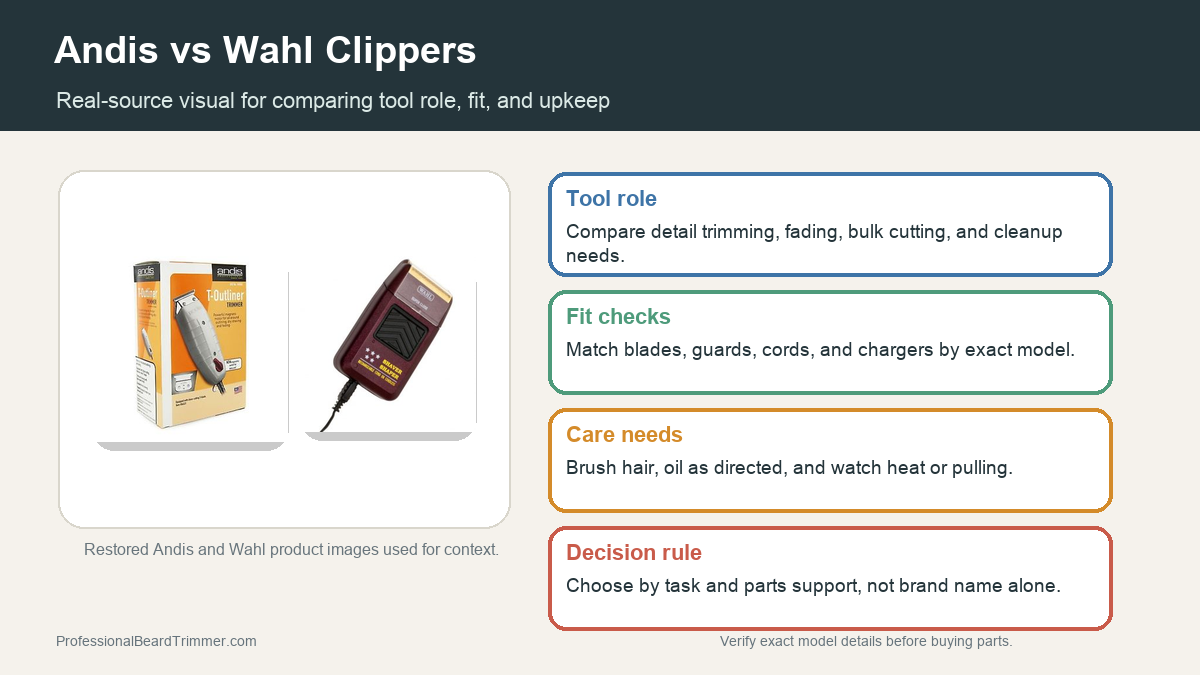
Neither Andis nor Wahl is automatically the better clipper brand. Choose between exact models by the work you need to do, blade and guard system, corded or cordless power, replacement-part path, cleaning requirements, and how the body fits your hand. Compare documented model features side by side; do not transfer one tool’s blade, guard, runtime, or maintenance instructions to another.
Andis vs Wahl at a Glance
| Decision area | What to compare | Why brand alone is insufficient |
|---|---|---|
| Primary task | Bulk cutting, fading, beard reduction, outlining, or finishing | Both brands sell tools with different roles and head sizes |
| Blade system | Adjustable, detachable, fixed, or replaceable cartridge | Blade families and mounting methods differ by model |
| Guards | Documented lengths, attachment method, and replacement availability | Guard numbers and fit are not universal |
| Power | Corded, cordless, charge method, regional voltage, and operating mode | Specifications vary across products and regions |
| Maintenance | Cleaning, oiling, alignment, disinfection, and storage instructions | Care procedures depend on the exact blade and housing |
| Support | Manuals, blades, guards, chargers, service, and seller terms | A familiar logo does not guarantee parts for an old model |
Start With the Grooming Task
Define the job before comparing products. A full-size clipper is useful for broad passes, scalp hair, fades, and reducing a long or dense beard. A narrower trimmer is easier to control around the mustache, cheek line, neckline, and other tight facial areas. A foil shaver is a finishing tool for very short remaining hair, not a substitute for guarded length control.
Andis and Wahl both offer multiple tool types, so a brand comparison cannot replace a role comparison. Use the trimmer, clipper, and shaver guide to identify the tool category first. Then compare only models designed for the same task. A compact detail trimmer should not be judged against a heavy-duty bulk clipper as though they are direct alternatives.
List the services or home-grooming steps the tool must cover. Include the longest starting hair, intended final length, edge work, available outlets, cleaning time, and whether another tool already handles close finishing. This prevents an attachment count or brand reputation from deciding a problem that should be defined by workflow.
Compare the Blade Systems
Check whether each candidate uses an adjustable blade, detachable blade, fixed screw-mounted blade, T-blade, or another documented system. Record the exact blade part number, cutting-width information, adjustment method, and replacement procedure. Similar-looking blades are not proof of compatibility.
The official Andis professional tool education and maintenance guides includes Andis blade, attachment-comb, motor, and maintenance references. Use those materials for the applicable Andis model, then use the exact Wahl manual or product support page for the Wahl candidate. Do not use one brand’s alignment distances, screws, blade drive, or lubrication directions on the other brand.
Inspect blade teeth and alignment before use. Stop if teeth are bent, broken, uneven, or able to contact skin in a way the manual does not permit. A “zero gap” label is not a universal setup instruction. Closer alignment can reduce the safety margin, and a moving cutter must never project beyond the stationary teeth.
Check Guards and Length Control
Guard numbers do not form a universal cross-brand standard. Confirm the millimeter or inch length stated for each attachment, how it locks to the exact blade, and whether replacement guards remain available. A guard that clips onto one Andis or Wahl family may not fit another family from the same brand.
If a model uses an adjustable lever, document the lever range and how it combines with guards. The clipper lever open versus closed guide explains the general relationship, but the exact model manual controls the actual range. Test a longer documented setting first, especially when shortening a beard rather than cutting scalp hair.
Secure each guard before a pass. Do not use an attachment that rocks, bends, has missing teeth, or can detach under light pressure. Guard fit is a more useful selection factor than the total number shown on a package.
Compare Corded and Cordless Power
Corded clippers can provide continuous operation when the outlet, cord length, voltage, and workspace are suitable. Cordless clippers reduce cable interference but add charging, battery aging, storage, and backup questions. Some models can operate while connected to power; others use the cable only for charging. Verify the manual rather than assuming “corded/cordless” behavior.
For each exact model, record regional voltage, supplied charger or cord, charging method, manufacturer-stated charge time and runtime, low-battery indication, and battery-service route. Runtime is a specification under stated conditions, not a promise for a used battery or every cutting load. Never use an unverified charger merely because its connector fits.
The corded versus cordless guide can help map those facts to a routine. For professional use, also decide what happens if the primary tool is charging, damaged, or awaiting a blade. Continuity may require a compatible backup rather than the largest advertised battery number.
Maintenance and Replacement Support
Maintenance can matter more over time than the logo on the housing. Confirm how to brush the blade, where and how often to oil it, whether it can be removed, how alignment is checked, which surfaces may be rinsed, and which disinfectants are permitted. “Washable,” “rinseable head,” “wet and dry,” and “waterproof” are different claims.
Wahl Professional publishes an official clipper and trimmer care guide covering cleaning, cooling, disinfection, oiling, and cord storage for applicable Wahl tools. Follow the exact product instructions and local sanitation rules. Do not assume a chemical, contact time, oil, or rinsing method approved for one product is approved for every tool.
Before buying, verify current access to the exact blade, guards, charger or cord, screws, blade drive where applicable, and authorized service. Older models may remain usable while proprietary wear parts become difficult to source. This page does not make current stock, price, warranty, or availability promises.
Handling, Noise, Heat, and Vibration
Published dimensions and weight help narrow a list, but comfort is individual. Consider handle diameter, balance, surface grip, switch location, blade visibility, cord pull, guard-change effort, and whether the tool can be controlled around facial curves. If possible, handle a clean display unit or buy under clear return terms.
This comparison does not provide measured noise, temperature, vibration, cutting speed, or fatigue results. An unusual increase in heat, sound, or vibration can reflect packed hair, poor lubrication, damaged teeth, misalignment, a worn drive component, or work outside the tool’s intended role. Stop and inspect rather than pressing harder.
How to Make the Final Choice
- Name the task. Separate bulk clipping, fading, guarded beard length, detail work, and close finishing.
- Choose comparable models. Compare products in the same tool class and regional configuration.
- Verify blade and guards. Record exact part numbers, documented lengths, attachment method, and replacement path.
- Check power. Confirm cord, charger, voltage, operating modes, battery service, and backup needs.
- Read care instructions. Compare cleaning, oiling, alignment, disinfection, water exposure, and storage.
- Assess handling separately. Treat grip and balance as personal fit, not a universal brand result.
- Confirm support and terms. Check manuals, current parts, service routes, seller condition, and return terms before purchase.
Frequently Asked Questions
Is Andis or Wahl better for beard trimming?
Neither brand is universally better. Compare exact trimmer or clipper models by head width, blade system, guards, minimum and maximum documented lengths, power, handling, and maintenance support for your beard routine.
Can Andis and Wahl guards be interchanged?
Do not assume so. Guard compatibility depends on the exact blade and attachment system. Verify the manufacturer part number and secure fit for the specific model.
Which brand is better for professional barbers?
Professional fit depends on services, sanitation requirements, parts access, backup tools, ergonomics, and local support. A brand name or “professional” label does not prove that one model suits every shop.
Should I choose corded or cordless?
Choose corded for continuous operation when the cable and outlet fit the workspace; choose cordless for mobility when charging and backup coverage are manageable. Verify whether the exact model can operate while connected.
Claim and Source Boundary
This is a neutral, source-backed selection framework. It does not name a brand winner or report hands-on testing, measured performance, durability, comfort, noise, heat, vibration, runtime, current price, stock, rating, warranty entitlement, or service availability. Verify the exact model, regional manufacturer documents, current parts support, seller condition, and return terms.