
Disclosure: This site may use affiliate links. Product specifications should be checked against manufacturer or retailer pages before purchase.
Direct Answer
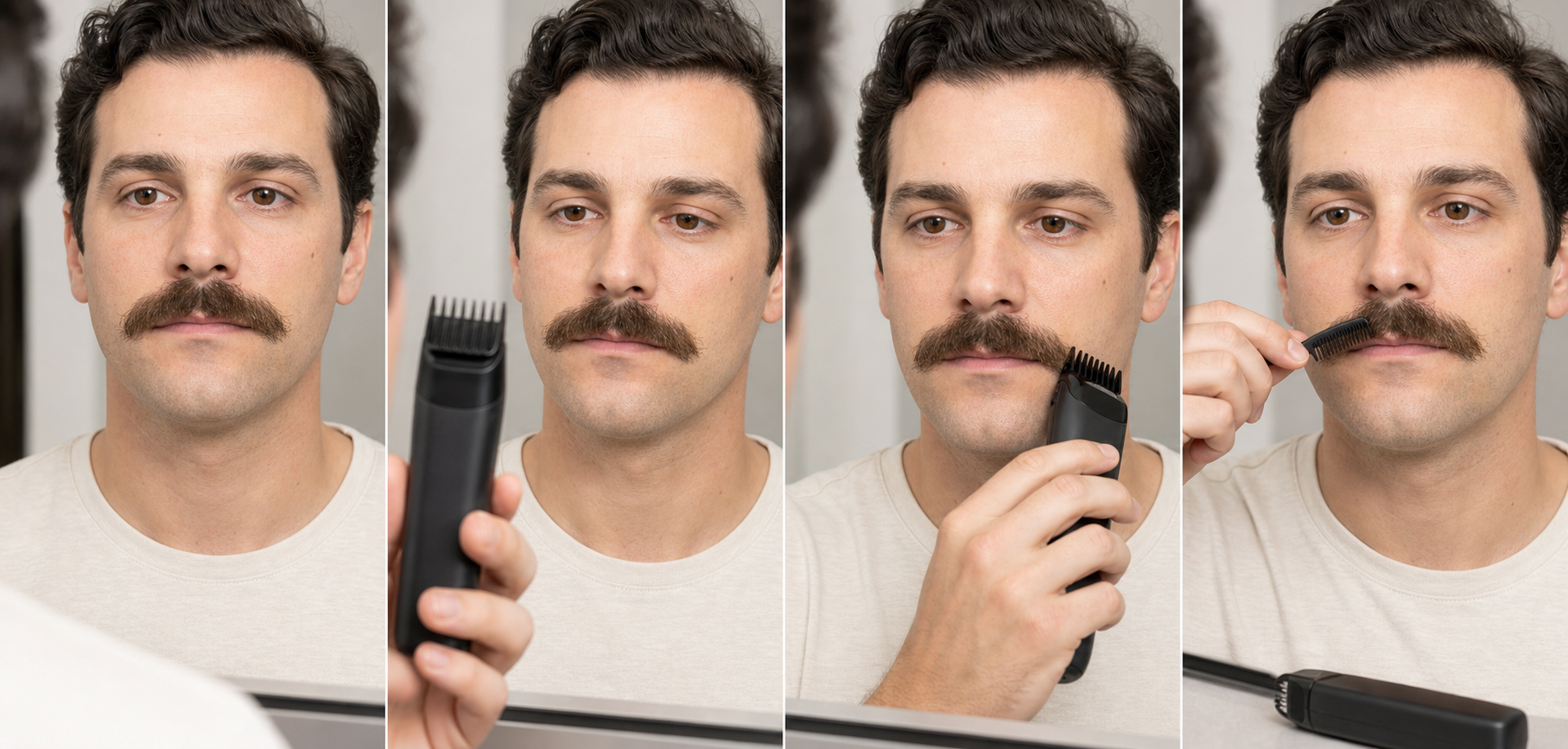
Direct answer: Touch up a mustache without overtrimming by recreating its normal dry baseline, preserving the center, base length, lip opening, corners, and beard connections, and selecting one stable maintenance target. Reuse only a verified prior setup, make one bounded correction, then switch off, clear, recomb, release, and compare the complete mustache before deciding whether to stop.
A touch-up is not a compressed full trim. It maintains an already approved shape by correcting one limited change. If several zones, the base length, center treatment, outline, or style need redesign, stop and plan a separate full session.
Define Touch-Up Scope Before Cutting
Name the exact target: one confirmed longer outer section, one isolated released end, a small bulk change inside an existing zone, or a minor endpoint that has moved outside the approved record. Write down everything that must remain unchanged.
Do not start with “tidy the whole mustache.” That phrase can quietly authorize center, lip, corner, connection, length, direction, and symmetry changes together. A valid touch-up has one target, one reference, one supported method, and one stop decision.
Keep This Intent Separate From Preparation and Full Trimming
The mustache preparation guide owns cleaning, drying, natural combing, boundary mapping, tool inspection, and baseline creation. Use it again when the current state cannot be compared with the prior record.
This page begins only when the established shape is still valid. It does not choose a new style, reset base length, create a center gap, outline the lip, redefine corners, or prescribe a universal cutting direction.
Recreate the Prior Dry Baseline
Use the same ordinary dry state, light, posture, mirror distance, and gentle combing method recorded after the last successful session. Remove heavy product and let compression from sleep, masks, hats, or hands release before comparing.
Wahl’s official trimmer instructions describe combing the mustache in its natural direction so stray hairs become visible. Remove the comb and let the hair settle; do not cut while tension creates a temporary target.
Confirm That the Existing Shape Still Works
Check center continuity or gap, outer width, lip clearance, mouth-corner endpoints, beard connections, and base length. If those elements remain coherent and only one small change persists after release, a touch-up may be appropriate.
If the complete shape has shifted, do not repair it through several local strokes. Return to preparation, guard choice, grain mapping, balance, and outline planning as a full session.
Compare the Current State With an Untouched Record
Use a prior photograph or written zone record when available. Match posture, expression, camera height, distance, and light. Compare the same landmarks rather than relying on a broad memory of how the mustache looked.
Record only observable change: which hair group projects, where it originates, how it settles after two releases, and which protected boundary remains nearby. Do not convert a temporary curl or lighting difference into a cutting target.
Separate Growth From Displacement
A section can appear longer because it grew, curled differently, crossed another zone, retained product, or was pressed out of position. Gently comb, release, wait, and compare again. Trace projecting hair to its origin.
If the target changes sides or disappears after release, no touch-up is needed. Maintenance should respond to a stable change, not to every variation in the way hair rests.
Protect the Existing Center Treatment
Record whether the center is continuous, overlapping, split, or intentionally gapped. Keep it outside the first and usually the entire touch-up. A small center change can alter the complete style and is difficult to reverse locally.
The mustache middle-gap guide treats creation or maintenance of that feature separately. A touch-up should preserve the prior center decision unless the center itself is the explicitly planned session.
Protect the Base Length
Identify the shortest released hair group that still supports coverage, bulk, endpoint structure, or a beard connection. The base length is the floor beneath the visible projecting target. Keep any setting or path that could reach it out of the touch-up.
Do not shorten the complete mustache because one end grew beyond the record. The touch-up method must isolate the excess without resetting the underlying zone.
Protect the Lip Opening and Mouth Corners
Observe the lip with the face relaxed. Do not stretch mobile tissue or use it as a hard cutting rail. Trace hair resting near the opening before assigning it to a target, and stop before a guarded path changes into exposed-blade edge work.
Compare each mouth corner independently. An endpoint that shifts with speech or expression is not a stable touch-up target until it returns to neutral and can be traced to one section.
Protect Beard and Goatee Connections
Separate mustache hair from cheek, beard, and goatee hair. Mark the point where ownership changes and preserve the existing connection weight. A broad guard can admit neighboring hair even when the visible target belongs only to the mustache.
Use the scissors-versus-clippers guide to distinguish isolated visible-end work from broader guarded reduction. Tool choice follows the target, not convenience.
Select One Stable Maintenance Target
A suitable target persists after two gentle comb-and-release comparisons, has clear hair ownership, stays away from protected boundaries, and can be reached with a supported method. Describe it narrowly, such as “left outer section extends beyond the prior endpoint.”
Do not select several stray hairs, both corners, and the complete lip edge together. If there is no single target, end the touch-up assessment and plan another session type.
Keep the Better Side or Zone Untouched
Use the side or neighboring zone that still matches the approved record as a reference. Do not alternate sides automatically. The untouched reference shows whether the correction has restored the prior relationship or moved the target.
The mustache balance guide explains matched landmarks and natural asymmetry. A touch-up maintains the chosen relationship; it does not force mathematical mirroring.
Verify the Exact Tool and Prior Setup
Confirm complete model, head, guard, setting, mounting direction, condition, and manual. Reuse a prior setup only when the same verified components, target zone, and base-length protection still apply.
Philips’ current MG3900 manual gives model-specific guard, movement, and cleaning instructions and notes that hair directions vary. Its instructions do not transfer automatically to another trimmer.
Do Not Guess From a Guard Number
Guard numbers, colors, and dial markings are system-specific. Inspect teeth, rails, tabs, locks, and adjustment stops with power off. Confirm the attachment seats as the manual describes and cannot move during the planned path.
The guard-size guide explains why the same label can represent different systems. Begin with the longest verified useful setting, not the shortest setting that could remove the target quickly.
Choose Between Guarded and Isolated-End Work
Use a guard when the target is a small area of bulk whose base length remains protected by the verified setting. Use an isolated-end method only when one released end is clearly visible, traceable, and separated from neighboring hair.
Do not remove the guard mid-pass and continue freehand. Switching methods changes the cutting plane, visibility, and boundary risk. Stop, switch off, and create a separate plan first.
Rehearse the Path With the Tool Off
Hold the switched-off tool beside the target and verify approach, direction, guard contact, stopping point, and distance from center, lip, corner, and connection. Confirm the target can enter without pressing the lip or collecting another zone.
If the path crosses a direction change or protected boundary, do not improvise. Reduce the target area or choose a different supported method.
Make One Bounded Correction
Use only the operation described for the exact tool. Correct the selected target with one controlled pass or one isolated-end action, then lift away before the boundary changes. Keep the reference side and all other zones untouched.
A touch-up is deliberately small. Do not continue because the tool is already running, the mirror reveals another detail, or the first action removed less than expected.
Do Not Add Pressure When Cutting Is Limited
Hair may lie outside the guard opening, curl across another zone, remain below the cutting plane, or be blocked by clippings. Pressure can change contact and hair admission without solving the mismatch.
Switch off, clear, and release before deciding. Do not flatten the lip, force the guard into skin, or repeat strokes to make the session feel complete.
Switch Off and Clear Before Reassessment
Switch off before touching, removing, or clearing an attachment. Follow the exact manual for brushing, rinsing, drying, oiling, and reassembly. Inspect for trapped hair, loose seating, or damaged teeth.
The cleaning and oiling guide supplies general care boundaries. Clearing is part of measurement because a loaded guard can admit hair differently on a second pass.
Recomb, Release, and Compare the Complete Mustache
Gently recomb both the target and untouched reference, remove the comb, and let the hair settle. Return to the original posture, expression, light, and mirror distance. Compare center, lip opening, corners, connections, and base length even though they were outside the correction.
Record what changed and what remained protected. Do not judge the result while holding the target, stretching a curl, or viewing only one close angle.
Change Only One Variable If Another Pass Is Justified
If the same stable target remains, change at most one verified variable: a smaller portion of the zone, a supported setting, or a manual-approved direction. Keep tool, preparation, pressure boundary, posture, and reference otherwise constant.
Do not shorten the setting, reverse direction, add pressure, enter the corner, and trim the other side together. Multiple changes turn a touch-up into an uncontrolled full trim.
Stop When the Prior Shape Is Restored
End the session when the released target again fits the approved landmarks, even if individual hairs are not identical. The aim is maintenance of a coherent shape, not removal of every visible variation.
Also stop when the difference is too small to assign reliably. Continuing past the record creates a new shape without a new plan.
Stop for Pulling, Heat, Movement, or Unexpected Removal
Stop immediately for pulling, pinching, painful contact, broken or bleeding skin, unusual heat, odor, smoke, sound, vibration, slowing, guard movement, or more removal than planned. Switch off before inspection.
Use the trimmer-pulling guide to separate tangles, loading, cutter condition, assembly, maintenance, power, and task mismatch. Do not continue to disguise an unexpected change.
Do Not Repair an Unexpected Cut by Matching the Other Side
After unexpected removal, stop, clear the tool, and let the complete mustache settle. Record the changed zone and protect the untouched reference, center, lip, corners, and connections.
The mustache mistake guide explains immediate recovery boundaries. A later decision may retain the difference, adjust one endpoint, or redesign the style; it should not be automatic equalization.
Know When the Touch-Up Has Become a Full Trim
Stop when several zones need work, the base length must change, both corners need redesign, the center needs a new treatment, or the outline no longer matches the intended style. These changes require a complete preparation and tool plan.
Do not expand scope stroke by stroke. Record the new full-trim need and schedule it as a separate session with its own baseline and boundaries.
Record the Maintenance Result
Record date, preparation state, target, reference, exact tool, head, guard, setting, direction, one correction, clearing, released comparison, and stop decision. Update photographs from matched front and three-quarter views when useful.
Do not describe the result as professionally tested, perfectly even, safer, more comfortable, or suitable for every face. Record only current observable evidence.
Mustache Touch-Up Checklist
- The existing style and base length remain valid.
- The prior dry baseline can be recreated.
- Center, lip opening, corners, connections, and shortest useful section are protected.
- One stable maintenance target persists after two releases.
- The better side or zone remains untouched as reference.
- The exact model, head, guard, setting, direction, and care rules are verified.
- The off-face path stays inside the target.
- Only one bounded correction is planned.
- The tool is switched off before clearing or adjustment.
- The complete mustache is recombed and released before another decision.
- Unexpected removal ends the touch-up.
- A broader change is deferred to a separate full trim.
Frequently Asked Questions
What counts as a mustache touch-up?
A touch-up is one small maintenance correction inside an already approved shape, such as a confirmed longer outer section or one isolated released end. It preserves the center, base length, lip opening, corners, beard connections, and untouched reference rather than repeating a full trim.
How do I touch up a mustache without making it shorter?
Recreate the prior dry baseline, protect the shortest useful section, reuse only a verified prior setup, and select one stable target. Make one bounded correction, switch off, clear, recomb, release, and compare the complete mustache before deciding whether the session is finished.
Should I touch up both sides of a mustache?
Only when each side has its own confirmed maintenance target. Do not trim the second side automatically after correcting the first. Keep the better-shaped side untouched as a reference, then reassess both sides under matched posture, light, and release.
When should a touch-up become a full trim?
Stop the touch-up when the base length, center, several zones, both corners, or the overall style need redesign. Rebuild preparation, guard, direction, outline, and stop plans as a separate full-trim session rather than expanding a small correction without review.