
Disclosure: This site may use affiliate links. Product specifications should be checked against manufacturer or retailer pages before purchase.
Editorial update, June 19, 2026: This recovered page was rebuilt as a practical men's grooming and tool-care guide using restored or current site media. It avoids firsthand-use claims, live shopping data, stock-status statements, score claims, and brand-owned imagery.
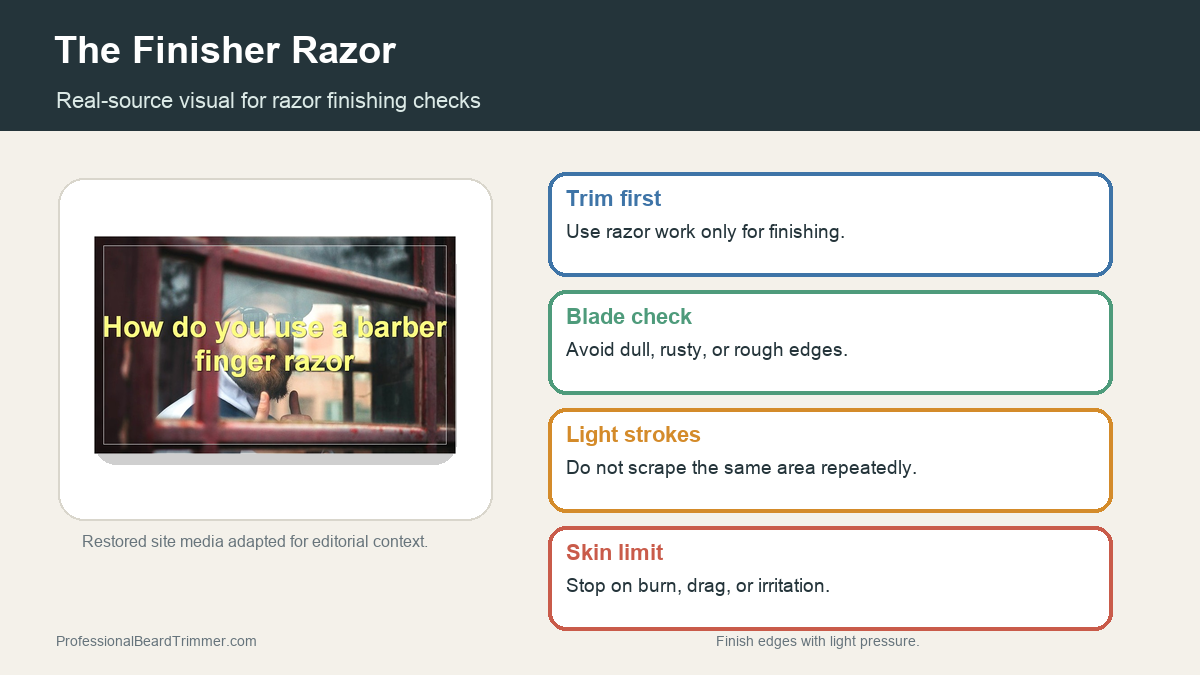
Image note: The image gives shaving-tool context from existing site media. It is not a medical claim, store listing, or usage proof for a specific razor.
Direct answer: A finisher razor is best used for short cleanup work around beard edges, cheek lines, and necklines after trimming. The key checks are blade condition, light pressure, clean skin, controlled angle, and stopping if irritation or dragging appears.
Finisher razor checks
| Check | What to do | Why it matters |
|---|---|---|
| Cleanup role | Use after trimming for short edge cleanup | Razors are not for bulk beard reduction |
| Blade condition | Use a clean, undamaged edge | A dull or damaged blade can drag |
| Pressure | Use light contact and short strokes | Pressure increases irritation risk |
| Skin check | Avoid broken, irritated, or inflamed skin | Damaged skin needs caution and may need professional advice |
| Aftercare | Rinse, dry, and clean the tool after use | Residue shortens tool life and can affect comfort |
How to use a finisher razor carefully
- Trim first. Reduce longer hair with a trimmer before using a razor for finishing.
- Check the blade. Do not use a blade that looks damaged, rusty, or rough.
- Prepare the edge area. Work on clean skin with a controlled angle and good visibility.
- Use short strokes. Keep pressure light and avoid scraping repeatedly over the same spot.
- Stop on irritation. Pause if the razor drags, burns, nicks, or feels uncomfortable.
Razor cleanup checklist
- Trimmed hair: Makes finishing easier and reduces dragging.
- Clean blade: Supports smoother edge cleanup.
- Light pressure: Helps protect the neckline and cheek line.
- Dry storage: Keeps the tool cleaner between uses.
For related reference pages, compare the open comb vs closed comb guide, the beard neckline guide, and the lineup pencil guide.
Frequently asked questions
What is a finisher razor used for?
It is used for short cleanup around beard edges, cheek lines, and necklines after trimming has already reduced the bulk.
Should a razor be used over irritated skin?
Avoid shaving over broken, irritated, or inflamed skin. If irritation is persistent or severe, stop and seek qualified guidance.
Why does a razor drag after trimming?
Dragging can come from hair that is still too long, a dull blade, dry skin, too much pressure, or repeated passes over the same area.
How should a finisher razor be stored?
Rinse residue, dry the tool, protect the blade edge, and store it away from moisture and loose grooming tools.