Disclosure: This site may use affiliate links. Product specifications should be checked against manufacturer or retailer pages before purchase.
Editorial update, June 18, 2026: This recovered page was rebuilt as a lever-position explainer with a neutral diagram, comparison table, safe testing process, and FAQ.
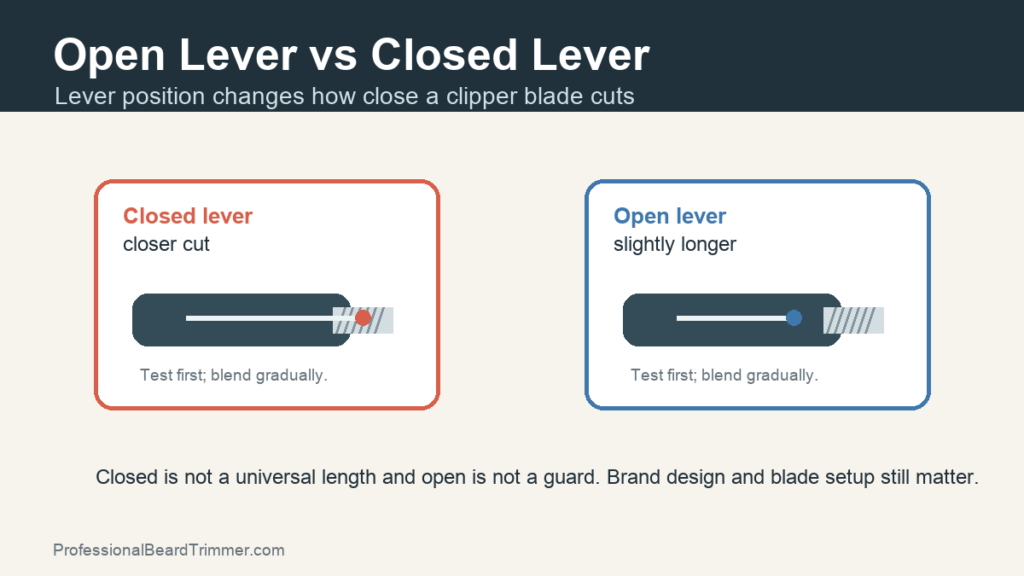
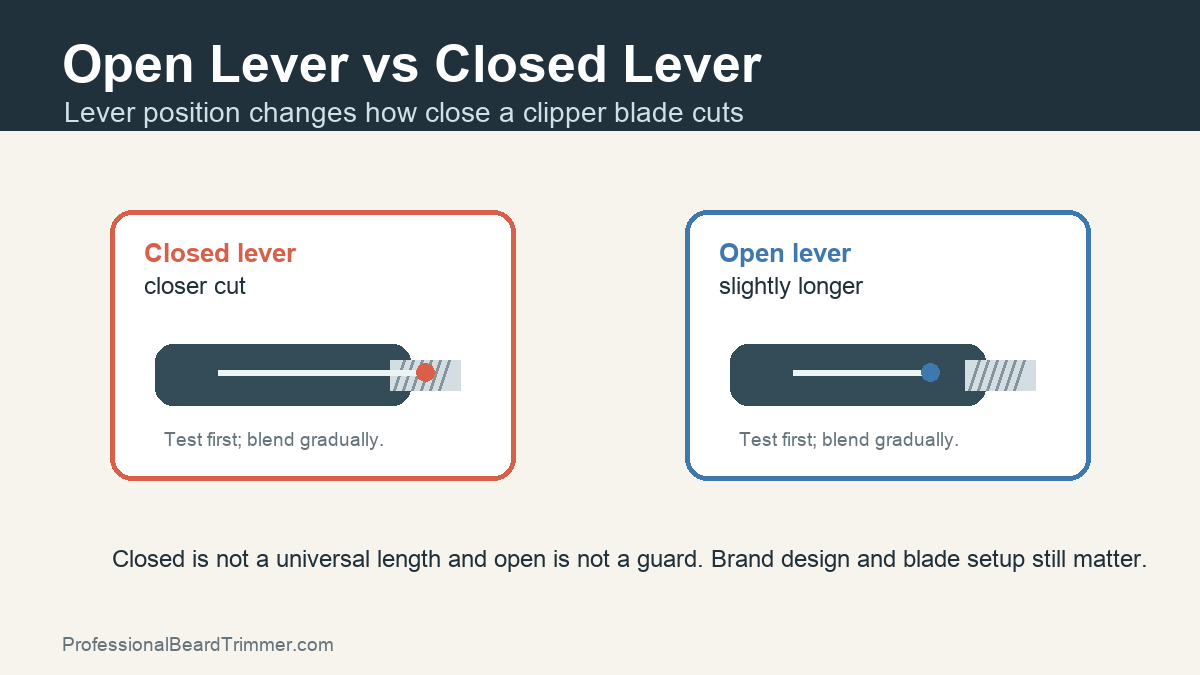
Direct answer: A closed lever usually moves the cutting blade into a closer position, while an open lever usually leaves slightly more length. The exact result is not universal because blade setup, guard fit, hair direction, and pressure still change the cut.
Open lever vs closed lever
| Position | Typical effect | Use when | Be careful with |
|---|---|---|---|
| Closed lever | Closer cut | You need a tighter finish, lower blend point, or cleaner stubble edge | It can remove more hair than expected |
| Open lever | Slightly longer cut | You need a softer first pass or want to blend gradually | It is not the same as adding a guard |
| Halfway lever | Intermediate length | You are softening a transition between close and open passes | Small movements can change the result |
Why the result is not universal
Lever position changes blade exposure, but it does not create a fixed millimeter length across every clipper. Blade adjustment, guard shape, hair density, skin pressure, and trimming direction all affect the final look. Treat lever position as a blending control, not a guaranteed measurement.
Safe testing process
- Start with the safer setting. Begin open or with a longer guard if you are not sure how close the tool cuts.
- Test under the jaw. Use a low-visibility area before trimming the full beard or hairline.
- Move the lever gradually. Close the lever in small steps and check the result after each pass.
- Blend with light strokes. Use short overlapping strokes instead of pressing hard into the skin.
- Clean the blade after use. Hair buildup can change how the blade feels and cuts.
For beard shaping, pair lever control with the beard fade guide, the neckline guide, and the 0.5mm vs 1mm length guide.
Frequently asked questions
Does closed lever always mean zero length?
No. Closed lever usually cuts closer, but the exact result depends on the blade, adjustment, guard, hair direction, and pressure.
Does open lever add a guard length?
No. Opening the lever usually leaves slightly more length, but it is not the same as adding a guard.
Which lever position should I start with?
Start open or with a longer guard when you are unsure, then close the lever gradually only after checking the result.
Can I use lever positions for beard fading?
Yes. Lever positions help soften transitions, but you still need gradual passes and careful blending.
Why do different clippers feel different at the same lever position?
Blade shape, blade gap, motor behavior, and guard design vary by tool, so lever positions are not universal measurements.