
Disclosure: This site may use affiliate links. Product specifications should be checked against manufacturer or retailer pages before purchase.
Editorial update, June 18, 2026: This recovered page was rebuilt as a practical vacuum-trimmer decision guide. It now uses a neutral cleanup diagram, clear tradeoff checks, FAQ, and safe maintenance steps instead of thin placeholder content.
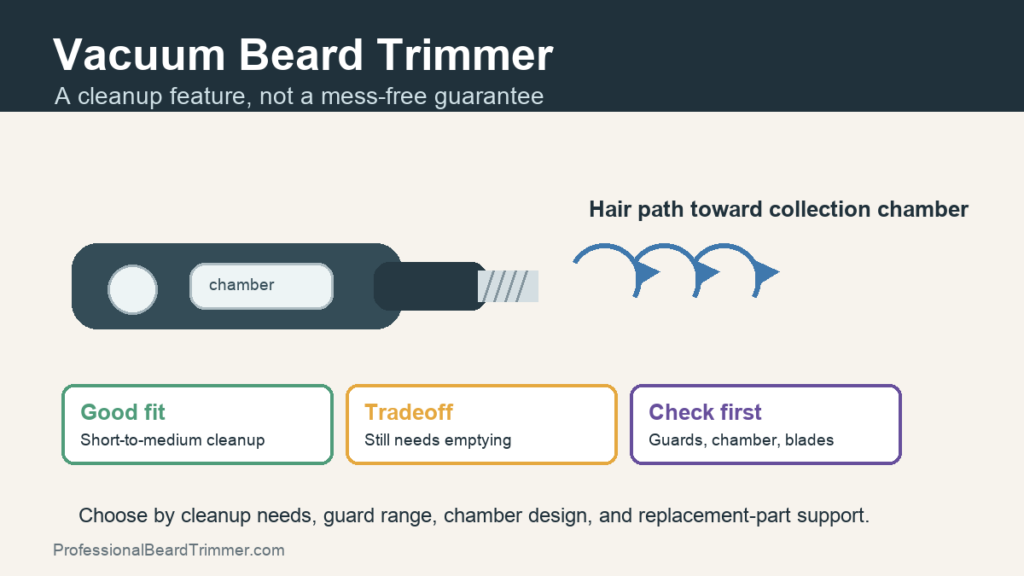
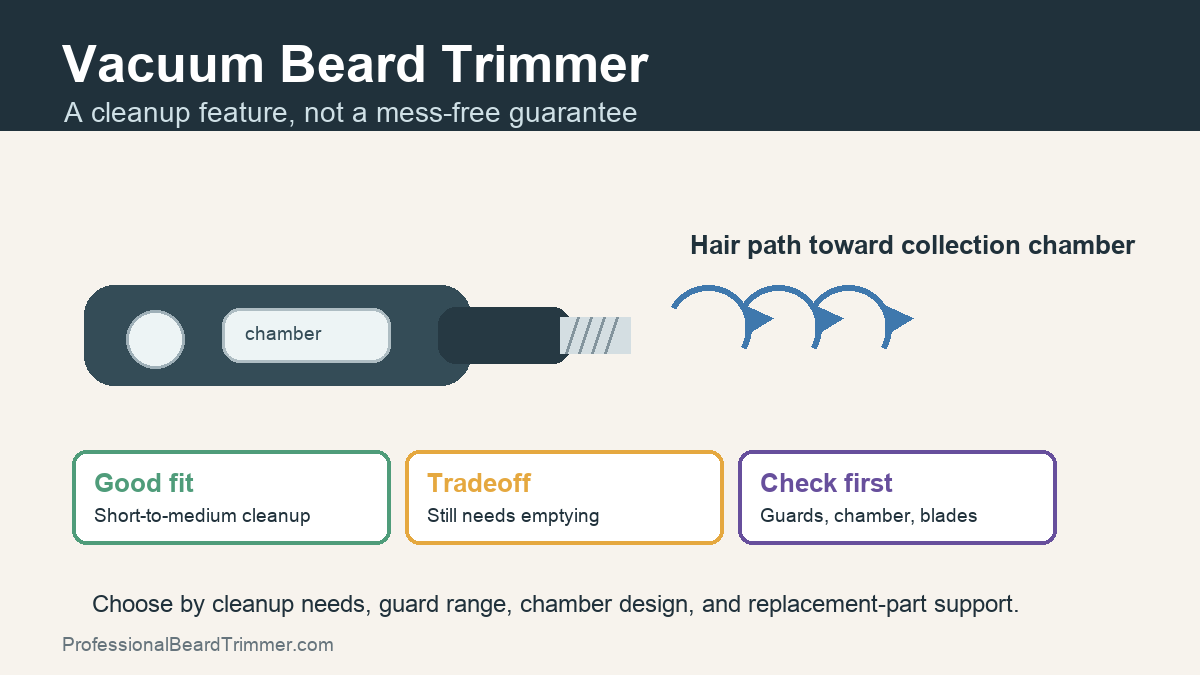
Direct answer: A vacuum beard trimmer can reduce loose clippings during short-to-medium cleanup, but it is not a mess-free guarantee. Choose one when sink cleanup is a major annoyance, the guard range matches your beard length, and the chamber is easy to empty and brush clean.
When a vacuum beard trimmer makes sense
The vacuum feature is most useful for regular stubble cleanup, short-beard maintenance, and quick edge tidying over a sink. It is less important if you mainly reduce long-beard bulk, fade dense cheek areas, or need a narrow detail head around the lips.
| Use case | Fit | Reason |
|---|---|---|
| Daily stubble cleanup | Strong fit | Short clippings are easier for the chamber to collect |
| Short boxed beard maintenance | Good fit | Useful if the guards cover your normal length |
| Long-beard bulk removal | Weak fit | Longer hair can clog the head or miss the chamber |
| Mustache detail work | Mixed fit | A bulky head can reduce precision near the lip |
| Travel use | Mixed fit | Cleanup helps, but chamber cleaning and charger type still matter |
Buying checklist
- Collection chamber: it should open easily and empty without scattering hair.
- Guard range: the useful guard lengths should match your normal beard style.
- Blade access: the head should allow brushing and normal blade care.
- Replacement support: guards, blades, and chargers should be available for the model family.
- Detail control: check whether the head shape can handle mustache, neckline, and cheek-line cleanup.
How to test one after buying
- Decide whether cleanup is the main problem. Choose a vacuum design only if loose sink hair matters as much as trim control.
- Match the guard range to your beard. Short and medium guard settings usually benefit most from the chamber.
- Inspect chamber access. Look for a chamber that opens easily and can be emptied without scattering hair.
- Check blade and guard support. Replacement blades, guards, and a cleaning brush keep the tool useful longer.
- Clean after each use. Empty the chamber and brush the head before storing the trimmer.
Before choosing by cleanup alone, compare the guard sizes guide, the length chart, and the blade oiling guide. Cleanup only helps if the trim length and blade care are right first.
Frequently asked questions
Do vacuum beard trimmers catch every clipping?
No. A vacuum chamber can reduce loose hair during short-to-medium cleanup, but some clippings still fall around the sink, collar, or guard.
Who should consider a vacuum beard trimmer?
It makes sense when sink cleanup is a major annoyance and you mostly maintain stubble or a short beard.
Are vacuum beard trimmers good for long beards?
They are usually less helpful for long-beard bulk removal because longer hair can miss the chamber or clog the head faster.
What should I check before choosing one?
Check guard range, chamber access, blade cleaning, replacement support, and whether the head shape suits neckline and mustache work.
Do I still need to brush and oil the blade?
Yes. The vacuum feature does not replace normal cleaning and blade care. Follow the tool manual for brushing and oiling.