Disclosure: This site may use affiliate links. Product specifications should be checked against manufacturer or retailer pages before purchase.
Direct Answer
Direct answer: Choose a beard balm scent by checking the complete ingredient list, fragrance wording, scent strength, and where you plan to wear it. Compare one balm at a time, use the smallest label-directed amount, and judge the settled scent rather than the open container. Choose fragrance-free when fragrance is unwanted or uncertain, and stop for any unexpected reaction.
This is a non-ranking selection and use guide. It does not name a universally best-smelling beard balm, report hands-on testing, guarantee how long a scent lasts, diagnose sensitivity, or publish live prices, stock, ratings, seller quality, or therapeutic claims.
Start With the Job the Balm Must Do
Define the grooming task before choosing a scent. A beard balm may be used for light control, surface smoothing, or a more structured finish, depending on its formula and directions. Fragrance is only one part of that decision. A pleasant scent cannot compensate for a texture, hold level, ingredient list, or application method that does not fit the routine.
Keep the product category clear. A balm commonly contains oils, butters, waxes, fragrance, and other cosmetic ingredients in different proportions. It is not automatically interchangeable with beard oil, beard butter, moisturizer, pomade, or trimmer lubricant. The beard oil versus beard butter guide separates lighter conditioning formats from heavier products without ranking either one.
Use a Non-Ranking Scent Framework
| Question | Evidence to check | Reason to reconsider |
|---|---|---|
| What scent family is described? | Manufacturer description plus the ingredient declaration | The seller uses only vague lifestyle language |
| How strong is it? | Brand directions, a conservative personal trial, and settled observation | Strength or duration is promised without a defined test |
| Is fragrance acceptable? | Fragrance-free wording and the complete ingredient list | Fragrance is present, hidden behind unclear wording, or unwanted |
| Where will it be worn? | Work, travel, shared spaces, exercise, and other scented products | The scent conflicts with a policy or close-contact setting |
| Does the balm fit the beard? | Texture, hold, directions, amount, removal, and residue | The formula is difficult to spread or leaves persistent buildup |
| Is the product current and identifiable? | Package, lot details, responsible company, seller, and condition | The delivered label differs from the listing |
This framework compares evidence and routine fit, not popularity. A product can be well known and still be the wrong strength, texture, ingredient profile, or context for a particular person.
Read the Complete Ingredient Declaration
Use the package or current manufacturer page rather than a marketplace title alone. Record the ingredients as shown and note fragrance, essential oils, botanical extracts, color additives, preservatives, waxes, and butters. The ingredient list helps comparison, but it does not prove how a product will smell on one person or whether it will be comfortable.
FDA’s cosmetic ingredient-name guidance explains that retail cosmetics generally require ingredients to be listed by common or usual names. Fragrance mixtures can still appear under general wording, so contact the responsible company when a specific concern cannot be resolved from the label.
Understand the Word Fragrance
The FDA guidance on fragrances in cosmetics explains that fragrance formulas may contain several natural or synthetic ingredients and may be listed simply as “Fragrance.” It also explains that some products labeled unscented can include fragrance used to mask another odor. That makes front-label wording an incomplete screening tool.
Do not assume that a botanical name reveals the complete fragrance system. Likewise, do not describe synthetic fragrance as automatically unsafe or natural fragrance as automatically gentle. Safety and tolerance depend on the finished formula, intended use, directions, exposure, and individual response.
Fragrance-Free and Unscented Are Different Checks
If fragrance is unwanted, look for fragrance-free wording and then inspect the ingredient declaration. Unscented can describe the absence of a noticeable smell while a masking fragrance is still present. Neither term establishes that every person will tolerate the formula.
The fragrance-free and unscented beard oil guide provides a related label-reading workflow. Apply the same principle to balm: use current package evidence, ask the manufacturer when necessary, and avoid turning a marketing phrase into a universal sensitivity claim.
Separate Scent Family From Scent Strength
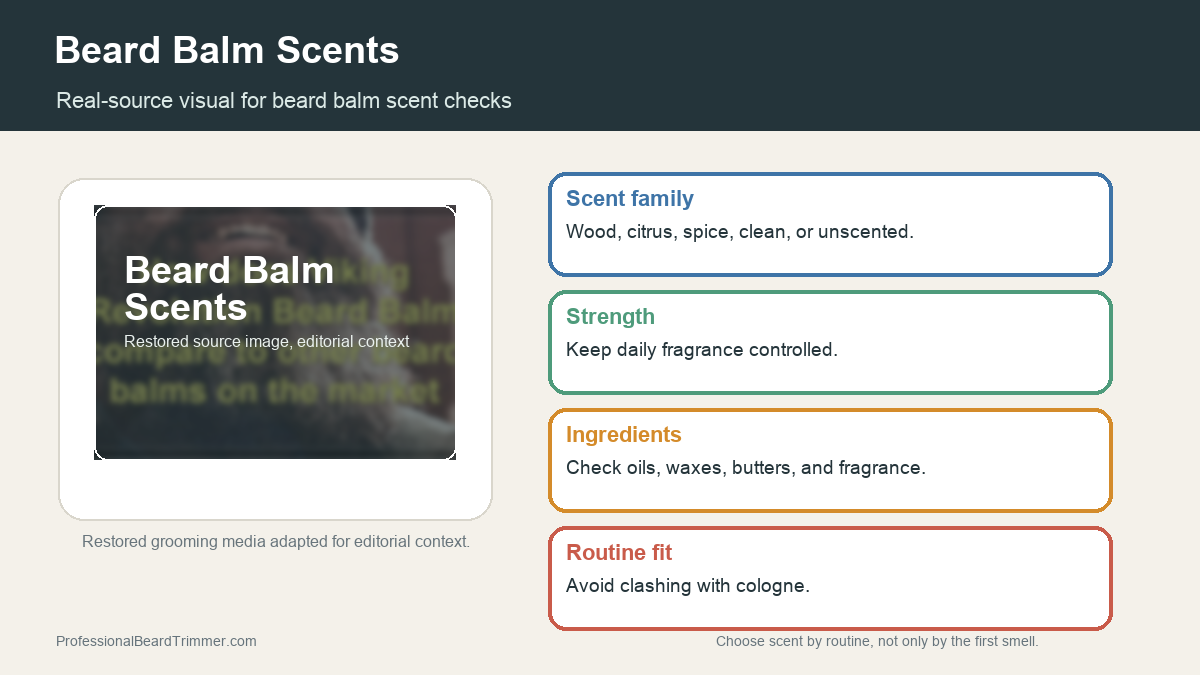
Wood, citrus, spice, mint, floral, resin, smoke, leather, vanilla, and clean-style descriptions identify an intended direction, not a standardized formula. Two products using the same family name can smell different because their ingredients, proportions, wax base, package age, and application amount differ.
Strength is a separate variable. A subtle wood balm and a strong wood balm do not create the same close-contact experience. Compare the amount used, time after application, and surrounding products under consistent conditions. Do not publish a universal “strong” or “all-day” claim from one description or testimonial.
Evaluate the Settled Scent
The smell from an open tin is not the complete wearing experience. Waxes and butters can affect how fragrance is released, and the perceived balance can change after the balm is warmed and spread. Follow the label, use a small amount, and assess the scent after it settles rather than repeatedly opening the container.
Record the product, amount, application time, other scented products, setting, and observation interval. This personal note can support a repeatable routine, but it is not a controlled laboratory test and does not establish performance for other people.
Plan Around Work and Shared Spaces
Some workplaces, clinics, schools, transport settings, events, and shared homes may have fragrance policies or occupants who prefer low-fragrance environments. Check the applicable policy and choose a conservative option when the context is uncertain. Personal preference does not override another person’s access or a written rule.
A fragrance-free balm can simplify close-contact routines, but it is not mandatory for every workplace and it is not guaranteed to have no odor. Raw materials can have their own smell. Verify the label and use context instead of relying on “office safe,” “subtle,” or similar seller language.
Coordinate Balm With Cologne and Aftershave
Using balm, cologne, aftershave, deodorant, cleanser, and hair products together can create a different combined scent than any product alone. If fragrance layering matters, introduce one scented product at a time and keep the others stable. A fragrance-free balm can reduce one variable.
There is no rule that balm must match cologne exactly. Compare intensity, application location, timing, and the settled result. Avoid applying more balm merely to strengthen fragrance because that also changes wax, oil, residue, and styling behavior.
Check Texture and Hold Separately
Scent does not determine whether a balm spreads evenly, adds suitable hold, transfers to clothing, or washes out under the normal routine. Read the intended use and directions, begin with a small amount, and assess hair control and skin feel separately from fragrance.
For a short beard, a heavy wax-rich product may be more structure than the routine needs. The short beard length and shape guide helps map the grooming task before a styling product is chosen. For longer beards, sectioning can improve distribution without increasing the dose immediately.
Do Not Rank Oils, Butters, or Waxes by Reputation
Shea butter, cocoa butter, beeswax, plant waxes, coconut oil, jojoba oil, argan oil, and other materials can appear in many formulas. Their presence alone does not prove scent quality, safety, non-greasiness, conditioning performance, pore compatibility, or suitability for every beard.
Compare the complete formula and directions. A recognizable ingredient can still be present with fragrance or other components that matter more to the decision. The coconut beard balm guide shows how to evaluate one ingredient theme without turning it into a best-product endorsement.
Treat Natural and Essential-Oil Claims Carefully
Natural origin does not establish that a fragrance ingredient is non-irritating, allergy-free, or appropriate for unlimited use. FDA applies cosmetic safety requirements to plant-derived and synthetic ingredients alike. Essential-oil language also does not prove therapeutic benefit or make a finished balm suitable for a medical condition.
Do not repeat claims that a scent treats stress, anxiety, sleep problems, inflammation, infection, dermatitis, acne, or hair loss. Product claims intended to treat disease or affect body structure or function can change the regulatory category and require different evidence.
Screen for Known Ingredient Concerns
If you already know an ingredient causes a reaction, compare the package declaration and ask the responsible company about unresolved fragrance details before use. FDA’s allergens in cosmetics guidance recommends reading ingredient panels and following manufacturer instructions; it also notes that general phrases such as hypoallergenic do not replace ingredient review.
This page cannot identify an allergy from symptoms or guarantee that a product will be tolerated. Persistent or severe reactions need appropriate medical assessment. For uncertainty without an active reaction, choose a simpler, well-documented routine and avoid adding several new products at once.
Test One Finished Balm Conservatively
Do not test several balms, oils, washes, and fragrances together and then guess which product caused a change. Keep cleanser, water temperature, towel, trimmer, and other leave-on products stable while introducing one finished balm according to its label.
Testing one finished product is not the same as testing isolated ingredients or approving the formula. FDA’s cosmetic product testing guidance explains that manufacturers are responsible for product safety and that FDA does not prescribe one required test list for every cosmetic.
Use the Smallest Practical Amount
Follow the product directions. Warm a small amount between clean hands and distribute it through mapped beard sections instead of placing a large amount on one area. Keep the balm away from eyes, lips, nostrils, broken skin, and any area excluded by the label.
Allow the product to settle before adding more. Too much balm can increase fragrance, residue, transfer, clumping, and wash effort at the same time. The beard product timing guide separates leave-on conditioning from tool use and helps keep cosmetic products away from moving cutters unless the trimmer instructions allow otherwise.
Keep Balm Away From Trimmer Maintenance
A beard balm is not blade oil. Waxes, butters, fragrance, and cosmetic oils can collect on guards, cutters, and housings. Use only the lubricant and cleaning process specified for the exact trimmer. Switch off or disconnect equipment as its manual directs before maintenance.
The trimmer cleaning and oiling guide covers guard, cutter, housing, drying, and lubricant checks. Applying balm after trimming can reduce accidental transfer to the tool, but the exact order should still follow product and equipment instructions.
Inspect Packaging and Product Condition
Check the seal, container, ingredient panel, responsible company, lot or batch marking when present, directions, warnings, and storage information. Compare the delivered product with the current manufacturer record. Do not rely on an old article image or seller title when the package has changed.
Stop for a broken seal, leakage, foreign material, mold, gas, severe separation, or an unexpected change in color, texture, or smell. Do not add water, fragrance, or another product to repair a questionable balm. Keep fingers and unclean tools out of the container.
Store the Balm as Directed
Heat, light, moisture, repeated opening, and contaminated hands can change a cosmetic product. Follow the label for storage temperature, closure, and handling. Record the opening date when it helps the routine, and keep the balm away from children, pets, food, and trimmer accessories.
The beard balm storage guide explains why a universal shelf life cannot be inferred from wax or oil content alone. A printed date does not override visible deterioration, and the absence of a date does not prove indefinite stability.
For comparison with a liquid leave-on format, the beard oil storage guide covers opening records, package hygiene, heat exposure, and discard signs. Do not transfer a storage interval from oil to balm without evidence for the exact finished product.
Verify the Seller and Current Listing
Confirm the responsible company, product name, net contents, package format, ingredient declaration, and seller return terms before buying. Save the listing and order details when formula identity matters. A marketplace page can be stale, combine variants, or display reviews for a different size or scent.
This guide intentionally omits current prices, stock, star ratings, discount codes, and affiliate rankings because those facts change and do not establish formula fit. Compare the delivered label with the record used for the decision and resolve any mismatch before applying the product.
Use a One-Product Comparison Log
For each trial, record product and scent name, package date or lot when available, amount, beard length, application time, other fragrances, setting, settled scent, residue, removal, and any reaction. Keep the observation language concrete rather than writing “best” or “works perfectly.”
Change one variable at a time. If both balm and cologne change, the comparison cannot isolate either scent. Personal notes can help select a routine for one user, but they do not prove general duration, projection, sensitivity, or performance.
Beard Balm Scent Buying Checklist
- The balm’s intended cosmetic use fits the grooming task.
- The complete current ingredient declaration is available.
- Fragrance-free and unscented wording has been checked carefully.
- Scent family and scent strength are evaluated separately.
- Workplace, travel, shared-space, and fragrance-layering needs are considered.
- Texture, hold, residue, and removal are assessed apart from scent.
- The package, seller, responsible company, and product condition are verified.
- One finished balm will be introduced conservatively.
- No therapeutic, allergy-free, performance, price, stock, or ranking claim is assumed.
- Storage, trimmer separation, and stop conditions are understood.
Stop Conditions
Stop using the balm for burning, swelling, hives, rash, worsening itch or redness, eye or breathing symptoms, painful or broken skin, or another unexpected reaction. Seek urgent medical help for severe symptoms and appropriate professional care for persistent, spreading, recurring, or unexplained symptoms.
Also stop when the product identity is unclear, the label differs from the listing, the seal is broken, or the balm shows contamination or deterioration. Do not mask a changed odor with added fragrance or continue use simply because the product was expensive or highly rated.
Frequently Asked Questions
What beard balm scent is best for everyday use?
There is no universal best scent. Start with a documented product, moderate or low fragrance strength, a context-appropriate scent family, and a conservative one-product trial. Fragrance-free is a practical option when scent is unwanted or difficult to evaluate.
Does beard balm need to match cologne?
No. Matching is optional. Evaluate the combined intensity and settled result under the actual routine. A fragrance-free balm can remove one layering variable when cologne is the intended primary scent.
Is unscented beard balm fragrance-free?
Not necessarily. FDA notes that some unscented cosmetics may contain fragrance used to mask another odor. Check fragrance-free wording, read the ingredient declaration, and contact the responsible company when the label is unclear.
How long should beard balm scent last?
No universal duration can be promised. Formula, amount, beard, environment, storage, and other scented products can affect perception. Use a consistent personal observation interval instead of relying on seller adjectives or anonymous reviews.
Sources and Claim Boundary
Primary references reviewed in July 2026 are FDA guidance on fragrances in cosmetics, cosmetic ingredient names, allergens in cosmetics, and cosmetic product testing. They support ingredient-label review, careful fragrance wording, manufacturer questions, finished-product responsibility, and conservative claim boundaries.
These sources do not rank beard balms, approve a product, guarantee tolerance, establish scent duration, or certify therapeutic benefits. This page reports no hands-on testing, live price, stock, rating, seller quality, fragrance performance, medical outcome, or guaranteed grooming result.