
Disclosure: This site may use affiliate links. Product specifications should be checked against manufacturer or retailer pages before purchase.
Direct Answer
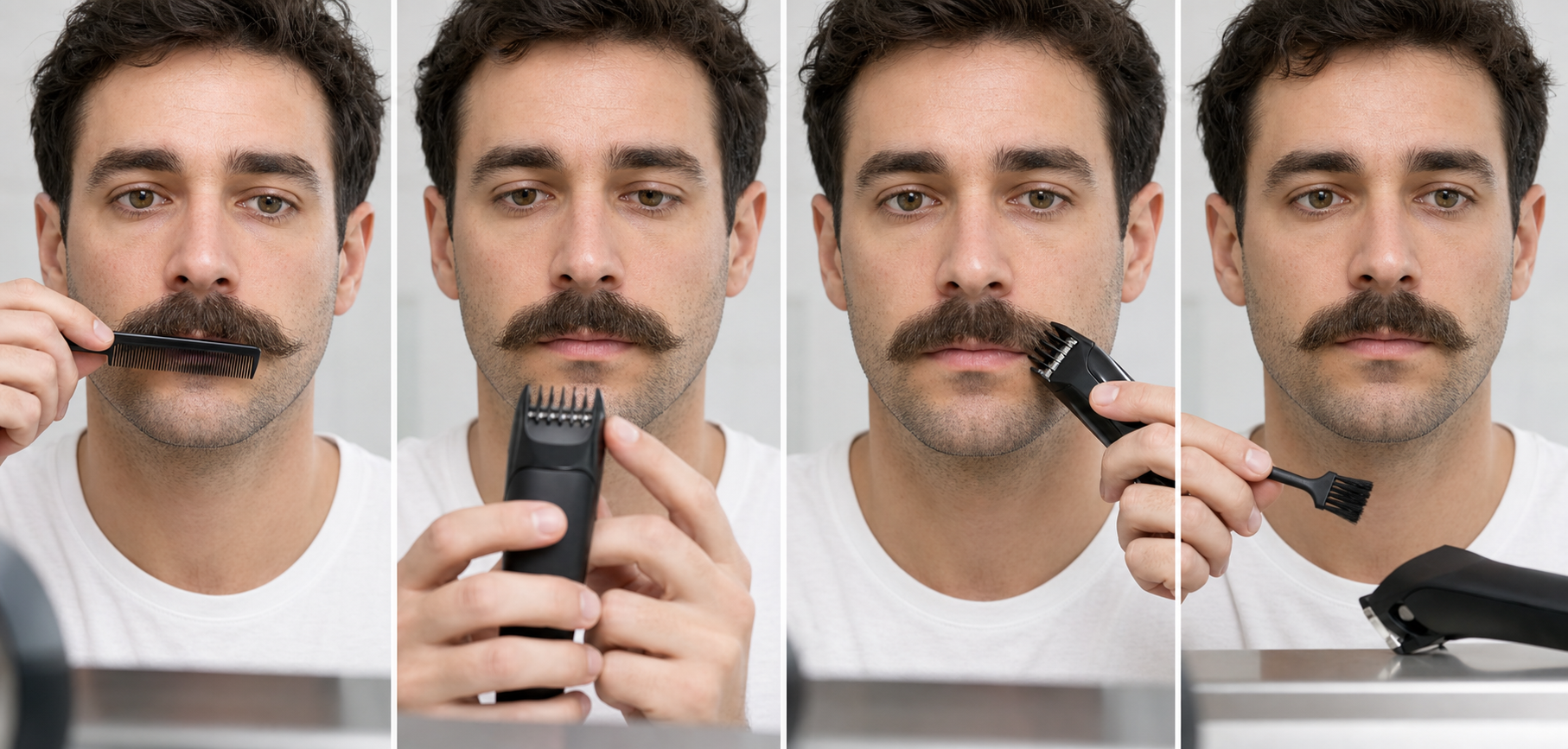
Direct answer: Avoid common mustache trimming mistakes by working on a dry, released reference; mapping the center, lip opening, corners, and beard connections; verifying the exact tool and guard; and protecting the shortest useful section. Make one small outer-zone correction, then switch off, clear, recomb, release, and compare before changing pressure, direction, setting, tool, or side.
This guide is a prevention and recovery checklist, not a complete style tutorial. It explains how errors arise and where to stop. Preparation, guard choice, grain direction, symmetry, lip-edge cleanup, and isolated-end work remain separate tasks with their own boundaries.
Define the Task Before the Tool Touches Hair
Name the single job: reduce bulk, shorten one confirmed longer zone, clean a visible edge, remove one isolated projecting end, or restore an existing endpoint. Do not begin with a vague instruction such as “make it look better.” A broad goal invites several cutting variables at once.
Record what must remain unchanged, including center treatment, lip clearance, corner endpoints, beard connections, shortest useful coverage, and the better-shaped reference side. A stop boundary is part of the task, not an optional caution added afterward.
Mistake: Trimming Before the Mustache Is Ready
Wet hair, styling product, compression, tangles, food residue, and repeated handling can change the visible shape and how hair enters a guard. Complete the mustache preparation workflow: clean as needed, dry completely, comb gently, remove the comb, release the hair, inspect the tool, and record a no-cut baseline.
Do not compare a stretched side with a released side. Do not trim immediately after pressing the mustache under a mask, towel, or hand. Wait until both sides return to their ordinary state.
Mistake: Treating One Downward Direction as Universal
Center hair can split outward, outer sections can angle diagonally, corners can curl, and beard connections can travel in another direction. Map each released zone separately. “With the grain” means the local natural direction, not one arrow across the complete mustache.
The mustache grain guide explains local mapping and manual conflicts. Follow the exact product instructions when they prescribe another supported movement rather than forcing a universal rule.
Mistake: Copying Another Trimmer’s Method
Guard contact, supported direction, wet/dry limits, attachment removal, cleaning, and oiling differ by model. Philips’ current MG3900 manual, for example, gives directions for the covered product and notes that hair grows in different directions. It is not a universal manual.
Verify the complete model, head, guard, setting, regional power components, and manual. A similar housing, fitting attachment, or marketplace title does not transfer instructions.
Mistake: Choosing a Setting From the Longest Hair
The longest projecting end is not the protected floor. Find the shortest released hair group that still contributes useful center continuity, lip coverage, corner structure, or connection weight. A setting that appears conservative for the longest hair may be too short for a supporting layer.
Use the mustache guard guide to verify exact-model fit and test the longest useful supported setting. Do not infer finished length from a number alone.
Mistake: Starting at the Center
The center is visually prominent and can contain opposing directions, overlap, or an intentional gap. A small unintended opening can require a broader style decision to disguise. Keep the center outside the first pass and preserve its released treatment.
If a gap already exists, record its width and edges before cutting elsewhere. The mustache middle-gap guide owns creation and maintenance of that feature.
Mistake: Using the Lip as a Hard Cutting Rail
The lip moves with speech, expression, and tension. Stretching it, pressing a guard into it, or drawing a straight path on mobile tissue can shift hair ownership and contact. Observe lip clearance with the mouth relaxed and trace each projecting end to its source.
Guarded bulk reduction should stop before exposed-blade lip work. If the task is an edge, define the visible boundary and supported tool separately rather than converting a broad pass into freehand cleanup.
Mistake: Carrying One Pass Through a Mouth Corner
An outer section can transition into a curl, lighter-density endpoint, beard connection, or mobile corner. The guard may meet different hair ownership and skin geometry without warning. Stop before the transition and release the hair.
Compare both corners in neutral posture. If an endpoint shifts with expression or cannot be traced, retain it until a separate corner decision is possible.
Mistake: Capturing Beard or Goatee Hair
Mustache hair can overlap cheek, goatee, or beard-connection hair. Move neighboring hair only long enough to identify its origin, then release it. Mark the handoff before any guard or scissors path approaches the side.
Do not shorten a beard connection merely because it enters a broad mustache guard. The scissors-versus-clippers guide distinguishes isolated-end work from broader guarded reduction.
Mistake: Trimming Under Comb Tension
Wahl’s official trimmer instructions describe combing a mustache in its natural direction so stray hairs become visible. Observation does not require cutting while the comb stretches or lifts the hair.
Comb gently, remove the comb, and let the section settle before deciding. Hair cut under tension can retract, curl, or shift after release and create a shorter-than-planned endpoint.
Mistake: Chasing Every Projecting Hair
A visible end may cross from another zone, support a corner, spring back after release, or appear only under one light angle. Trace it from root to released end and compare it after two gentle recombs.
If the end remains isolated and its removal fits the defined outline, use a separate isolated-end method. Do not turn one projecting hair into repeated bulk removal.
Mistake: Declaring One Side Longer Too Quickly
Lighting, head tilt, expression, density, curl, and camera distance can create a false side difference. Compare matched landmarks twice under the same posture and light. Name the exact stable mismatch instead of labeling an entire side uneven.
The mustache balance guide explains reference-side protection. Leave the better side untouched while testing one correction on the confirmed longer zone.
Mistake: Alternating Sides After Every Stroke
Automatic alternation moves the reference and can create a shortening cycle. Correct one bounded target, switch off, clear, release both sides, and compare the whole mustache before deciding whether any second action is needed.
Do not trim the reference side merely because the first correction changed the visual target. A stable reference is the evidence that tells you when to stop.
Mistake: Pressing Harder When Little Hair Is Removed
Reduced cutting can mean the hair lies outside the guard opening, is shorter than the cutting plane, curls across another zone, or is blocked by clippings. Pressure can change guard contact and hair admission without solving the cause.
Switch off, clear the attachment, release the hair, and verify the setup. Do not flatten the lip, force the teeth into skin, or repeat rapidly to make the pass feel productive.
Mistake: Repeating Passes Without Clearing
Trapped hair can change how the next section enters a guard, hide a damaged tooth, and make a secure attachment appear unstable. After the first bounded pass, switch off before touching or removing any component.
Follow the exact manual for brushing, rinsing, drying, and reassembly. The cleaning and oiling guide</a provides general boundaries; the model instructions control.
Mistake: Changing Several Variables Together
Shortening the setting, reversing direction, adding pressure, entering another zone, and switching tools in one sequence destroys the comparison. When the result changes, there is no reliable way to identify which variable caused it.
After clearing and release, change at most one verified variable. Keep preparation, posture, light, protected boundaries, reference side, and tool condition stable.
Mistake: Removing the Guard Mid-Task
A guarded bulk task does not authorize exposed-blade outlining. Removing the guard changes the cutting plane, contact, endpoint risk, and visible task. Stop and define a separate outline or isolated-end workflow before proceeding.
Switch off before attachment changes. Confirm that the manual permits the intended head and that the lip opening, center, corners, and beard connections remain outside an uncertain path.
Mistake: Using Scissors as a Faster Guard Substitute
Scissors can isolate visible ends but can also capture hair under tension, cross a moving lip boundary, or remove supporting layers. A comb-and-scissors method is a different task with its own hand position, visibility, and stop conditions.
Choose scissors only when the exact target is visible, released, and isolated from neighboring hair. Do not use them to imitate a broad guard setting by eye.
Mistake: Trimming Curled Hair While Stretched
A curl can appear much longer under tension and retract after release. Trace the curl group, preserve its support layer, and compare its ordinary spring-back before cutting. Do not pull the end straight to create a simple ruler.
If curl behavior controls the task, pause the basic workflow. Curl grouping, spring-back, and layer protection require a separate deliberate method rather than repeated corrections.
Mistake: Trying to Equalize Density With Length
A denser side can look darker or wider even at the same endpoint. Shortening it until equal skin is visible may remove useful coverage without changing the underlying density. Record length, width, curl, direction, and density separately.
Retain natural density differences or choose an intentional style response. Do not infer a medical cause, growth diagnosis, or treatment from a grooming comparison.
Mistake: Ignoring a Loose or Damaged Guard
Inspect teeth, rails, tabs, locks, dial stops, head seating, and cutter condition with power off. Stop for cracks, bent teeth, movement, corrosion, residue that cannot be cleared, or a mount that does not seat as the manual describes.
Do not hold a loose attachment in place by hand or substitute a similar-looking guard. Use the guard-size guide for compatibility evidence and manufacturer confirmation.
Mistake: Continuing Through Pulling or Heat
Stop immediately for pulling, pinching, painful contact, broken or bleeding skin, unusual heat, odor, smoke, sound, vibration, slowing, guard movement, or unexpected removal. Switch off before inspection.
The trimmer-pulling guide separates tangles, loading, cutter condition, assembly, maintenance, power, and task mismatch. Do not press harder or continue to “even out” an unexpected change.
Mistake: Treating a Startup Test as Proof of Condition
A tool that powers on may still have damaged teeth, intermittent power, a weak battery, an incompatible charger, or a loose attachment. Inspect the complete setup off-face before a hair test and stop for abnormal behavior.
This guide does not report measured performance, runtime, durability, comfort, or safety. Condition and support must be verified for the exact unit.
Mistake: Trusting an Old Setting Record Without Rechecking
Hair length, style, density, curl, guard condition, and tool setup can change between sessions. A prior setting is a reference, not automatic permission. Reconfirm the shortest useful section and complete attachment identity each time.
Record the model, head, guard, setting, zone, direction, and released result so a later session can reproduce the evidence rather than rely on memory alone.
Mistake: Trying to Repair an Error Immediately
After unexpected removal, stop, switch off, clear the tool, and let the complete mustache return to a stable released state. Record the center, lip opening, corners, connections, and untouched areas before considering a response.
Do not shorten the opposite side automatically. A recovery decision may be to retain the difference, adjust a limited endpoint later, or change the style after the result is stable.
Mistake: Hiding an Error With Unsupported Claims
Do not describe a result as professional, safer, irritation-free, perfectly even, longer-lasting, or suitable for every face. Do not convert one session into a product rating, performance measurement, or hands-on endorsement.
Record only observable facts: setup, zone, number of passes, clearing, released comparison, unexpected change, and stop decision. The exact manual and current evidence control product-specific statements.
Build a Pre-Trim Error Check
- The task and protected boundaries are written down.
- The mustache is clean as needed, dry, gently combed, and released.
- The center, lip opening, corners, connections, and shortest useful section are mapped.
- The exact model, head, guard, setting, direction, and care instructions are verified.
- The tool and attachment are clean, undamaged, and securely seated.
- One low-consequence outer zone and one untouched reference are selected.
- The first action changes only one variable.
- Switch-off, clearing, release, comparison, and stop steps are planned.
Use a One-Pass Recovery Record
After each bounded action, record the target zone, reference side, tool setup, direction, pressure boundary, number of passes, clipping load, released result, and whether protected landmarks changed. A short factual record reduces memory-driven overcorrection.
Stop when the target disappears after release, cannot be assigned to one zone, belongs to density or anatomy, crosses a protected boundary, or requires repeated shortening of the reference.
Frequently Asked Questions
What is the most common mustache trimming mistake?
Starting before the mustache is dry, released, mapped, and compared against a protected reference causes several avoidable errors at once. Prepare first, verify the exact tool and guard, then test one small outer section before approaching the center, lip opening, or corners.
How do I avoid trimming a mustache too short?
Protect the shortest useful section, begin with the longest verified compatible setting, keep one side or zone untouched as a reference, and make one bounded pass. Switch off, clear, recomb, release, and compare before changing a setting or removing more.
Should I trim every stray mustache hair I can see?
No. A projecting hair may cross from another zone, spring back after release, support an endpoint, or appear only under tension. Trace its origin, release it naturally, and decide whether it belongs to an outline, isolated-end, bulk, or symmetry task.
What should I do after an unexpected mustache cut?
Stop immediately, switch off, clear the tool, release the mustache, and record what changed. Do not shorten the opposite side automatically. Protect the remaining center, lip, corners, and connections, then choose a later recovery or style decision from the stable released result.