
Disclosure: This site may use affiliate links. Product specifications should be checked against manufacturer or retailer pages before purchase.
Direct Answer
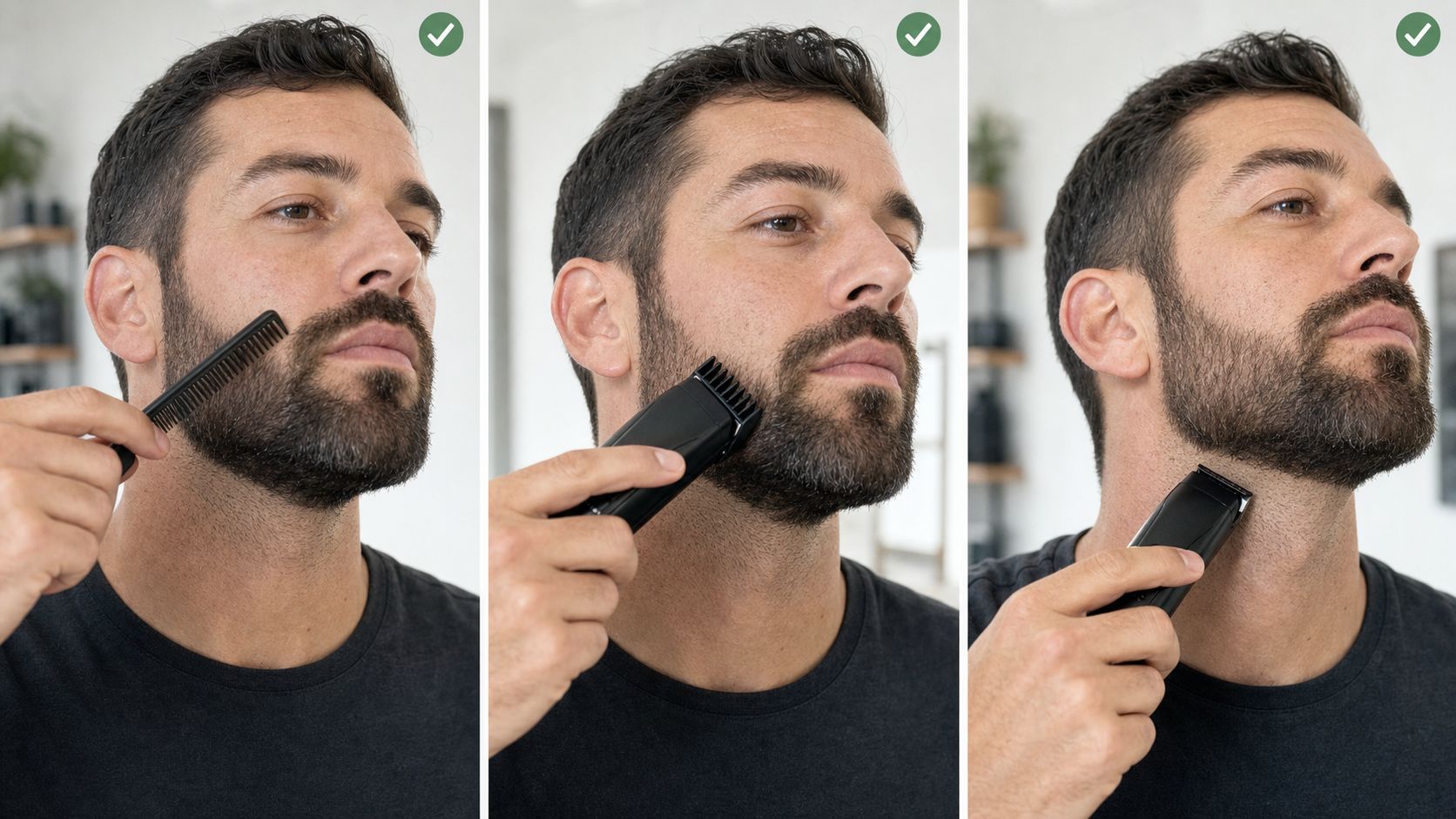
Direct answer: Touch up a short beard without overtrimming by defining one small maintenance goal before switching on. Comb clean, dry hair into place, preserve the recorded base length, and work only on isolated longer hairs, one genuinely overlength zone, or hair outside an existing cheek or neckline boundary. Use the longest effective documented setting, alternate sides, clear clippings, and stop after one controlled correction.
A touch-up is not a shortened version of a full trim. It should leave most of the beard untouched. If the whole beard has lost its intended length or shape, schedule a complete base-length workflow instead of making many disconnected spot corrections.
Touch-Up Decision Table
| What you see | Touch-up response | Stop condition |
|---|---|---|
| One or two hairs extending beyond the surface | Comb, isolate, and trim only those hairs with a model-approved detail method | The surrounding beard begins entering the cutter |
| One small zone is genuinely longer | Use the recorded base setting or longer on that zone only | The visual difference is density rather than length |
| Hair outside the established cheek line | Restore the existing line conservatively | The previous boundary is unclear |
| Hair below the established neckline | Work from the center outward outside the boundary | The line begins moving into the visible beard |
| Whole beard looks bulky or uneven | Plan a full trim with a base-length pass | Several zones need different corrections |
The official Philips MG3900-series manual supports starting with longer settings, using smooth gentle movements, keeping a guard in contact, clearing collected hair, and using a precision head with gentle pressure. Braun’s beard-trimming guide separates length reduction from final shaping. These are general controls; the exact trimmer manual remains authoritative.
Define One Maintenance Goal
State the task in one sentence before preparing the tool: remove three visible flyaway hairs, restore the lower half of the existing neckline, or reduce one small patch that has grown beyond the recorded base setting. A narrow goal prevents the mirror session from expanding into an unplanned full trim.
If the goal includes cheek length, jaw transition, chin shape, neckline placement, and mustache balance at the same time, it is no longer a touch-up. Use a complete workflow and establish one base length first. The short-beard mistakes guide covers broader error prevention during that process.
Prepare Hair Before Judging Length
Follow the exact model’s approved wet or dry method. For a typical dry guarded touch-up, let the beard become fully dry, remove heavy product, and comb hair into its normal position. Water, balm, sleep compression, collars, and repeated brushing can temporarily change which hairs appear longer.
Inspect in even front and side light. Use the same head position and mirror distance for both sides. Brush away loose hair before deciding that another pass is needed. Close inspection under a bright directional light can exaggerate harmless differences that disappear at normal viewing distance.
Preserve the Recorded Base Length
Use notes or photographs from the last complete trim. Record the model, guard or dial position, documented millimeters, and any intentionally longer chin or mustache zone. Guard numbers are not portable between tools, and an attachment that looks similar may cut differently.
For a genuinely overlength patch, begin at the previous base setting or one documented step longer. Test a small section, clear the guard, and compare it with an untouched area. Do not select a shorter setting simply because the touch-up involves less hair.
The guard selection workflow explains model identity and conservative test passes. Those controls also apply to a short beard even when the final length is longer than stubble.
Use a Zone Map
Divide the beard into cheek, side, jaw corner, front chin, under-jaw, mustache, cheek boundary, and neckline boundary. Mark only the zone that requires maintenance. Keep the tool away from every zone already at the intended length.
Natural density and growth direction can make one side appear darker without being longer. Comb each zone and compare actual hair extension before cutting. If the issue is a jaw-corner length step, use the dedicated jaw-corner blend guide rather than repeatedly spot-trimming the dark side.
Trim Isolated Longer Hairs
Comb the beard outward, then let it return to position. An isolated hair that remains clearly beyond the surface can be addressed with the model-approved detail head or a guarded method that protects surrounding length. Keep the tool switched off while positioning and maintain visibility of the intended hair.
Do not skim a bare cutter across the entire beard surface to catch one flyaway. That can remove multiple correctly sized hairs and gradually reduce the base. Work in short sections and stop as soon as the defined target no longer extends beyond the outline.
Correct One Overlength Zone
Attach the verified guard, confirm that it locks level, and use light contact. Make one controlled pass through the selected zone using a direction allowed by the manual. Clear clippings and compare before repeating. Keep the boundary between corrected and untouched hair visible.
If the patch remains darker but the hairs no longer extend beyond the guard length, density or direction may explain the appearance. More passes can create a real short patch without making density equal. Stop and reassess in normal light.
Restore the Cheek Line Conservatively
Identify the existing cheek boundary before using a close-detail attachment. Remove only hairs clearly outside that line. Do not lower or reshape the main boundary during a routine touch-up unless a separate style decision has been made.
Work in short visible sections with gentle pressure. Alternate sides after matched sections instead of completing a new line on one side first. If the old line is unclear, preserve growth and wait for a planned shaping session rather than guessing.
Restore the Neckline Without Raising It
Stand upright and identify the center and jaw-corner endpoints of the existing neckline. Philips’ official neckline guide works from the center outward and distinguishes the jawline from the lower neck boundary.
Remove only hair below the established line. Keep a strip of untouched hair immediately inside the boundary as a visual reference until the outside area is complete. The site neckline guide provides a complete planning workflow when the boundary needs to be created rather than merely restored.
Keep Mustache and Chin Work Separate
A short-beard touch-up can accidentally flatten the chin or shorten the mustache because those zones project farther from the face. Comb the mustache away from the lip and the chin downward before deciding what extends beyond the intended outline.
Use a guard or precision method documented for the exact tool. Do not run a shorter cheek setting through the central chin by habit. Preserve any intentionally longer zone and trim only hair that clearly exceeds its own recorded target.
Use a Pass Limit and Cooling-Off Check
Set a pass limit before starting: one pass, clear, compare, and at most one targeted correction. A limit prevents repeated cutting caused by clippings, lighting, compressed hair, or mirror proximity. Turn the tool off between comparisons.
After the defined task is complete, step away for several minutes, brush the beard, and inspect at normal distance. Do not reopen the session for a new issue unless it is clearly outside the original boundary or length plan.
Tool and Skin Stop Conditions
Stop if a guard is loose, cracked, unidentified, or unable to sit flat; if cutter teeth are bent or damaged; or if the tool pulls, rattles, stalls, smells unusual, becomes unexpectedly hot, or has damaged power parts. Do not hold a loose guard in place while operating.
Do not trim over broken, painful, markedly inflamed, or bleeding skin. This page does not diagnose skin conditions. Switch off and disconnect charging power before attachment changes or cleaning, and follow the exact manual for rinsing, drying, lubrication, charging, and storage.
Repeatable Minimal Touch-Up Sequence
- Define one limited maintenance goal and name the target zone.
- Prepare hair with the exact model’s approved wet or dry method.
- Comb, clear product, and inspect in even light.
- Confirm the previous model-specific base setting and zone plan.
- Mark all already-correct zones as off-limits.
- Use the longest effective documented guard or detail method.
- Make one controlled pass, switch off, clear clippings, and compare.
- Restore cheek or neckline boundaries only outside the existing line.
- Stop after one targeted correction and reassess at normal distance.
- Record what changed for the next full trim.
Frequently Asked Questions
What counts as a short-beard touch-up?
A touch-up is limited maintenance between full trims: removing isolated longer hairs, restoring a previously planned edge, or correcting one genuinely overlength zone without resetting the beard’s base length.
Should I use the same guard as my last full trim?
Use the recorded model-specific base setting only when a guarded area is genuinely longer. Start at that setting or longer, test a small zone, and leave already-correct areas untouched.
Can I touch up a short beard every day?
Daily cutting is not automatically necessary. Inspect first and trim only a defined issue. Repeated passes over already-correct hair can gradually shorten the beard and move its boundaries.
How do I stop a neckline touch-up from creeping higher?
Mark or identify the existing boundary before switching on, remove only hair outside it, work from the center outward, and stop if the previous line is unclear.
Sources and Claim Boundary
Primary references reviewed in July 2026 are the Philips MG3900-series manual, Braun beard-trimming guide, and Philips neckline guide linked above. This is a generic minimal-maintenance workflow, not hands-on testing, and it does not promise a visual result. The exact model manual controls guard identity, direction, contact, precision-head use, cleaning, wet use, charging, and safety.